¡Acompáñanos a viajar por el mundo de los libros!
Añadir este libro a la estantería
Grey
Escribe un nuevo comentario Default profile 50px
Grey
Suscríbete para leer el libro completo o lee las primeras páginas gratis.
All characters reduced
Blue Water Thesis - Maritime Strategy and Global Power Dynamics - cover

Blue Water Thesis - Maritime Strategy and Global Power Dynamics

Fouad Sabry

Editorial: One Billion Knowledgeable

  • 0
  • 0
  • 0

Sinopsis

Discover the untold story of maritime power's impact on global politics in "Blue Water Thesis." This book delves into how naval strategies shape international relations and maritime law, providing valuable insights for professionals, students, and enthusiasts.
 
1-Blue Water Thesis-Introduces the concept, exploring its origins and significance in today's geopolitics.
 
2-Colony-Examines how maritime power has influenced colonial expansion and governance.
 
3-Self-determination-Explores the role of self-determination in maritime contexts.
 
4-Decolonization-Focuses on the impact of naval power on the dissolution of empires.
 
5-Status of Gibraltar-Analyzes Gibraltar's strategic maritime significance and ongoing disputes.
 
6-Act of Free Choice-Reviews pivotal moments of self-determination influenced by maritime control.
 
7-Decolonisation of Africa-Traces Africa’s decolonization, highlighting naval power’s importance.
 
8-UN List of Non-Self-Governing Territories-Reviews the UN's role in monitoring self-governance, with maritime insights.
 
9-Western Sahara Advisory Opinion-Delves into the legal and political intricacies of Western Sahara, a key maritime region.
 
10-Special Committee on Decolonization-Examines the UN's Special Committee's efforts in maritime contexts.
 
11-Political Status of Western Sahara-Discusses ongoing debates and conflicts over Western Sahara’s status.
 
12-Independence-Explores paths to independence with a focus on maritime power.
 
13-Associated State-Discusses the influence of maritime power on associated states’ relations.
 
14-UN Declaration on Independence-Analyzes the declaration's maritime implications.
 
15-UN Security Council Resolution 312-Investigates its impact on maritime disputes and decolonization.
 
16-Indigenous Rights-Explores the intersection of indigenous rights and maritime territories.
 
17-UN General Assembly Fourth Committee-Reviews the Fourth Committee’s role in maritime issues.
 
18-Political Status of Puerto Rico-Delves into Puerto Rico’s complex status with a maritime focus.
 
19-UNGA Resolution 1541 (XV)-Examines this resolution's influence on maritime law.
 
20-UNGA Resolution 1654 (XVI)-Explores its significance in decolonization and maritime power.
 
21-Sahrawi Nationalism-Understands the rise of Sahrawi nationalism with maritime dimensions.
 
Invest in "Blue Water Thesis" to gain deep insights into how maritime power shapes global politics, offering knowledge that extends far beyond the cost of the book.
Disponible desde: 04/09/2024.
Longitud de impresión: 258 páginas.

Otros libros que te pueden interesar

  • Walls of Words - How Boundaries Define Free Speech - cover

    Walls of Words - How Boundaries...

    Thomas T. Taylor

    • 0
    • 0
    • 0
    Delve into the intricate dance of free speech in the United States. "Walls of Words" is not just another book about the First Amendment; it is a deep dive into the intricate boundaries that define our freedom of expression. With a rich blend of history, jurisprudence, and real-world examples, this book paints a comprehensive picture of how speech has been shaped, celebrated, and suppressed since the founding of America. 
     
    Ever wondered about the intentions of the Founding Fathers when they penned the First Amendment? Or how landmark cases over the centuries have redefined its interpretation? From the early American media's struggles with censorship to the rise of digital platforms, discover the evolution of speech boundaries and the forces that have constantly sought to redraw them. 
     
    But it doesn't stop there. In today's digital age, speech boundaries are more complex than ever. Dive into the thorny issues of cyberbullying, doxing, and the rise of disinformation. Understand when speech crosses the line into crime, from threats and extortion to false advertising and copyright infringement. And for those moments when you find yourself walking on the eggshells of culturally sensitive speech, this book offers guidance on navigating those murky waters. 
     
    Moreover, in a world where the line between private censorship and public responsibility is increasingly blurred, "Walls of Words" challenges readers to reflect on the ethical implications of speech boundaries. How do we balance tolerance with limitation? What role do private entities play in shaping the discourse? And as technology continues to transform the landscape of expression, what challenges lie ahead for the future of free speech? 
     
    "Walls of Words" promises an enlightening journey through the ever-evolving wall of words that defines our collective responsibility to uphold the spirit of free speech.
    Ver libro
  • On Truth in Politics - Why Democracy Demands It - cover

    On Truth in Politics - Why...

    Michael Patrick Lynch

    • 0
    • 0
    • 0
    Do any of us really care about truth when it comes to politics? Should we? In a world of big lies, denialism, and conspiracy theories, democracies are experiencing two interlocked crises: a loss of confidence in democracy itself and the growing sense among many that politics is only about power—not truth. In this book, Michael Patrick Lynch argues that truth not only can—but must—matter in politics. He shows why truth is an essential democratic value—a value we need to sustain our democratic way of life—and how it can be strengthened. 


    Despite evidence that people are rarely motivated by truth when it comes to politics, On Truth in Politics argues that this isn't inevitable. Accessibly written and rigorously argued, it draws on the American pragmatist tradition to develop an original theory of the nature and value of truth in the messy world of politics. Contrary to the belief of many, political beliefs can be true or false. But if democracy is to continue to be a space of reason and not just an arena of power, we must build a better infrastructure of knowledge, including stronger schools and media, and renew our commitment to science and history. 


    A vital and timely book, On Truth in Politics makes an original case for why democracy cannot survive without truth.
    Ver libro
  • Titans of Capital - How Concentrated Wealth Threatens Humanity - cover

    Titans of Capital - How...

    Peter Phillips, Dan Kovalik

    • 0
    • 0
    • 0
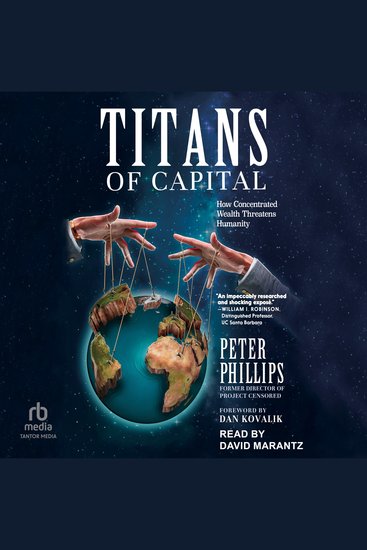
    A fascinating examination of the rapid concentration of global capital, with chapters that focus on China and Russia. 


    In Titans of Capital, Peter Phillips, a political sociologist, poses three key research questions: To what extent do the wealthy influence—or even dominate—decision making that affects all of us in society? Who are the most powerful people? And how does the accumulation of capital work? 


    Networks of wealthy individuals have evolved since the COVID-19 pandemic, and Titans of Capital shows how the financial investments of transnational elites threaten human rights and the future of the planet. Phillips warns that while continued concentration of global capital increases the profits enjoyed by the global economy's "Titans,", it also increases global inequality, starvation, and civil unrest, threatening the lives of the hundreds of millions of people living in extreme poverty. It is imperative to ask how we can reverse the concentration of Titan wealth and revitalize grassroots democracy unbridled by extreme wealth. Identifying 117 global Titans by name and exposing the networks and interests that unite them provides listeners opposed to militarism and committed to economic equality with crucial tools to directly engage the power elite who endanger life on earth.
    Ver libro
  • The Case for Basic Income - Freedom Security Justice - cover

    The Case for Basic Income -...

    Jamie Swift, Elaine Power

    • 0
    • 0
    • 0
    Inequality is up. Decent work is down. Free market fundamentalism has been exposed as a tragic failure. In a job market upended by COVID-19—with Canadians caught in the grip of precarious labour, stagnant wages, a climate crisis, and the steady creep of automation—an ever-louder chorus of voices calls for a liveable and obligation-free basic income.
    		 
    Could a basic income guarantee be the way forward to democratize security and intervene where the market economy and social programs fail? Jamie Swift and Elaine Power scrutinize the politics and the potential behind a radical proposal in a post-pandemic world: that wealth should be built by a society, not individuals. And that we all have an unconditional right to a fair share.
    		 
    In these pages, Swift and Power bring to the forefront the deeply personal stories of Canadians who participated in the 2017–2019 Ontario Basic Income Pilot; examine the essential literature and history behind the movement; and answer basic income’s critics from both the right and left.
    Ver libro
  • The Birth of Anarchism - 1849-1887 - cover

    The Birth of Anarchism - 1849-1887

    Pierre-Joseph Proudhon, Mikhail...

    • 0
    • 0
    • 0
    Mankind can rule itself without the force of top-down authority, and freedom is more than just choosing how to meet the needs and demands of capital. Inequality is structural and intentional, not inevitable and necessary. It does not have to be this way. In solidarity, we are better.Think for yourself, and question authority.This is the essence of anarchism, which has a bad name and reputation because it attacks the necessity of centralised power and authority. The media archetype is Tyler Durden, filled with violence and nihilism – yet anarchism is the most positive of political philosophies, one that Jesus and Buddha both preached, stating that empathy and a rejection of authority were key to human flourishing. Neither would disagree with most early anarchists.Proudhon, whose “property is robbery” is perhaps the most well-known anarchist slogan, lays out the conceptual foundation for key anarchist ideas. He argues that usury (charging interest) is a fundamental harm to society, that there is enough for everyone if we simply take other values to be higher than capital gain, that mutualism is inevitable, and that all governments and ideologies make the same mistake, in trying to change society from the top. Positive change must arise from the great masses of humanity, not from their rulers.Bakunin's speeches are about solidarity arising from the masses, and the ground for a global reconfiguration.Louis Lingg was convicted to death with six others, for being one of the ‘Chicago Anarchists’. They were executed to make a political point, based on corrupted evidence and perjury. His statement is one of contempt for the powers that be, and his belief that mankind should be free and should fight until it is.We end with Kropotkin, who firmly believed in decentralized society. He believed that the greatest strength of mankind lies in the masses, not their rulers, and exhorts us to “Act for Yourselves”.
    Ver libro
  • The Big Truth - Upholding Democracy in the Age of “The Big Lie” - cover

    The Big Truth - Upholding...

    David Becker, Major Garrett

    • 0
    • 0
    • 0
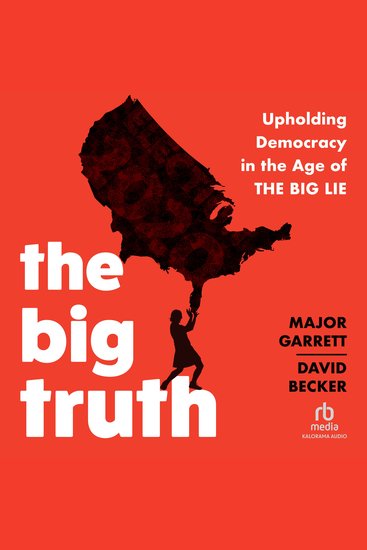
    When a seven-million-vote margin of victory and 306 electoral votes pointed to Joe Biden as the victor in the 2020 Presidential Election, Trump-fueled conspiracy theories exploded. 


    In The Big Truth, CBS's Chief Washington Correspondent Major Garrett and the nation's foremost elections expert David Becker completely upend The Big Lie that has infected the Far Right with firsthand stories of election officials like Georgia Secretary of State Brad Raffensperger and Bucks County, Pennsylvania, election director Thomas Freitag. And they reveal the concrete evidence proving that 2020 may have been the most secure US election ever. But Garrett and Becker go beyond the key players from all six swing states, the pre-election litigation that clarified the rules for both parties, and the fully auditable and verifiable ballots used. They lay bare the methods being undertaken right now to undercut faith, belief, and effectiveness of elections, identifying the places where the most dire actions have been taken since 2020—where election laws have been changed; or election officials been hounded out of office, retired out of frustration/fatigue, or been replaced by pro-Trump political figures.
    Ver libro