¡Acompáñanos a viajar por el mundo de los libros!
Añadir este libro a la estantería
Grey
Escribe un nuevo comentario Default profile 50px
Grey
Suscríbete para leer el libro completo o lee las primeras páginas gratis.
All characters reduced
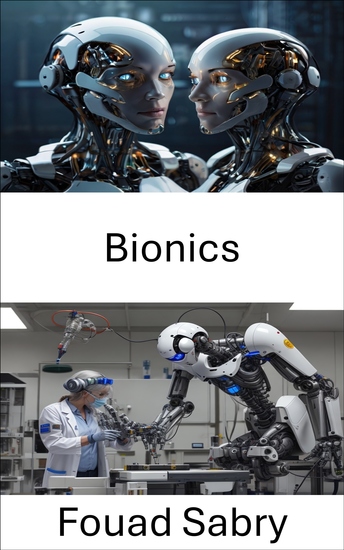
Bionics - Enhancing Nature Through Engineering - cover

Bionics - Enhancing Nature Through Engineering

Fouad Sabry

Editorial: One Billion Knowledgeable

  • 0
  • 0
  • 0

Sinopsis

1: Bionics: Explores the core concepts, blending biology and robotics for groundbreaking results.
 
2: Biomedical engineering: Examines the medical applications of bionic systems for human benefit.
 
3: Biomimetics: Discusses technology inspired by biological systems to solve complex problems.
 
4: Bioinspired computing: Analyzes computing techniques rooted in natural processes.
 
5: Janine Benyus: Profiles the biomimicry pioneer and her influence on bionic applications.
 
6: Biorobotics: Reviews robots mimicking biological functions for enhanced adaptability.
 
7: Neuroprosthetics: Explores advancements in robotic prosthetics for neural integration.
 
8: Rahul Sarpeshkar: Highlights this key figure's contributions to bionics and bioengineering.
 
9: Biological engineering: Examines the crossover of biology and engineering in robotics.
 
10: Biomaterial: Investigates materials derived from or inspired by biology.
 
11: Biomimetic material: Focuses on materials designed to mimic biological properties.
 
12: Cyborg: Looks at the merging of human biology with robotics for enhanced abilities.
 
13: Bionic (disambiguation): Clarifies the terminology and scope of "bionic" in various fields.
 
14: Biomimicry Institute: Covers the organization's impact on bioinspired technologies.
 
15: Werner Nachtigall: Honors the researcher's foundational work in biomimetics.
 
16: Bioinspired robotics: Discusses robots inspired by biological movements and adaptations.
 
17: Biomimetic architecture: Reviews architecture influenced by natural forms and systems.
 
18: Bioinspiration: Highlights diverse applications of biologyinspired design in technology.
 
19: Bioinspired photonics: Explores photonics inspired by biological visual systems.
 
20: Biochemical engineering: Discusses biochemical processes applied in robotic functions.
 
21: Biocompatibility: Addresses how bionics can harmonize with human biology safely.
Disponible desde: 09/12/2024.
Longitud de impresión: 257 páginas.

Otros libros que te pueden interesar

  • The Silent Universe - How Dark Energy Drives Galactic Evolution - cover

    The Silent Universe - How Dark...

    Dirk Fallon

    • 0
    • 0
    • 0
    Dark energy represents one of the most perplexing and enigmatic components of our universe, fundamentally altering our understanding of cosmic evolution. This mysterious force, which constitutes a major part of the cosmos, has intrigued scientists, astronomers, and physicists for decades. Its discovery, in part by observing the accelerated expansion of the universe, challenged long-held beliefs that gravity would eventually decelerate the cosmic expansion after the Big Bang. The revelation that the universe is not slowing down but actually speeding up has led to an explosion of theories and debates regarding the true nature of dark energy. 
    The initial hints of dark energy arose from studies that observed distant supernovae and measured their redshifts. When these measurements indicated that galaxies were moving away from each other at accelerating speeds, researchers were forced to rethink the previously accepted model of a decelerating universe. This unexpected acceleration suggested that some form of energy, previously unknown, was counteracting the force of gravity on a cosmic scale. Scientists have since begun to consider the possibility that this energy is uniformly spread throughout space, rather than being concentrated in specific locations, an idea that fundamentally differs from classical forms of matter and energy. 
    One of the core puzzles in understanding dark energy lies in its apparent uniformity and pervasive influence. Unlike ordinary matter, which clumps together to form stars, planets, and galaxies, dark energy seems to work in a diffuse, omnipresent manner, influencing the fabric of space itself. Its effects are subtle and counterintuitive, pushing galaxies apart rather than drawing them together.
    Ver libro
  • The Elements of Marie Curie - How the Glow of Radium Lit a Path for Women in Science - cover

    The Elements of Marie Curie -...

    Dava Sobel

    • 0
    • 0
    • 0
    The acclaimed Pulitzer Prize finalist and #1 New York Times bestselling author of Galileo’s Daughter crafts a luminous chronicle of the most famous woman in the history of science, and the untold story of the remarkable young women trained in her laboratory 
     
    “Even now, nearly a century after her death, Marie Curie remains the only female scientist most people can name,” writes Dava Sobel at the opening of her shining portrait of the sole Nobel laureate decorated in two separate fields of science—Physics in 1903 with her husband, Pierre, and Chemistry by herself in 1911. And yet, as brilliant and creative as she was in the laboratory, Marie Curie was equally memorable outside it. Grieving Pierre’s untimely death in 1906, she took his place as professor of physics at the Sorbonne, devotedly raised two brilliant daughters, drove a van she outfitted with X-ray equipment to the front lines of World War I, befriended Albert Einstein and other luminaries of twentieth-century physics, won support from two US presidents, and inspired generations of young women to pursue science as a way of life.  
     
    As Sobel did so masterfully in her portrait of Galileo through the prism of his daughter, she approaches Marie Curie from a unique angle, narrating her remarkable life of discovery and fame alongside the women who became her legacy—from France’s Marguerite Perey, who discovered the element francium, and Norway’s Ellen Gleditsch, to Mme. Curie’s elder daughter, Irène, winner of the 1935 Nobel Prize in Chemistry. For decades the only woman in the room at international scientific gatherings that probed new theories about the interior of the atom, Marie Curie traveled far and wide, despite constant illness, to share the secrets of radioactivity, a term she coined. Her two triumphant tours of the United States won her admirers for her modesty even as she was mobbed at every stop; her daughters, in Ève’s later recollection, “discovered all at once what the retiring woman with whom they had always lived meant to the world.” 
     
    With the consummate skill that made bestsellers of Longitude and Galileo’s Daughter, and the appreciation for women in science at the heart of The Glass Universe, Dava Sobel has authored a radiant biography and a masterpiece of storytelling, illuminating the life and enduring influence of one of the most consequential figures of our time.
    Ver libro
  • Information Theory for Beginners - Demystifying Information Theory A Beginner's Guide - cover

    Information Theory for Beginners...

    James Ferry

    • 0
    • 0
    • 0
    "Information Theory for Beginners: Demystifying Information Theory. A Beginner's Guide" is an accessible and comprehensive beginner's guide that unravels the complexities of information theory, making it easily understandable for readers new to the subject. Whether you're a student, researcher, or enthusiast eager to delve into the fascinating world of information theory, this book serves as your indispensable companion on the journey to mastering this fundamental discipline. 
    In this book, author [Insert Author Name] takes readers on a captivating exploration of information theory, from its foundational principles to its practical applications in various fields. Through clear explanations, illustrative examples, and engaging anecdotes, readers will gain a deep understanding of key concepts such as entropy, Shannon's information theory, coding theory, and more. 
    With a focus on simplicity and clarity, "Information Theory for Beginners" breaks down complex topics into digestible chunks, empowering readers to grasp the underlying principles of information theory without getting lost in technical jargon. Whether you're interested in understanding the mathematics behind data compression, error correction, or cryptography, this book equips you with the knowledge and skills to navigate the intricacies of information theory with confidence. 
    "Information Theory for Beginners: Demystifying Information Theory. A Beginner's Guide" is not just a book—it's your gateway to unlocking the secrets of information theory and gaining a deeper appreciation for the remarkable insights and innovations that have emerged from this field. Whether you're embarking on your academic journey or simply seeking to broaden your intellectual horizons, this beginner's guide will inspire and enlighten you on the fascinating journey through the world of information theory. 
     
    Ver libro
  • Hot Spot - A Doctor's Diary From the Pandemic - cover

    Hot Spot - A Doctor's Diary From...

    Dr. Alex Jahangir, Katie...

    • 0
    • 0
    • 0
    When Nashville identified its first case of coronavirus in March 2020, the city was between Public Health Department directors and as unprepared as the rest of the world for what was to come. Dr. Alex Jahangir, a trauma surgeon acting at that time as chair of the Metro Nashville Board of Health, unexpectedly found himself head of the city's COVID-19 Task Force and responsible for leading it through uncharted waters. 


    What followed was a year of unprecedented challenge and scrutiny. Jahangir, who immigrated to the United States from Iran at age six, grew up in Nashville. He thought he knew the city well. But the pandemic laid bare ethnic, racial, and cultural tensions that daily threatened to derail what should have been a collective effort to keep residents healthy and safe. 


    Hot Spot is Jahangir's narrative of the first year of COVID, derived from his op notes (the journal-like entries surgeons often keep following operations) and expanded to include his personal reflections and a glimpse into the inner sanctums of city and state governance in crisis.
    Ver libro
  • Nephrology - Kidney Health Explained - cover

    Nephrology - Kidney Health...

    Mike Crawford

    • 0
    • 0
    • 0
    The kidneys are two bean-shaped organs located on either side of the spine, just below the ribcage. Despite their small size, each roughly the size of a fist, they play a vital role in maintaining overall health. As part of the urinary system, the kidneys filter waste, balance bodily fluids, regulate blood pressure, and contribute to red blood cell production. Understanding how the kidneys function is crucial for appreciating their importance and recognizing potential health concerns. 
    Each kidney contains about a million tiny filtering units called nephrons. These nephrons work tirelessly to remove waste products and excess fluids from the blood, which are then excreted as urine. The kidneys also help maintain the body’s electrolyte balance by regulating levels of sodium, potassium, and calcium. This precise balance is essential for proper nerve and muscle function. Additionally, the kidneys produce hormones such as erythropoietin, which stimulates red blood cell production in the bone marrow, and renin, which helps regulate blood pressure. Without the kidneys' ability to perform these tasks, the body would struggle to maintain equilibrium, leading to serious health complications. 
    One of the kidneys' primary functions is detoxification. Every day, they filter around 50 gallons of blood, removing harmful substances such as urea, creatinine, and toxins that accumulate from food, medications, and metabolic processes. This filtration process ensures that waste products do not build up to dangerous levels in the bloodstream. When kidney function declines, these substances can accumulate, leading to symptoms like fatigue, swelling, and confusion.
    Ver libro
  • Stranded - Finding Nature in Uncertain Times - cover

    Stranded - Finding Nature in...

    Maddalena Bearzi, Carl Safina

    • 0
    • 0
    • 0
    Marooned in LA by the pandemic, a marine biologist rediscovers the delights and wonders of the natural world in her own backyard. 


    Conservationist and marine biologist Maddalena Bearzi made her career studying the wild creatures of the deep, but when COVID-19 made landfall on the California coast this seafaring scientist found herself shuttered up ashore, her wide blue world constricted by pandemic lockdown. Never good at sitting idle, she despaired at the confines of her Los Angeles flat—until she began to find wonder in the wilderness of her own backyard. 


    Stranded charts Bearzi's discovery of both rapture and resilience in the unsung wildlife of urban LA. With a green thumb and a canine sidekick, she finds as much to marvel at in her garden's singing blackbirds, night-blooming cacti, and industrious wasps as in the whales, dolphins, and sea lions at the center of her maritime adventures. Discovering in the quotidian an antidote to the grief occasioned by captivity and climate chaos, Bearzi reveals how each of us can take heart, find courage, and discover inspiration in the thrumming systems of life that surround us. With a scientist's precision and a poet's instinct, she invites us to look at, listen to, and revel in the everyday grandeur of the natural world—and to embrace, with urgency, our responsibility to sustain it.
    Ver libro