¡Acompáñanos a viajar por el mundo de los libros!
Añadir este libro a la estantería
Grey
Escribe un nuevo comentario Default profile 50px
Grey
Suscríbete para leer el libro completo o lee las primeras páginas gratis.
All characters reduced
Bag of Words Model - Unlocking Visual Intelligence with Bag of Words - cover

Bag of Words Model - Unlocking Visual Intelligence with Bag of Words

Fouad Sabry

Editorial: One Billion Knowledgeable

  • 0
  • 0
  • 0

Sinopsis

What is Bag of Words Model
 
In computer vision, the bag-of-words model sometimes called bag-of-visual-words model can be applied to image classification or retrieval, by treating image features as words. In document classification, a bag of words is a sparse vector of occurrence counts of words; that is, a sparse histogram over the vocabulary. In computer vision, a bag of visual words is a vector of occurrence counts of a vocabulary of local image features.
 
How you will benefit
 
(I) Insights, and validations about the following topics:
 
Chapter 1: Bag-of-words model in computer vision
 
Chapter 2: Image segmentation
 
Chapter 3: Scale-invariant feature transform
 
Chapter 4: Scale space
 
Chapter 5: Automatic image annotation
 
Chapter 6: Structure from motion
 
Chapter 7: Sub-pixel resolution
 
Chapter 8: Mean shift
 
Chapter 9: Articulated body pose estimation
 
Chapter 10: Part-based models
 
(II) Answering the public top questions about bag of words model.
 
(III) Real world examples for the usage of bag of words model in many fields.
 
Who this book is for
 
Professionals, undergraduate and graduate students, enthusiasts, hobbyists, and those who want to go beyond basic knowledge or information for any kind of Bag of Words Model.
Disponible desde: 13/05/2024.
Longitud de impresión: 99 páginas.

Otros libros que te pueden interesar

  • The Book on Medical Health Manager Career Development Planning - Job Hunting Change Interview Questions Preparation & Coaching Guide for Adults & Young Teens - cover

    The Book on Medical Health...

    Brian Mahoney

    • 0
    • 0
    • 0
    End Money Worries! 
    The Book on Medical Health Manager Career Development Planning 
    Job Hunting Change Interview Questions Preparation & Coaching Guide for Adults & Young Teens 
    by Brian Mahoney   Narrated by Brian Mahoney & Katie Johnson 
           Discover... 
    * How to Become a Medical Health Manager 
       * What is the salary of a Medical Health Manager 
          * What is the future Job outlook for a Medical Health Manager 
             * how long does it take to become a Medical Health Manager 
          * How to Prepare for Your Job Interview 
       * Tips the pros use to Ace their Job Interview 
    * You'll be confident with the best answers for the toughest job interview questions 
    The knowledge and ability to change your life all for less than the cost of 1 movie ticket! 
     If you are ready to get started & want the knowledge, help & motivation to change your life now!... 
    Then this Book is for you!!! 
                         So Don't wait. You'll wait your life away...
    Ver libro
  • Moral Philosophy - Navigating Right and Wrong - cover

    Moral Philosophy - Navigating...

    Hector Davidson

    • 0
    • 0
    • 0
    Moral philosophy, or ethics, is the branch of philosophy that examines concepts of right and wrong, virtue and vice, justice and injustice. It seeks to understand the foundations of moral principles, how they are applied in human life, and whether moral truths are objective or subjective. From ancient civilizations to modern societies, moral philosophy has played a crucial role in shaping human thought, behavior, and institutions. 
    One of the fundamental questions in moral philosophy is whether morality is a product of reason, emotion, or social convention. Some philosophers argue that moral principles stem from rational deliberation, while others suggest that morality is deeply tied to human emotions, such as compassion and guilt. Social constructivists, on the other hand, emphasize that moral norms evolve through cultural traditions, religious beliefs, and historical contexts. 
    The study of moral philosophy is often divided into three main branches. Meta-ethics explores the nature and meaning of moral language, questioning whether moral statements express objective truths or subjective opinions. Normative ethics examines different ethical theories that propose principles for moral conduct, such as consequentialism, deontology, and virtue ethics. Applied ethics focuses on practical moral issues, including debates on human rights, justice, medical ethics, and environmental concerns.
    Ver libro
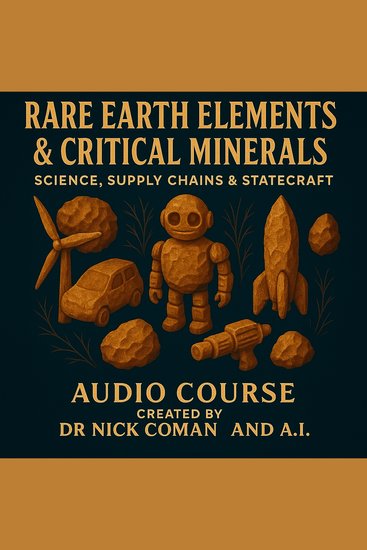
  • Rare Earth Elements & Critical Minerals: Science Supply Chains & Statecraft - What They Do Why They Matter & What The Future Holds… - cover

    Rare Earth Elements & Critical...

    Dr. Nick Coman, I. A.I.

    • 0
    • 0
    • 0
    A 36‑lecture audio course on the materials that run the modern world—from ore bodies and brines to magnets, batteries, chips, and reactors. Each lecture focuses on one element or mineral, tracing its journey from deposit geology through beneficiation and refining to the devices it powers. 
    We make the flowsheet legible: comminution and flotation; roasting, high‑pressure acid leaching, solvent extraction, and ion exchange; separation to oxides and metals; alloying and specialty powders. See how neodymium‑iron‑boron magnets are born, why lithium hexafluorophosphate matters in electrolytes, where gallium nitride wins in power, how graphite anodes evolve with silicon, and how the uranium fuel cycle and vanadium flow batteries actually work. 
    Markets and politics are treated as engineering constraints. Learn to spot yield killers, read offtake agreements, and separate strategic scarcity from narrative. Test real substitutions—ferrites in small motors, sodium‑ion for short‑range storage, gallium nitride versus silicon carbide—and where performance cliffs block redesign. We map chokepoints beyond the mine: separation capacity, reagents, waste handling, water and energy intensity, and manufacturer qualification cycles. Then we follow the consequences—export controls and quotas, permitting and community consent, tariffs and friend‑shoring, standards and labeling rules. 
    Rigorous, narrative‑driven, and built for the intellectually ambitious, this course is an operator’s guide to the science, supply chains, and statecraft of a materials‑constrained century.
    Ver libro
  • The Shocking Truth about Medical Innovations - cover

    The Shocking Truth about Medical...

    Zoey Fraisers

    • 0
    • 0
    • 0
    Medical innovation has long been a driving force behind longer life expectancy, improved quality of life, and the eradication of once-deadly diseases. From antibiotics and vaccines to robotic surgery and gene editing, the rapid advancement of medical technology has saved countless lives. Yet, behind every breakthrough lies a complex web of ethical dilemmas, financial motivations, and unforeseen consequences. While many medical innovations deliver on their promise, others have caused more harm than good, raising critical questions about the true cost of progress.  
      
    History has shown that not all medical advancements are as beneficial as they seem at first glance. Some treatments that were once hailed as revolutionary later proved to be disastrous. For example, the introduction of thalidomide in the late 1950s as a treatment for morning sickness led to severe birth defects in thousands of newborns. Likewise, the opioid crisis, fueled by the aggressive marketing of painkillers as “safe and non-addictive,” has devastated millions of lives worldwide. These examples highlight the darker side of medical innovation—where rushed approvals, corporate interests, and inadequate regulation can turn hopeful breakthroughs into public health disasters.  
      
    At the heart of this issue is the tension between progress and safety. In the race to bring new treatments and technologies to market, are we sacrificing patient well-being in favor of speed and profit? The pharmaceutical industry, medical device manufacturers, and even hospitals often prioritize financial gain over patient outcomes. Meanwhile, regulatory agencies such as the FDA and the World Health Organization struggle to keep up with the sheer volume of new developments, sometimes failing to catch risks before they reach the public. 
    Ver libro
  • Cardiac Cowboys - The Heroic Invention of Heart Surgery - cover

    Cardiac Cowboys - The Heroic...

    M.D. Gerald Imber

    • 0
    • 0
    • 0
    Cardiac Cowboys is the dramatic story of five deeply flawed geniuses who together—and in competition with each other—invented open-heart surgery against all conventional medical wisdom and saved millions of lives. 


    A decade after World War II, there was still no such thing as open-heart surgery, and yet half a million Americans were dying from heart disease every year. One in a hundred children would suffer and die from congenital heart disease as well, and doctors did little other than predict their deaths. After the first daring operation in 1954 and through the next three decades, five heroic surgeons braved the scorn of their peers, withstood fierce desperation, and faced possible death in order to devise procedures that would save overwhelming numbers of those doomed children and provide hope for a new life to all manner of heart-failing individuals. Devising and mastering heart transplants and bypass surgery, they invented artificial heart valves, the lifesaving pacemaker, and worked toward the holy grail of an artificial heart as their private and professional lives imploded. The story of the Cardiac Cowboys, their outsized personalities, and often self-destructive behavior is a saga more thrilling and exhilarating than fiction.
    Ver libro
  • Fog Computing - Extending Cloud Capabilities to the Edge - cover

    Fog Computing - Extending Cloud...

    May Sherry

    • 0
    • 0
    • 0
    In an era where data-driven decisions and real-time processing are paramount, fog computing emerges as a transformative force, bridging the gap between the cloud and edge computing. Fog Computing: Extending Cloud Capabilities to the Edge offers a comprehensive exploration of this pivotal technology, designed for both newcomers and seasoned professionals in the field. 
    This book delves into the essence of fog computing, elucidating its fundamental concepts, architecture, and key components. It provides a clear comparison with cloud and edge computing, highlighting how fog computing enhances data processing, reduces latency, and optimizes resource management by bringing computation closer to where data is generated. 
    With its clear explanations, practical examples, and forward-looking perspectives, Fog Computing: Extending Cloud Capabilities to the Edge serves as an invaluable resource for IT professionals, researchers, and anyone interested in understanding and leveraging the power of fog computing to enhance digital infrastructure and applications. 
     
    Ver libro