¡Acompáñanos a viajar por el mundo de los libros!
Añadir este libro a la estantería
Grey
Escribe un nuevo comentario Default profile 50px
Grey
Suscríbete para leer el libro completo o lee las primeras páginas gratis.
All characters reduced
Modern Woman: Her Intentions - Empowering Women: Breaking Societal Shackles - cover

Modern Woman: Her Intentions - Empowering Women: Breaking Societal Shackles

Florence Farr

Editorial: Good Press

  • 0
  • 0
  • 0

Sinopsis

In "Modern Woman: Her Intentions," Florence Farr presents a compelling examination of the evolving role of women in early 20th-century society. Through a blend of poignant essays and insightful reflections, Farr addresses the social, political, and cultural movements shaping women's identities, particularly in the wake of suffrage and burgeoning feminist ideologies. Her literary style is characterized by a blend of eloquence and critical analysis, tapping into contemporary debates while drawing on historical context, making the text both a product of its time and a forward-thinking discourse on gender equality. Florence Farr, a prominent figure associated with the British literary circle and theosophical society, was deeply influenced by her personal experiences and the intellectual milieu of her time. As an actress, playwright, and lecturer, she engaged with the burgeoning feminist movement and sought to explore the complexities of female agency. Farr's background in theatre and her connections with leading cultural figures imbued her writing with a unique depth, allowing her to articulate the untold stories and aspirations of modern women effectively. This book is a must-read for those interested in gender studies, feminist literature, and the evolution of societal norms. Farr's astute observations encourage readers to reflect on women's roles and the broader implications of their aspirations, making it an essential addition to any scholarly collection.
Disponible desde: 21/08/2022.
Longitud de impresión: 37 páginas.

Otros libros que te pueden interesar

  • A Light in the Northern Sea - Denmark's Incredible Rescue of Their Jewish Citizens During WWII - cover

    A Light in the Northern Sea -...

    Tim Brady

    • 0
    • 0
    • 0
    August 25, 1943. A lone bicyclist transports a cache of explosives, hidden in a beer crate, to a Copenhagen hall being readied to house German troops. In a violent blast, the would-be barracks is reduced to rubble. It's the boldest act yet of Holger Danske and the growing Danish resistance combating the oppressiveness of Hitler's Reich. 


    In 1940, on its way to conquering Western Europe, Germany coerced the Danish government into a "cooperative" agreement that lasted three long years until the increasing brazenness of the Resistance movement prompted a crackdown. Denmark's nearly 8000 Jews, who had so far been spared Hitler's wrath, now became the focus of his rage. A roundup was ordered to begin on October 1st, 1943, the first day of the Jewish New Year. 


    The only passage to safety was across the Oresund to Sweden. But no group existed to organize an escape. Until the last moment, Sweden didn’t agree to allow the refugees into the country; and the strait between the two nations was swarming with Gestapo. What happened next was a miracle. 95% of Denmark's Jews survived the Holocaust, the highest percentage in Europe. Here are the riveting true accounts of ordinary Danes who, using their modest resources, wiles, remarkable courage, and camaraderie, quietly orchestrated their escape.
    Ver libro
  • Summary: Adult Children of Emotionally Immature Parents - How to Heal from Distant Rejecting or Self-Involved Parents - cover

    Summary: Adult Children of...

    Alice Moore, Liam Daniels

    • 0
    • 0
    • 0
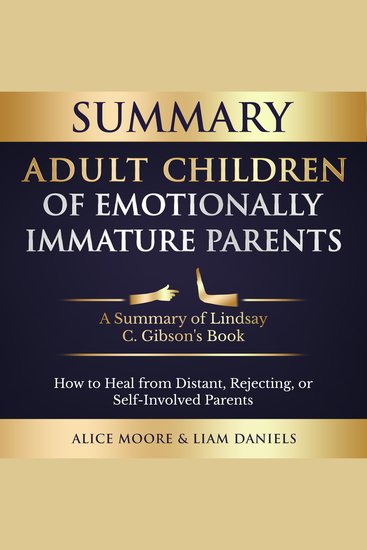
    Every person experiences emotions; it's one of life's most natural aspects. Unfortunately, not everyone is capable of dealing with these intense feelings effectively. And, when you’ve been raised by emotionally immature parents who don’t allow you to be an individual who can express their feelings, you will be set up for failed (and sometimes even abusive) relationships in the future. 
    As children, our number one role models are our parents; we give them unconditional trust to guide us through the world. But when the trust is broken, and their behavior and temperament toward us are less than ideal, we can develop coping mechanisms in a bid to shield ourselves from the hurt. If your parent starved you emotionally, then you have a pretty clear picture of what this means – but it doesn't have to remain this way. 
    In her original, Dr. Lindsay Gibson discusses this phenomenon, the effect that the poor emotional development of parents can have on their children’s lives, and practical steps you can take to break free from this cycle. 
    With this summary, you will:Understand in depth the effect that emotionally immature parents have on the adult lives of their children.Gain insight into how your parents' emotional immaturity has shaped your emotional landscape, and identify the subsequent effects.Explore the personality traits associated with emotional immaturity to be able to identify it in others and avoid falling trap to their actions.Learn the steps you can take to wake up from the effects of emotional immaturity to experience the liberation you long for.Learn how to build solid, lasting relationships filled with the emotional intimacy that you desire.And more! 
    But there's only one rule – don't be afraid to dig deep and feel. Facing the resurfacing emotions of your past may be uncomfortable, to say the least, but it is an essential part of the process.
    Ver libro
  • How We Got Our Antiracist Constitution - Canonizing Brown v Board of Education in Courts and Minds - cover

    How We Got Our Antiracist...

    Jesse Merriam

    • 0
    • 0
    • 0
    Over the past decade, several American cities have been rocked by race riots. With each passing year, a new racial agenda emerges—from police defunding to education reform to reparations—inciting more and more division and radicalization along racial lines. What started all of this? The roots of this pathology run much deeper than the recent symptoms suggest. The civil rights revolution unleashed an assault on the US Constitution, and the sacralization of that revolution, marked by the canonization of Brown v. Board of Education (1954), has transformed our constitutional order. A system once rooted in local self-governance and natural rights now operates along new moral axes, entirely foreign to the American way of life. The choice is increasingly obvious: Either the traditional American order or the new civil rights regime will prevail.
    Ver libro
  • How to Analyze People - Learn the Advanced Methods and Techniques of Speed Reading and Analyzing People - cover

    How to Analyze People - Learn...

    Kevin Hallstone

    • 0
    • 0
    • 0
    In this volume, our focus shifts slightly to the actual personality types; everyone should be aware of and susceptible to when they cross our paths. These are the people you probably don't want to know. 
    Why? They're people who really don't like other people. Well, they do, but what they like about people is exploiting, damaging, and controlling them. They like people for what they can do for them financially, in their careers, and in terms of their status in society. 
    We've covered some of the general personality types in Book One of our series. That information will have given you some insight into the people you meet and how to read them. But what I've saved for this volume is an examination of those who walk among us who are corrosive and psychologically compromised. Also, in this book, you'll be reading about the role of intuition in detecting the truth about situations and people and how to foster and use it to protect yourself and others from the excesses of the disorders described in this book. 
    We'll be focusing on personality disorders, the behaviors of those who are burdened with them, and how to see them coming. There are tell-tale signs early on in interactions with these people that can save you a lot of drama and chaos.  
    As you move along, you'll note an overlap between symptoms and behaviors. In the Cluster B personality disorders, we'll be looking at, the symptomatic overlap is not only common but expected. Further, those who fall under the headings in the cluster often have what is referred to as "co-morbidities." These are the double whammy types, who live with more than one personality challenge or disorder.
    Ver libro
  • Whitehead's The Function Of Reason - cover

    Whitehead's The Function Of Reason

    Alfred North Whitehead

    • 0
    • 0
    • 0
    Whitehead presented these three lectures at Princeton University in 1929. Although 85 years have passed, his central thesis and his analysis remain remarkably current. The scientific materialism that Whitehead opposed with such vigor continues to dominate in academic circles, and even now those who question that worldview are often accused of being anti-scientific.
     
    This is especially true in discussions of the nature of the human mind and its relation to the body (particularly the brain). It is hard to find a contemporary thinker with a better perspective on the nature and role of natural science than Whitehead who, with Bertrand Russell, published the Principia Mathematica in 1910; who taught logic and mathematics at Trinity College of Cambridge University; who taught philosophy of science at University College London; and who was professor of philosophy at Harvard University beginning in 1924. Whitehead’s cosmology is far from anti-scientific, but he does explain why scientific method and technological practice alone are not able to provide a comprehensive understanding of the full range of human thought and experience. This work explains what we must do to achieve such a comprehensive understanding.
    Ver libro
  • Culinary Jailbreak - The Remarkable Tale of Freedom Won with an Unexpected Concoction - cover

    Culinary Jailbreak - The...

    John Harpoon

    • 0
    • 0
    • 0
    In the depths of confinement, where the walls are more than just bricks and mortar but a constant reminder of lost opportunities, an unexpected force emerged: food. This story is not just about escape in the traditional sense, but about breaking free from the psychological and emotional prisons that can often be more suffocating than physical ones. It is a testament to the unyielding human spirit, its capacity for creativity and resilience even in the most stifling of conditions. 
    Incarceration is a test of endurance. Every day is marked by repetition, isolation, and the stripping away of autonomy. It’s easy to feel like hope is a distant dream, slipping further away with each passing hour. But in the midst of despair, something remarkable happened—a plan was forged in the most unlikely of places: the prison kitchen. It was here, in a space designed to merely nourish the body, that a group of individuals came to realize the power of food as a vehicle for something greater: freedom. 
    The idea didn’t start as a grand blueprint or a well-thought-out escape plan. It began with the simple, shared joy of creating something from limited ingredients, turning mundane meals into small acts of rebellion. The kitchen, a place that was simultaneously a site of routine and surveillance, became a sanctuary for ingenuity. It was a space where culinary skills, often honed outside the confines of prison walls, found new purpose in the service of something far more important than sustenance—it became the key to unlocking doors that seemed forever closed.
    Ver libro