Junte-se a nós em uma viagem ao mundo dos livros!
Adicionar este livro à prateleira
Grey
Deixe um novo comentário Default profile 50px
Grey
Assine para ler o livro completo ou leia as primeiras páginas de graça!
All characters reduced
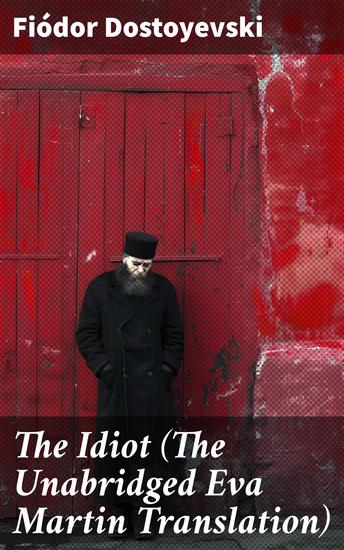
The Idiot (The Unabridged Eva Martin Translation) - Exploring morality spirituality and human nature in 19th-century Russia - cover
LER

The Idiot (The Unabridged Eva Martin Translation) - Exploring morality spirituality and human nature in 19th-century Russia

Fiódor Dostoyevski

Editora: Good Press

  • 0
  • 0
  • 0

Sinopse

In "The Idiot," Fi√≥dor Dostoyevski crafts a profound exploration of virtue and morality through the poignant character of Prince Myshkin, a man whose profound innocence and compassion starkly contrast with the corrupt society around him. This unabridged translation by Eva Martin preserves Dostoyevski'Äôs intricate narrative style, rich in psychological depth and philosophical discourse, immersing readers in the tumult of 19th-century Russian society. The novel is intricately woven with themes of faith, redemption, and the quest for authentic humanity, challenging the reader to ponder the complexities of goodness in a world rife with selfishness and ambition. Dostoyevski, a figure profoundly shaped by his own tumultuous experiences with poverty, exile, and existential despair, delves into the human psyche with startling insight. His interest in the dichotomy of moral ideals versus societal expectation resonates strongly in "The Idiot," as it mirrors his personal struggles with faith and human folly. This rich backdrop informs his portrayal of Myshkin's earnestness amidst the cynicism of those around him, making the work a reflective lens on Dostoyevski's own philosophical inquiries. "The Idiot" is essential reading for those seeking to understand the depths of human consciousness and moral complexity. Through its compelling character study and evocative prose, Dostoyevski invites readers to engage with timeless questions of love, sacrifice, and the essence of true nobility. This translation will captivate both newcomers and seasoned readers of Russian literature alike, making it a worthy addition to any literary collection.
Disponível desde: 19/12/2023.
Comprimento de impressão: 709 páginas.

Outros livros que poderiam interessá-lo

  • Julia Ried: Listening and Led - cover

    Julia Ried: Listening and Led

    Isabella "Pansy" Alden

    • 0
    • 0
    • 0
    Continuing the charming tales of the Ried family, younger sister Julia now embarks on her own journey of overcoming temptation, making tough choices, and finding her way on the path to true faith and love. Facing exceptional and difficult situations with her family, Julia sets out at a young age to find ways to support herself and her ailing mother. However, she becomes distracted and entrapped by the new frivolities and friendships around her. The young Julia must learn the value of eternal treasures over temporal joys and uncover who her true friends and spiritual examples in life are.  This series, published by ONE Audiobooks, seeks to produce Classic Christian titles read by handpicked audiobook narrators. ONE takes great care to cast these titles with readers who will provide an unmatched listening experience for these important works.
    Ver livro
  • The Piazza Tales - cover

    The Piazza Tales

    Herman Melville

    • 0
    • 0
    • 0
    "The Piazza Tales" by Herman Melville is a collection of short stories exploring the complexities of human experience. From the eerie "Bartleby, the Scrivener" to the adventurous "Benito Cereno," the tales traverse a range of themes. They delve into the enigmatic Bartleby's passive resistance, the dark secrets aboard a slave ship in "Benito Cereno," and the haunting quest for the White Whale in "The Encantadas." Through Melville's evocative prose, the collection offers a profound exploration of human nature, morality, and the mysteries that shape our lives.
    Ver livro
  • Candide - cover

    Candide

    Voltaire

    • 0
    • 0
    • 0
    Candide is characterised by its sarcastic tone, as well as by its erratic, fantastical and fast-moving plot. A picaresque novel with a story similar to that of a more serious bildungsroman, it parodies many adventure and romance clichés, the struggles of which are caricatured in a tone that is mordantly matter-of-fact. Still, the events discussed are often based on historical happenings, such as the Seven Years' War and the 1755 Lisbon earthquake. As philosophers of Voltaire's day contended with the problem of evil, so too does Candide in this short novel, albeit more directly and humorously.    Voltaire ridicules religion, theologians, governments, armies, philosophies, and philosophers through allegory; most conspicuously, he assaults Leibniz and his optimism. Voltaire's men and women point his case against optimism by starting high and falling low. A modern could not go about it after this fashion. He would not plunge his people into an unfamiliar misery. He would just keep them in the misery they were born to. But such an account of Voltaire's procedure is as misleading as the plaster cast of a dance.    Look at his procedure again. Mademoiselle Cunégonde, the illustrious Westphalian, sprung from a family that could prove seventy-one quarterings, descends and descends until we find her earning her keep by washing dishes in the Propontis. The aged faithful attendant, victim of a hundred acts of rape by negro pirates, remembers that she is the daughter of a pope, and that in honor of her approaching marriage with a Prince of Massa-Carrara all Italy wrote sonnets of which not one was passable. We do not need to know French literature before Voltaire in order to feel, although the lurking parody may escape us, that he is poking fun at us and at himself. His laughter at his own methods grows more unmistakable at the last, when he caricatures them by casually assembling six fallen monarchs in an inn at Venice.    A modern assailant of optimism would arm himself with social pity. There is no social pity in "Candide." Voltaire, whose light touch on familiar institutions opens them and reveals their absurdity, likes to remind us that the slaughter and pillage and murder which Candide witnessed among the Bulgarians was perfectly regular, having been conducted according to the laws and usages of war. Had Voltaire lived today he would have done to poverty what he did to war. Pitying the poor, he would have shown us poverty as a ridiculous anachronism, and both the ridicule and the pity would have expressed his indignation.
    Ver livro
  • Flight A (Unabridged) - cover

    Flight A (Unabridged)

    Charles Dickens

    • 0
    • 0
    • 0
    A Flight is a short story by Charles Dickens. Charles John Huffam Dickens (7 February 1812 - 9 June 1870) was an English writer and social critic. He created some of the world's most memorable fictional characters and is generally regarded as the greatest novelist of the Victorian period. During his life, his works enjoyed unprecedented fame, and by the twentieth century his literary genius was broadly acknowledged by critics and scholars. His novels and short stories continue to be widely popular. Born in Portsmouth, England, Dickens was forced to leave school to work in a factory when his father was thrown into debtors' prison.
    Ver livro
  • Alice's Adventures in Wonderland - cover

    Alice's Adventures in Wonderland

    Lewis Carroll

    • 0
    • 0
    • 0
    Alice's Adventures in Wonderland (also known as Alice in Wonderland) is an 1865 English children's novel by Lewis Carroll, a mathematics don at the University of Oxford. It details the story of a girl named Alice who falls through a rabbit hole into a fantasy world of anthropomorphic creatures. It is seen as an example of the literary nonsense genre.  
    Plot: 
    Alice, a young girl, sits bored by a riverbank and spots a White Rabbit with a pocket watch and waistcoat lamenting that he is late. Surprised, Alice follows him down a rabbit hole, which sends her into a lengthy plummet but to a safe landing. Inside a room with a table, she finds a key to a tiny door, beyond which is a garden. While pondering how to fit through the door, she discovers a bottle labelled "Drink me". Alice drinks some of the bottle's contents, and to her astonishment, she shrinks small enough to enter the door. However, she had left the key upon the table and cannot reach it. Alice then discovers and eats a cake labelled "Eat me", which causes her to grow to a tremendous size. Unhappy, Alice bursts into tears, and the passing White Rabbit flees in a panic, dropping a fan and two gloves. Alice uses the fan for herself, which causes her to shrink once more and leaves her swimming in a pool of her own tears. Within the pool, Alice meets various animals and birds, who convene on a bank and engage in a "Caucus Race" to dry themselves. Following the end of the race, Alice inadvertently frightens the animals away by discussing her cat... 
    CREATED: 
    Narrated by Abigail Weir 
    Author: Lewis Carroll 
    Date of original publication: 1865 
    Genre: children's novel 
    Language : English 
    Version : unabridged, full/complete 
    Without subtitles
    Ver livro
  • House Decoration (Unabridged) - cover

    House Decoration (Unabridged)

    Oscar Wilde

    • 0
    • 0
    • 0
    Oscar Wilde (16 October 1854 - 30 November 1900) was an Irish poet and playwright. After writing in different forms throughout the 1880s, he became one of the most popular playwrights in London in the early 1890s.
    HOUSE DECORATION: A lecture delivered in America during Wilde's tour in 1882. It was announced as a lecture on 'The Practical Application of the Principles of Æsthetic Theory to Exterior and Interior House Decoration, With Observations upon Dress and Personal Ornaments.' The earliest date on which it is known to have been given is May 11, 1882.
    Ver livro