¡Acompáñanos a viajar por el mundo de los libros!
Añadir este libro a la estantería
Grey
Escribe un nuevo comentario Default profile 50px
Grey
Suscríbete para leer el libro completo o lee las primeras páginas gratis.
All characters reduced
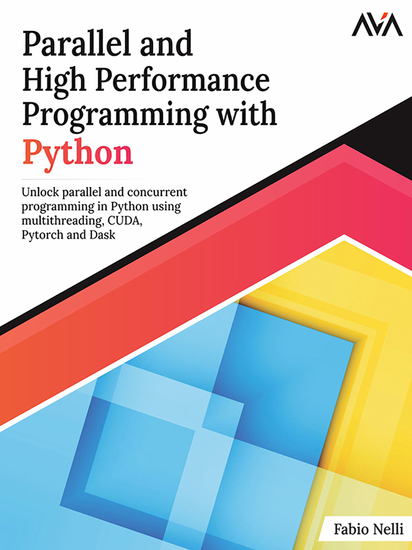
Parallel and High Performance Programming with Python - cover

Parallel and High Performance Programming with Python

Fabio Nelli

Editorial: Orange Education Pvt Ltd

  • 0
  • 0
  • 0

Sinopsis

Unleash the capabilities of Python and its libraries for solving high performance computational problems. 

KEY FEATURES 
- Explores parallel programming concepts and techniques for high-performance computing. 
- Covers parallel algorithms, multiprocessing, distributed computing, and GPU programming. 
- Provides practical use of popular Python libraries/tools like NumPy, Pandas, Dask, and TensorFlow. 

DESCRIPTION 
This book will teach you everything about the powerful techniques and applications of parallel computing, from the basics of parallel programming to the cutting-edge innovations shaping the future of computing. 
The book starts with an introduction to parallel programming and the different types of parallelism, including parallel programming with threads and processes. The book then delves into asynchronous programming, distributed Python, and GPU programming with Python, providing you with the tools you need to optimize your programs for distributed and high-performance computing. 
The book also covers a wide range of applications for parallel computing, including data science, artificial intelligence, and other complex scientific simulations. You will learn about the challenges and opportunities presented by parallel computing for these applications and how to overcome them. 
By the end of the book, you will have insights into the future of parallel computing, the latest research and developments in the field, and explore the exciting possibilities that lie ahead. 
WHAT WILL YOU LEARN 
- Build faster, smarter, and more efficient applications for data analysis, machine learning, and scientific computing 
- Implement parallel algorithms in Python 
- Best practices for designing, implementing, and scaling parallel programs in Python 

WHO IS THIS BOOK FOR? 
This book is aimed at software developers who wish to take their careers to the next level by improving their skills and learning about concurrent and parallel programming. It is also intended for Python developers who aspire to write fast and efficient programs, and for students who wish to learn the fundamentals of parallel computing and its practical uses. 

TABLE OF CONTENTS 
1. Introduction to Parallel Programming 
2. Building Multithreaded Programs 
3. Working with Multiprocessing and mpi4py Library 
4. Asynchronous Programming with AsyncIO 
5. Realizing Parallelism with Distributed Systems 
6. Maximizing Performance with GPU Programming using CUDA 
7. Embracing the Parallel Computing Revolution 
8. Scaling Your Data Science Applications with Dask 
9. Exploring the Potential of AI with Parallel Computing 
10. Hands-on Applications of Parallel Computing
Disponible desde: 13/04/2023.

Otros libros que te pueden interesar

  • Tech Startups - Building and Scaling Innovative Companies - cover

    Tech Startups - Building and...

    Craig Dames

    • 0
    • 0
    • 0
    The foundation of every successful tech startup lies in adopting the right mindset—one that embraces uncertainty, thrives under pressure, and is relentlessly focused on solving real problems. Unlike traditional business models that may prioritize structure and predictability, startups demand a different kind of thinking: bold, experimental, and deeply resilient. The startup mindset is not just about launching a product; it’s about challenging the status quo and envisioning a better way of doing things. 
    At the heart of this mindset is the willingness to take risks. Entrepreneurs must accept that failure is not just a possibility—it’s often a necessary step toward success. Embracing risk doesn’t mean acting recklessly, but rather being comfortable making decisions without having all the answers. It means testing assumptions, learning quickly from setbacks, and moving forward with renewed insight. The ability to pivot when something isn’t working is a hallmark of great startup founders. 
    Equally important is cultivating a culture that thrives on problem-solving. Tech startups are often born out of frustration with how something works—or doesn’t work—in the world. Founders who succeed are those who remain obsessed with their customers’ pain points and are constantly looking for innovative ways to address them. This requires curiosity, empathy, and a drive to keep iterating until a solution clicks. It also involves surrounding oneself with a team that shares this passion and can offer diverse perspectives on how to improve and evolve.
    Ver libro
  • Early Detection - Catching Cancer When It's Curable - cover

    Early Detection - Catching...

    Bruce Ratner, Adam Bonislawski

    • 0
    • 0
    • 0
    Catching cancer early remains the single best way to combat a disease that is the second-leading killer in both the US and worldwide. But the vast majority of resources in the fight against cancer are devoted to relatively ineffective late-stage treatments. Early Detection examines this important anomaly in an accessible and expertly researched survey.In a co-authorship that brings together the passion and urgency of someone touched deeply by the experience of cancer with the knowledge of a skilled science writer, Ratner and Bonislawski narrate compelling case studies across a range of screening programs and different forms of cancer. They look at the science underpinning early detection and discuss the organizational and social challenges of widespread screening, a dimension that has been shown to be especially important in the COVID-19 pandemic. And they call for the government and the medical establishment to provide resources for expanding screening, especially in economically disadvantaged communities that have traditionally been underserved.
    Ver libro
  • Cultivated Cuisine - The Future of Lab-Grown Meat - cover

    Cultivated Cuisine - The Future...

    Gordon Rayner

    • 0
    • 0
    • 0
    Dive into the Future of Feasting: Where Science Meets Your Dinner Plate 
     
    Prepare to be transported to a future where dinner grows in a lab, not a field. "Cultivated Cuisine: The Future of Lab-Grown Meat" offers a cutting-edge exploration of the revolutionary world of cellular agriculture. Attention: The book takes a thrilling plunge into the complexities of lab-grown meat, examining its scientific origins, environmental implications, and potential to redefine our food system. 
    Author Gordon Rayner, a biologist by education and agribusiness professional by experience, unravels this innovative food technology with dexterity and wit. He skillfully bridges the divide between hard science and accessible storytelling, offering a comprehensive guide that enlightens as much as it entertains. 
     
    Imagine a world where the burger on your plate is just as juicy and flavorful as the one from your favorite barbecue joint but without the associated environmental or ethical concerns. That's the promise of cultured meat that Rayner interrogates from every angle. 
     
    Whether you're a food enthusiast curious about sustainable trends, a science geek hungry for innovative topics, or a concerned citizen seeking balanced information on the future of food, this book is a must-read. Feast on a hearty serving of knowledge – sink your teeth into "Cultivated Cuisine: The Future of Lab-Grown Meat" today!
    Ver libro
  • Ancient Lights - cover

    Ancient Lights

    Algernon Blackwood

    • 0
    • 0
    • 0
    "Ancient Lights," written by Algernon Blackwood in 1912 and published two years later, is the tale of a man hired to remove a standing grove of trees so the owner's house can maintain the direct light and view that it has enjoyed for a number of years.
    Ver libro
  • Handmade Houses and Feeders for Birds Bees and Butterflies - cover

    Handmade Houses and Feeders for...

    Michele McKee-Orsini

    • 0
    • 0
    • 0
    These handmade birdhouses and feeders, bee hotels, and butterfly and ladybird homes will bring welcome visitors to your garden.
    
    Handmade Houses and Feeders for Birds, Bees, and Butterflies features 35 beautiful havens to build to attract more wildlife into your garden. Each house is beautifully designed, with colourful details, but is also perfectly adapted for its intended inhabitants. There are birdhouses you can hang up or place on stands, and a bee house you can 'plant' in your flowerbed. There are also feeders for birds, and homes for butterflies and ladybirds. With her trademark attention to detail, Michele McKee-Orsini has designed a gorgeous collection of miniature palaces for the wildlife that we should all be encouraging into our gardens. Michele takes you through the basic woodworking and decorating skills you will need, and the step-by-step project instructions, clear artwork, and stunning photography will all inspire you to build your own havens for our flying friends. Handmade Houses and Feeders for Birds, Bees, and Butterflies is a compilation of previously published favourites.
    Ver libro
  • From Chaos to Stability - How the Brain Invents Our Conscious Worlds - cover

    From Chaos to Stability - How...

    Edward Ziff, Israel Rosenfield

    • 0
    • 0
    • 0
    At the heart of Israel Rosenfield and Edward Ziff's inquiry is the nature of brain function. The sensory world is disordered and chaotic. There are no labels for tables, chairs, or airplanes, and indeed there are no colors, sounds, or smells, only photons, airwaves, odorant molecules, and so on, which are unlabeled and impossible to "know." 


    To make sense of this chaos, the brain must simplify the sensory inputs by creating, or inventing, the colors, sounds, smells, forms, and faces that are perceived in consciousness, which become a proxy for the chaotic world in which we live. The brain's ability to generalize and categorize these invented perceptions, and to relate them to one another, enables it to form memories, which are not fixed representations of things past, but a dynamic and malleable function of the brain that is relational. 


    When formation of these worlds breaks down, neurological differences arise. Although the mechanisms that transform sensory chaos into the simplified perceptions experienced in consciousness remain elusive, Rosenfield and Ziff relate what they have learned by means of imaging brain activity and by mapping the neural circuits that comprise memory traces. In addition, the authors offer perspectives for future studies of consciousness.
    Ver libro