Unisciti a noi in un viaggio nel mondo dei libri!
Aggiungi questo libro allo scaffale
Grey
Scrivi un nuovo commento Default profile 50px
Grey
Iscriviti per leggere l'intero libro o leggi le prime pagine gratuitamente!
All characters reduced
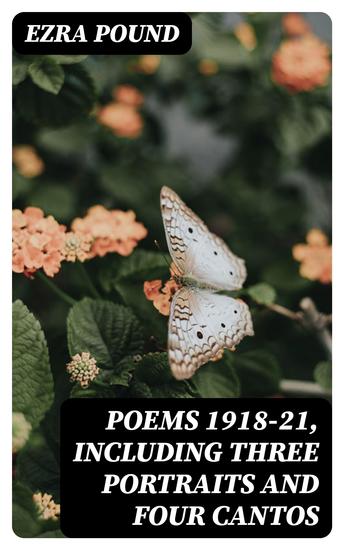
Poems 1918-21 Including Three Portraits and Four Cantos - cover

Poems 1918-21 Including Three Portraits and Four Cantos

Ezra Pound

Casa editrice: DigiCat

  • 0
  • 0
  • 0

Sinossi

In "Poems 1918-21, Including Three Portraits and Four Cantos," Ezra Pound showcases his pioneering modernist style, blending imagery, rhythm, and a variety of forms that challenge traditional poetic conventions. This collection reflects Pound's response to the tumultuous social and political landscape of the post-World War I era, characterized by disillusionment and a quest for artistic innovation. The inclusion of "Three Portraits" and "Four Cantos" exemplifies his commitment to capturing not only the zeitgeist of his time but also his belief in the transformative power of art. Throughout these works, Pound's use of economy in language, alongside rich allusions to culture and history, invites readers into a complex interplay of thought and emotion. Ezra Pound, a central figure in the modernist movement, was deeply influenced by his experiences in Europe and his interactions with contemporaries such as T.S. Eliot and Gertrude Stein. His fervent desire to redefine poetry and expand its expressive capabilities stemmed from his early studies of classical literature and his fascination with various cultural artifacts. As a critic, editor, and poet, Pound's dedication to language and form laid the groundwork for much of 20th-century literature. This collection is a must-read for anyone intrigued by modernist poetry and the intricacies of Pound's vision. Readers will find themselves challenged and inspired, as Pound deftly navigates intricate themes of identity, war, and the nature of artistic creation. "Poems 1918-21" not only enriches our understanding of Pound's oeuvre but also serves as an essential touchstone in the evolution of modern poetry.
Disponibile da: 29/05/2022.
Lunghezza di stampa: 33 pagine.

Altri libri che potrebbero interessarti

  • Lava (NHB Modern Plays) - (new edition) - cover

    Lava (NHB Modern Plays) - (new...

    James Fritz

    • 0
    • 0
    • 0
    A small asteroid has hit the capital city. Thousands have been displaced. And in a town far away, a young man called Vin is finding it hard to talk. The only person who seems to notice is Rach, who resolves to find out what's troubling him and help him find his voice again.
    But when Rach's family take in an articulate and charismatic survivor of the asteroid incident, Vin's silence is no longer her first priority. How does it feel when the suffering of others seems more legitimate than our own?
    James Fritz's Lava is a timely play about grief and the power of expression, rocking with raw emotion and sharp humour. It premiered at Nottingham Playhouse in 2018, in a co-production with Fifth Word who commissioned the play. It was revived on tour in 2022, including a run at Soho Theatre, London.
    'Compassionate, warm and funny... Fritz's work pairs structural playfulness with emotional intelligence and inky wit... his plays are contained and compassionate, and frequently find reservoirs of humour in places you wouldn't expect' - The Stage
    Mostra libro
  • Poets on Poetry - The most artistic and creative form of writing we have a selection of poems from those artistic and creative minds about poetry itself - cover

    Poets on Poetry - The most...

    Matthew Arnold, Sarojini Naidu,...

    • 0
    • 0
    • 0
    Who has not tried to write a poem?  The poetic form of words seems to be rather easy.  In its basic form, which we learn as children, the rhyming couplet is, in a child’s written and spoken words, pure joy - success!  In the hands of a Shakespeare it is magnificent with a reach and understanding that the rest of us enjoy but are far from even attempting.    
     
    As we listen to various poetic forms, schools and movements we can only react with wonder at how these innocent words are assembled to create symphonies of ideas, wonder and revelation.  The emotions they seek to invoke can be anything from happiness to sadness, from love to revulsion. 
     
    Arnold, Stevens, Keats, Akhmatova, Browning, Herrick, Hood, Killigrew are but a few of the roll-call of wordsmiths who with mere words create ravenous beauty that reveals tender lines and sensitive verse on how and why they are who they are. 
     
    01 - Poets on Poetry - An Introduction 
    02 - When I Write Poems by Anna Akhmatova 
    03 - Of My Poems by Thomas MacDonagh 
    04 - An Apology For Her Poetry by Duchess of Newcastle, Margaret Cavendish 
    05 - Sonnet 76 - Why is My Verse So Barren of New Pride by William Shakespeare 
    06 - The Austerity of Poetry by Matthew Arnold 
    07 - Of Modern Poetry by Wallace Stevens 
    08 - Poetry by Claude McKay 
    09 - The Poetry of Keats by George Meredith 
    10 - Future Poetry by Alice Meynell 
    11 - Sonnet 17 - Who Will Believe My Verse in Time to Come by William Shakespeare 
    12 - Poetic Eggs by Ezra Pound 
    13 - Poem by William Carlos Williams 
    14 - On the Grasshopper and Cricket by John Keats 
    15 - Ode on the Poetical Character by William Collins 
    16 - Introduction and Conclusion of a Long Poem by Alan Seeger 
    17 - A True Account of the Birth and Conception of a Late Famous Poem by Charles Sackville, Earl Of Dorset 
    18 - The Poem That Took the Place of a Mountain by Wallace Stevens 
    19 - The Poet and the Poem by Elizabeth Stuart Phelps 
    20 - Of English Verse by Edmund Waller 
    21 - Love, The Soul of Poetry by Anne Killigrew 
    22 - Why, If All Poets Crown Their Love with Verse by Emily Hickey 
    23 - Verse Making Was the Least of My Virtues by Robert Browning 
    24 - The Poet's Love-Song by Sarojini Naidu 
    25 - A Letter to a Brother of the Pen in Tribulation by Aphra Behn 
    26 - Not Every Day Fit for Verse by Robert Herrick 
    27 - On the Poetic Muse by George Moses Horton 
    28 - Sonnet - Written in Keats by Thomas Hood 
    29 - Sonnet 86 -Was It the Proud Full Sail of His Great Verse by William Shakespeare 
    30 - Song in Imitation of Shakespeare by James Beattie 
    31 - The High-toned Old Christian Woman by Wallace Stevens 
    32 - Poetry is a Destructive Force by Wallace Stevens 
    33 - To My Most Dearly Loved Friend Henry Reynolds Esquire of Poets and Poesie by Michael Drayton 
    34 - His Poetry His Pillar by Robert Herrick 
    35 - To Live Merrily and to Trust to Good Verses by Robert Herrick 
    36 - Poem for the End by Ivor Gurney
    Mostra libro
  • Astrology Poetry 101: Cypher - cover

    Astrology Poetry 101: Cypher

    Gregory Sulface

    • 0
    • 0
    • 0
    Imagine when the zodiac signs have all gathered together, maybe sharing some drinks and having a long chat—in poetry.  Will they talk about who is more fun? Will they point fingers at who is being dramatic? Or would they talk about the people who represent them and if these people were representing their signs very well? Will these signs be friends? Will Aries, Leo, and Sagittarius throw fire at other signs? Will Cancer, Scorpio, and Pisces douse everyone else with water? Will the earth (Capricorn, Taurus, and Virgo) and air (Gemini, Libra, and Aquarius) signs meet? There would surely be intriguing topics and heightened emotions involved in this party. If you want to eavesdrop, get a copy of Astrology Poetry 101: Cypher.
    Mostra libro
  • Testament to Beauty - A former Poet Laureate demonstrates his poetic talents in this tender and beautiful verse - cover

    Testament to Beauty - A former...

    Robert Seymour Bridges

    • 0
    • 0
    • 0
    Robert Seymour Bridges, OM was born on 23rd October 1844 at Walmer in Kent where he spent his early childhood in a house overlooking the anchoring ground of the British fleet.  
    His father died aged only 47 in 1853. A year later his mother remarried and the family relocated to Rochdale, where his stepfather was the vicar.  
    In 1854 Bridges was sent to Eton College and attended until 1863.  After Eton he went to Corpus Christi College at Oxford. There he became good friends with Gerard Manley Hopkins and would later compile an edition of his poems that is now considered a major contribution to English literature. 
    He graduated from Oxford, in 1867, with a second-class degree in literae humaniores.  Initially he planned to join the Church of England and travelled to the Middle East to broaden his religious horizons.  However, he soon decided that life as a physician would be a better path and, after 8 months studying German (that being the language of many scientific papers at the time) he began his study of medicine at St. Bartholomew's Hospital in 1869.  His long-term ambition was that by the age of forty he could retire from medicine to devote himself to writing. 
    Unfortunately Bridges failed his final medical examinations in 1873 and, as unable to immediately retake the papers, spent six months in Italy learning Italian as well as immersing himself in its art. In July 1874 he went to Dublin to continue his medical studies. Re-examined in December he passed and became a house physician at St Bartholomew's Hospital. It was whilst here that he engaged in a series of highly critical remarks about the Victorian medical establishment. One such was his claim that whilst working as a young doctor he saw a staggering 30,940 patients in one year. 
    A bout of severe pneumonia and lung disease forced his retirement from the medical profession in 1882 and so, slightly ahead of schedule, he began his literary career in earnest.  He already been writing for several years and had published his first poetry collection in 1873.  
    After his illness and a trip to Italy, Bridges moved, with his mother, to Yattendon in Berkshire.  It was during this time, from 1882 to 1904, that Bridges wrote most of his best-known lyrics as well as eight plays and two masques, all in verse.  
    It was also here, in 1884, that he married Monica Waterhouse. They would go on to have three children and spend the rest of their lives in rural seclusion, in an idyllic marriage, first at Yattendon, then at Boars Hill, Oxford. 
    Bridges made an important contribution to hymnody with the publication in 1899 of his Yattendon Hymnal. This collection of hymns became a bridge between the Victorian hymnody of the late 19th century and the modern hymnody of the early 20th century. He was also a chorister at Yattendon church for 18 years. 
    In 1902 Monica and his daughter Margaret became seriously ill with tuberculosis, and a move from Yattendon to a healthier climate was in order. After several temporary homes they moved abroad to spend a year in Switzerland before returning to settle again in England at Chilswell House, which Bridges had designed, and built on Boar's Hill overlooking Oxford University.   
    His greatest achievement though was still some years ahead of him.  The office of Poet Laureate was held by Alfred Austin but with his death it was offered first to Rudyard Kipling, who refused it, and then to Bridges. He was appointed Poet Laureate in 1913 by George V, the only medical graduate to have ever held the office. Bridges, at this time, was neither highly regarded nor well known but a safe pair of hands in a World rapidly being overshadowed by the storms about to erupt over Europe and the First World War. 
    The events of this War, including the wounding of his son, Edward, had a sobering effect on Bridges' poetry. His work became fiercely patriotic. In 1915 edited a volume of prose and poetry, The Spirit of Man, intended to appeal to readers living in war time
    Mostra libro
  • The Hound of Heaven - An ode about faith and devotion to God - cover

    The Hound of Heaven - An ode...

    Francis Thompson

    • 0
    • 0
    • 0
    A gloriously talented poet who although now almost forgotten wrote verse that is still powerful and prescient
    Mostra libro
  • Top 10 Poets – England The - The West Midlands - Five poems each from poets born in the English West Midlands - cover

    Top 10 Poets – England The - The...

    Wilfred Owen, A E Housman, Mary...

    • 0
    • 0
    • 0
    The language of Poetry is an art that most of us attempt at some point in our lives.  Although its commonplace exposure has been somewhat marginalised in today’s often fast-paced lives we all recognise good verse that can empathise with our thoughts or open us up to experience new things in new ways, to better understand and to enjoy the many strands of our lives. 
    But finding a starting point can be overwhelming, even off-putting, so in this series we offer up our Top 10 classic poets, who brim with talent and verse, on a range of subjects and themes that we can all enjoy. 
    For centuries England has always had a leading and admired reputation for its poets and poetry.  In this volume we explore those born in the West Midlands who created such revered, enduring and respected verse.
    Mostra libro