¡Acompáñanos a viajar por el mundo de los libros!
Añadir este libro a la estantería
Grey
Escribe un nuevo comentario Default profile 50px
Grey
Suscríbete para leer el libro completo o lee las primeras páginas gratis.
All characters reduced
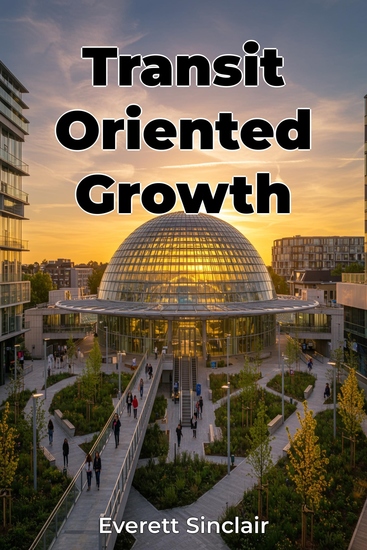
Transit Oriented Growth - cover

Transit Oriented Growth

Everett Sinclair

Traductor A AI

Editorial: Publifye

  • 0
  • 0
  • 0

Sinopsis

Transit Oriented Growth explores how integrating transportation infrastructure with urban design can create sustainable and equitable communities. It examines transit-oriented development (TOD) principles, emphasizing walkability, reduced congestion, and enhanced mobility. The book argues for a shift from auto-centric planning to prioritizing public transit, pedestrian, and bicycle infrastructure, addressing urban sprawl and social inequity. It also considers the architecture and political dimensions of policy implementation in the context of these urban transformations.

 
The book begins by tracing urban planning's evolution and introduces TOD principles like mixed-use development and density near transit hubs. Case studies illustrate successful and unsuccessful TOD implementations. For example, TOD can increase property values and reduce transportation costs.

 
It further delves into the social equity implications of TOD, focusing on affordable housing and inclusive community development. The framework presented guides policymakers and planners in implementing TOD strategies by navigating zoning regulations and community engagement. The book draws evidence from urban planning studies, transportation data, and economic assessments, offering a practical guide for creating sustainable cities through effective transit-oriented development.
Disponible desde: 21/02/2025.
Longitud de impresión: 82 páginas.

Otros libros que te pueden interesar

  • The Fever Syndrome - cover

    The Fever Syndrome

    Alexis Zegerman

    • 0
    • 0
    • 0
    Professor Richard Myers, now in his 70s and suffering from advanced Parkinson’s disease, is about to receive a lifetime achievement award for his work in the development of in-vitro fertilization. That calls for a family reunion, and given this high-functioning, dysfunctional family, there’s bound to be trouble ahead. As they gather, old resentments erupt as they fight over Richard’s legacy while facing another family member’s serious illness. 
     
    Incudes a conversation with playwright Alexis Zegerman. 
     
    This play is part of L.A. Theatre Works’ Relativity Series of science-themed plays. Lead funding for the Relativity Series is provided by the Alfred P. Sloan Foundation, bridging science and the arts in the modern world. 
     
    Recorded at The Invisible Studios, West Hollywood in December 2023. 
     
    Directed by Sarah Drew 
    Producing Director: Susan Albert Loewenberg 
     
    An L.A. Theatre Works full cast recording, starring: 
     
    Hugo Armstrong as Professor Richard Myers 
    Seamus Dever as Thomas Myers 
    Sarah Drew as the voice of Karen 
    Patrick Heusinger as Anthony Myers 
    Kelly McCreary as Dot Myers-Cooper 
    Monica McSwain as Lily Cooper and Young Dot 
    Matthew Floyd Miller as Nate Cooper 
    Desean K. Terry as Phillip Tennyson 
    Joanne Whalley as Megan Myers. 
     
    Senior Producer: Anna Lyse Erikson 
    Prepared for audio by Mark Holden. 
    Recorded, designed, and mixed by Charles Carroll, and edited by Neil Wogensen for The Invisible Studios, West Hollywood. 
    Piano music and musical characters adapted and performed by Rusty Tinder, recorded by Charles Carroll, and Directed by Mark Holden. 
    Senior Radio Producer: Ronn Lipkin 
    Foley Artist: Stacey Martinez
    Ver libro
  • The English Constitution - cover

    The English Constitution

    Walter Bagehot

    • 0
    • 0
    • 0
    The challenge facing Walter Bagehot while writing the essays that became his study of The English Constitution is that, infamously, there is no "English constitution," at least, not one that has ever been written down. The government of Great Britain and Ireland, in Bagehot's day, is the result of centuries of evolution, and so is the product of custom, precedent, reform, and a great degree of chance. As a "constitutional monarchy," the theory of government that Bagehot describes entails chiefly the role of the monarch, the main legislative assembly—the House of Commons—and its counterpart in the "upper house," the House of Lords which, despite its apparently higher social register, is in reality a subordinate assembly. In these arrangements, the Reform Acts of 1832 and 1867 (the latter being debated while Bagehot was writing his essays) played a major role, and loom large in Bagehot's discussion of the institutions of his day. The second edition of his work, published in 1872, takes a considered view of effects of the second phase of reform. At the time of writing, Bagehot was well settled into his role as Editor of The Economist , then a newspaper under the ownership of his father-in-law. Bagehot's prose remains eminently readable, showing a light touch and sense of humor in explaining sometimes arcane arrangements of government, and often reflecting on its contrast with American practice. His sturdy prose bears comparison with that of his contemporary, the novelist Anthony Trollope . In some ways, The English Constitution could be seen as the theoretical basis for Trollope's political novels , and those novels (especially Phineas Finn , Phineas Redux , and The Prime Minister ) as commentaries on Bagehot's theory. While now dated, Bagehot's essays were widely influential and remain the standard work on British constitutional arrangements. Woodrow Wilson took inspiration from Bagehot in his own thesis, Congressional Government , in which he called Bagehot "the most sagacious of political critics," without peer in "that field of critical exposition in which he was supreme, the philosophical analysis … of the English Constitution."
    Ver libro
  • The Chicago Outfit during the 1960s - cover

    The Chicago Outfit during the 1960s

    John J. Binder

    • 0
    • 0
    • 0
    The Chicago Outfit, which evolved from the Capone gang at the end of Prohibition, became the most successful of the Cosa Nostra crime families in terms of enriching its members.
    This was primarily due to the criminal abilities of two men, Paul Ricca and Tony Accardo, who were at the top of the organization for years. At its height in the 1960s, the Chicago Outfit was involved in gambling, labor racketeering, juice lending, prostitution, narcotics, and strong-arm activities such as hijacking and robbery. It did so by using violence and, since many of its activities were essentially out in the open, by corrupting numerous police officers and politicians. During the early 1960s, before the US government was fully up to speed on fighting organized crime, honest local politicians and members of law enforcement fought an uphill battle against it.
    The discussion and photographs in this book, which are largely from author John J. Binder's extensive personal collection, cover the many aspects of the Chicago Outfit during this decade when it was at its zenith, with operations in the Chicago area and elsewhere in the country.
    Ver libro
  • Permian Period The: The History and Legacy of the Era with the Largest Mass Extinction Event - cover

    Permian Period The: The History...

    Editors Charles River

    • 0
    • 0
    • 0
    Among the most interesting of the prehistoric eras is the Permian age, the most extreme period in the planet’s history. It spanned 47 million years, beginning with an ice age, warming, and ending with the most cataclysmic volcanic episode in the planet’s history. The great bulk of all life on the Earth was almost immediately snuffed out, barely crawling back over the following 10 to 30 million years, and it set the stage for the “Age of Dinosaurs.” 
    	What is termed by some as the “Pennsylvanian” or “Carboniferous” period prepared the emergence of the Permian age. Named for the abundance of rocks from the period found in the state of Pennsylvania, many prefer the term “Silesian” or “Carboniferous” era. In the preceding “Mississippian era,” warm, shallow seas disappeared causing serious upheaval to marine life in a tendency toward glaciation.  
    	“Significant glaciation” marks the beginning of the Carboniferous immediately preceding the Permian. Carboniferous glaciation began in the late Ordovician Period long before. The eventual Andean-Saharan glaciation, a minor ice age, occurred later in the Silurian Age. These were all remnants of the “Snowball Earth” period of the Cryogenian. 
    	The resultant sea level drop as the Carboniferous ice age set in produced conditions much like that of today, with ice on both poles, wet tropics near the equator and temperate regions in between. Despite similar conditions, the Carboniferous lacked the output of greenhouse gases produced by humans. 
    	Fragments of plates collided as continents were still fusing into the supercontinent Pangea. During glaciation, “latitudinal climactic belts were widespread.” Permian rocks have been found on all the continents and some have been displaced “considerable distances from their original latitudes” in the Mesozoic and Cenozoic eras that followed the Permian.
    Ver libro
  • The meditation Top Of The World - cover

    The meditation Top Of The World

    Max Topoff

    • 0
    • 0
    • 0
    Today, I invite you to go to the Top of the World and meet your true identity.  You’ll remember and like our journey today, that’s for sure. Because the Top of the World is the place where every pilgrim yearns to get to. This is the exact place where we feel at our best, like we’re back home again. This is the place where all our dreams are fulfilled and our wishes come true. This exact place is a Holy Grail of all our existence. This visualization will help you to see the thing which may be your destination; to feel the unity of soul, heart and mind; to feel your true identity…This visualization will help you see exactly what may be your purpose; feel the unity of the soul, heart and mind; feel your true self… Enjoy listening.
    Ver libro
  • Hidden History of Music The: Beethoven Symphony No 6 - cover

    Hidden History of Music The:...

    Hank Wilson

    • 0
    • 0
    • 0
    Step into the world of Beethoven like never before with The Hidden History of Music: Beethoven Symphony No. 6. This digital audio experience combines the power of live performance with the rich, untold stories behind one of the composer’s most beloved symphonies.


    Why This Experience?


    Imagine not just listening to Beethoven's Symphony No. 6, but understanding it on a deeper, more personal level. This special digital audio edition offers two distinct, yet seamlessly integrated tracks:


    The Performance Tracks: Experience the majesty of Beethoven’s Symphony No. 6, also known as the Pastoral Symphony, in a high-quality performance that brings to life the lush, nature-inspired themes that made this work a revolutionary piece in the classical music canon.


    The History Track: Delve into the lesser-known facts, fascinating insights, and hidden contexts behind this masterpiece. From the inspiration behind its pastoral scenes to Beethoven’s struggles with hearing loss while composing, this track uncovers stories and facts rarely explored, making you hear the music in an entirely new light. Did you know that Beethoven’s depiction of nature was more than just a picturesque escape? Or that the symphony reflected his own personal turmoil, even as it embraced the serenity of the countryside?
    Ver libro