¡Acompáñanos a viajar por el mundo de los libros!
Añadir este libro a la estantería
Grey
Escribe un nuevo comentario Default profile 50px
Grey
Suscríbete para leer el libro completo o lee las primeras páginas gratis.
All characters reduced
Great Wall Engineering - cover

Great Wall Engineering

Everett Sinclair

Traductor A AI

Editorial: Publifye

  • 0
  • 0
  • 0

Sinopsis

Great Wall Engineering explores the remarkable construction of the Great Wall of China, focusing on the engineering ingenuity required to build this extensive fortification across diverse terrains. It highlights the adaptive design philosophy employed by ancient Chinese engineers, who expertly modified construction techniques and materials based on local conditions, showcasing a deep understanding of structural mechanics. The book reveals how the Wall's success stemmed from this ability to adapt to challenges, which involved not only overcoming geographical obstacles but also efficiently managing resources and manpower.

 
The book examines the Wall's historical context, tracing its evolution across dynasties and the political motivations driving its construction. It then dives into specific engineering challenges, such as foundation construction on unstable ground and the transportation of heavy materials. Through a synthesis of historical texts, archaeological surveys, and modern engineering analyses, the book unveils the intricacies of the Wall's design and construction.

 
The final section explores the Wall’s impact on Chinese society and its legacy, demonstrating how the Great Wall influenced subsequent fortification designs and construction practices.
Disponible desde: 04/03/2025.
Longitud de impresión: 71 páginas.


Otros libros que te pueden interesar

  • Tears Over Russia - A Search for Family and the Legacy of Ukraine's Pogroms - cover

    Tears Over Russia - A Search for...

    Lisa Brahin

    • 0
    • 0
    • 0
    Between 1917 and 1921, twenty years before the Holocaust began, an estimated 100,000 to 250,000 Jews were murdered in anti-Jewish pogroms across the Ukraine. Lisa grew up transfixed by her grandmother Channa’s stories about her family being forced to flee their hometown of Stavishche, as armies and bandit groups raided village after village, killing Jewish residents. Channa described a perilous three-year journey through Russia and Romania, led at first by an American who had snuck into the Ukraine to save his immediate family and ended up leading an exodus of nearly eighty people to safety. With almost no published sources to validate her grandmother’s tales, Lisa embarked on an incredible journey to tell Channa’s story, forging connections with archivists around the world to find elusive documents to fill in the gaps of what happened in Stavishche. She also tapped into connections closer to home, gathering testimonies from her grandmother’s relatives, childhood friends, and neighbors. The result is a moving historical family narrative that speaks to universal human themes—the resilience and hope of ordinary people surviving the ravages of history and human cruelty. With the growing passage of time, it is unlikely that we will see another family saga emerge so richly detailing this forgotten time period. Tears Over Russia eloquently proves that true life is sometimes more compelling than fiction.
    Ver libro
  • Start of World War II The: The History of the Events that Culminated with Nazi Germany’s Invasion of Poland - cover

    Start of World War II The: The...

    Editors Charles River

    • 0
    • 0
    • 0
    "My good friends," the mustached, bony man with thick eyebrows and large, strong teeth somewhat reminiscent of those of a horse, shouted to the crowds from the second-floor window of his house at 10 Downing Street, "this is the second time in our history, that there has come back to Downing Street from Germany peace with honor. I believe it is peace for our time." The man addressing the crowd, British Prime Minister Neville Chamberlain, had just returned from the heart of Nazi Germany following negotiations with Adolf Hitler, and the crowd gathered outside the English leader's house on September 30, 1938 greeted these ringing words with grateful cheers. The piece of paper Chamberlain flourished exultantly seemed to offer permanent amity and goodwill between democratic Britain and totalitarian Germany. In it, Britain agreed to allow Hitler's Third Reich to absorb the Sudeten regions of Czechoslovakia without interference from either England or France, and since high percentages of ethnic Germans – often more than 50% locally – inhabited these regions, Hitler's demand for this territory seemed somewhat reasonable to Chamberlain and his supporters. With Germany resurgent and rearmed after the disasters inflicted on it by the Treaty of Versailles following World War I, the pact – known as the Munich Agreement – held out hope of a quick end to German ambitions and the return of stable, normal international relations across Europe. 
    Of course, the Munich agreement is now notorious because its promise proved barren within a very short period of time. Chamberlain's actions either failed to avert or actually hastened the very cataclysm he wished to avoid at all costs. The "Munich Agreement" of 1938 effectively signed away Czechoslovakia's independence to Hitler's hungry new Third Reich, and within two years, most of the world found itself plunged into a conflict which made a charnel house of Europe and left somewhere between 60-80 million people dead globally.
    Ver libro
  • Major Trade-Offs - The Surprising Truths about College Majors and Entry-Level Jobs - cover

    Major Trade-Offs - The...

    Corey Moss-Pech

    • 0
    • 0
    • 0
    An eye-opening look at the relationship between students’ majors and their entry-level jobs.Humanities majors are used to answering the question, “So, what are you going to do with that degree?” The common misconception is that students in humanities programs don’t learn any useful skills for the real world. In Major Trade-Offs, Corey Moss-Pech argues that not only do humanities majors learn real-world skills, but they actually use them when they graduate. Despite this discrepancy, graduates with so-called practical degrees like business and engineering are much more likely to find employment, and they earn higher salaries. Why do we belittle a liberal arts education despite the valuable skills that students acquire during their studies?
    
    Major Trade-Offs addresses this question by following students from different majors as they enter the workforce. Moss-Pech conducted nearly 200 interviews with roughly ninety students from four majors at a large Midwestern university: engineering, business, English, and communications. He follows these students through their senior years, chronicling their internships and the support their universities provide in helping them pursue their career paths. Graduates from practical majors entered the labor market successfully, typically through structured internship programs. However, many ended up in entry-level jobs that were largely clerical and didn’t necessarily require a degree to perform. Liberal arts majors rarely accessed structured internships and were largely left to carve out their own paths, but used their degree skills once they secured a job. This challenges the popular myths about the “marketability” of these different majors and offers a new vision for the future of higher education.
     
    
    Major Trade-Offs calls on colleges and universities to advocate for liberal arts majors, leveling the playing field for students as they plan for entry-level work.
    Ver libro
  • Empowered Ladies - A Trip in Pants Through History - cover

    Empowered Ladies - A Trip in...

    Susan Marg

    • 0
    • 0
    • 0
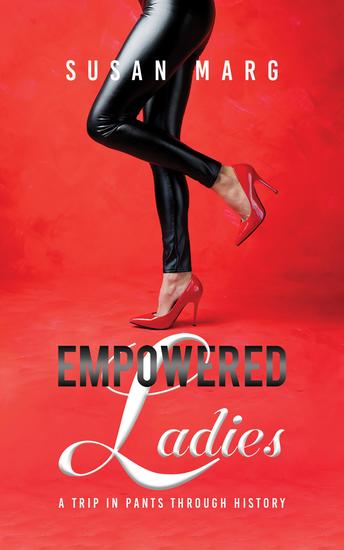
     Empowerment doesn't always follow a fairy-tale script. Neither its beginnings nor its journeys are always paved with acceptance. Women who dared to don trousers lived with the tremor of discovery, particularly those who veiled themselves as men to enlist in early wars, when only men were permitted to serve. Their fear was not just the battle cries, but the disgrace of being unmasked and sent home. 
     The world paused in disbelief when, upon the death of jazz musician Billy Tipton, it was revealed that he was a she. Similarly, when Dr. James Barry, who ascended to the zenith of medical ranks in the British Army, was uncovered as a woman posthumously, the army swathed the truth in secrecy. 
     Not all were 'ladies' in the conventional sense, but they were undeniably women - women who defied the societal mold. They sometimes cloaked themselves in trousers or other male disguises, challenging the expectations of their eras. 
     Their ranks encompassed saints and sinners, queens, countesses, and commoners. While names like Joan of Arc and Calamity Jane might ring familiar, their tales, along with those of others, are captivating in Empowered Ladies. This book unearths the narratives of these audacious women, weaving a tapestry of resilience and defiance that continues to inspire the quest for empowerment. 
    Ver libro
  • Frederick Douglass Revolt & Rebellion - cover

    Frederick Douglass Revolt &...

    Frederick Douglass

    • 0
    • 0
    • 0
    Frederick Douglass was an American social reformer, abolitionist, orator, writer, and statesman. After escaping from slavery in Maryland, he became a national leader of the abolitionist movement in Massachusetts and New York, becoming famous for his oratory and incisive antislavery writings. Accordingly, he was described by abolitionists in his time as a living counterexample to slaveholders' arguments that slaves lacked the intellectual capacity to function as independent American citizens. Northerners at the time found it hard to believe that such a great orator had once been a slave. It was in response to this disbelief that Douglass wrote his first autobiography. 
     
    Following the Civil War, Douglass was an active campaigner for the rights of freed slaves . Douglass also actively supported women's suffrage, and he held several public offices. Without his permission, Douglass became the first African American nominated for vice president of the United States, as the running mate of Victoria Woodhull on the Equal Rights Party ticket. 
     
    Douglass believed in dialogue and in making alliances across racial and ideological divides, as well as in the liberal values of the U.S. Constitution. When radical abolitionists, under the motto "No Union with Slaveholders", criticized Douglass's willingness to engage in dialogue with slave owners, he replied: "I would unite with anybody to do right and with nobody to do wrong.
    Ver libro
  • Crosses of Iron - The Tragic Story of Dawson New Mexico and Its Twin Mining Disasters - cover

    Crosses of Iron - The Tragic...

    Nick Pappas, Richard Melzer

    • 0
    • 0
    • 0
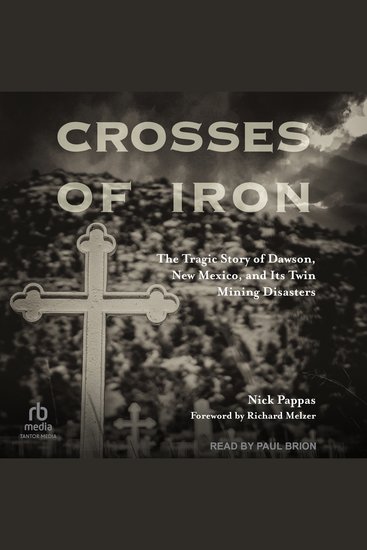
    In October 1913, 261 miners and two rescuers died when a massive explosion ripped through a mine operated by Phelps, Dodge & Company in Dawson, New Mexico. Ten years later, a second blast claimed the lives of another 120 miners. Today, Dawson is a deserted ghost town. All that remains is a sea of white iron crosses memorializing the nearly four hundred miners killed in the two explosions—a death toll unmatched by mine disasters in any other town in America. 


    Now, to mark the centennial of the second disaster, veteran journalist Nick Pappas tells the tragic story of what was once New Mexico's largest and most modern company town and of how the strong, determined residents of the community coped with two heartbreaking catastrophes.
    Ver libro