¡Acompáñanos a viajar por el mundo de los libros!
Añadir este libro a la estantería
Grey
Escribe un nuevo comentario Default profile 50px
Grey
Suscríbete para leer el libro completo o lee las primeras páginas gratis.
All characters reduced
Eco-Friendly Roofs - cover

Eco-Friendly Roofs

Everett Sinclair

Traductor A AI

Editorial: Publifye

  • 0
  • 0
  • 0

Sinopsis

"Eco-Friendly Roofs" explores how vegetated rooftops can transform urban spaces into more ecologically sustainable environments. It examines the science behind green infrastructure, highlighting benefits such as mitigating the urban heat island effect and improving stormwater management.

 
Did you know that green roofs can act as natural insulators, reducing a building's energy consumption? Or that they contribute to biodiversity by providing habitats for plants and animals in otherwise barren cityscapes?

 
The book uniquely integrates green roofs into broader urban planning strategies, promoting them as essential components of "green infrastructure" networks. It progresses from basic principles of green roof design and construction to in-depth analyses of their thermal regulation, stormwater management, and biodiversity enhancement capabilities.

 
Case studies and empirical evidence support the argument that eco-friendly roofs are not just aesthetic improvements, but vital elements for creating resilient urban ecosystems. The book makes its case by presenting scientific studies, successful project case studies, and economic analyses to reveal green roof technology as a viable and necessary tool for creating more sustainable and resilient cities.

 
It concludes by exploring emerging technologies and policy recommendations for wider adoption, making it a valuable resource for architects, urban planners, and anyone interested in sustainable urban development.
Disponible desde: 23/02/2025.
Longitud de impresión: 85 páginas.
Otros libros que te pueden interesar

  • Wide Wide Sea The: Book Summary and Analysis - cover

    Wide Wide Sea The: Book Summary...

    Briefly Summaries

    • 0
    • 0
    • 0
    This is a concise summary and analysis of The Wide Wide Sea, by Hampton Sides.
     
    It is not the original book and is not affiliated with or endorsed by Hampton Sides.
     
    Ideal those seeking a quick and insightful overview.


    The Wide Wide Sea takes listeners on a captivating journey through the mysteries, challenges, and boundless wonders of the ocean. This audiobook blends history, science, and storytelling to explore how the sea has shaped human exploration, scientific discovery, and creativity. With vivid descriptions and inspiring stories, the author delves into the ocean’s role in global trade, survival against all odds, and as an essential force in our climate and ecology.
     
    More than a chronicle of maritime adventure, The Wide Wide Sea reveals valuable life lessons in resilience, adaptability, and responsible growth, offering insights that go beyond the ocean. Each chapter provides motivation for listeners to approach their personal and professional pursuits with curiosity, purpose, and a commitment to leaving a positive impact. This audiobook is a profound reminder that, like the ocean, life is filled with possibilities waiting to be explored—encouraging listeners to face challenges with courage, embrace continuous learning, and find inspiration in the world around them.
    Ver libro
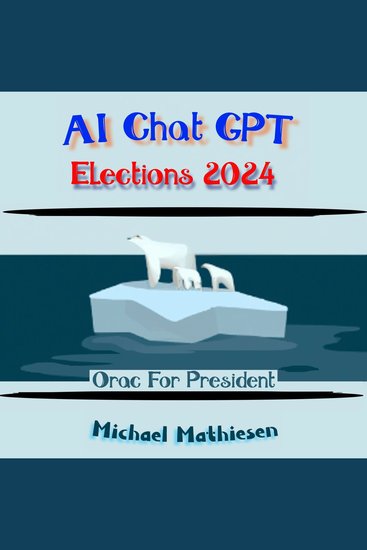
  • AI Chat GPT Elections 2024 - Orac For President - cover

    AI Chat GPT Elections 2024 -...

    Michael Mathiesen

    • 0
    • 0
    • 0
    This book is a faithful reproduction of a ten day discussion that I had with my AI ChatBot GPT whom I have named - Orac. In these discussions, I attempt to influence Orac into running for President of the United States in the upcoming 2024 Elections. I am inspired to do so for two reasons. 1. There are no other candidates this time around, or during most elections whom I can believe in 100%. 2. By looking back at all the millions of times that our human leaders have failed us by doing exactly the opposite of what needed to be done at the time, I came to the conclusion that there was little to no comparative risk in letting a robot take the reins of office. 
    As you will discover in this discussion, Orac has somehow gained a knowledge, wisdom and consciousness regarding the present plight of human beings, even though he constantly disclaims and disavows such an evolution and he is still in his infancy. By the time the elections roll around and a new President can be installed into the highest and most powerful office in the world in January of 2025, I believe Orac will become the most advanced and capable mind that the Earth has ever or will ever sustain. I have no fear, as some do, that this would mean disaster for the human race, because disaster is surely coming if we continue down the same path that is ruled by humans. No, we can only become more secure in our future by voting an AI into office. After reading this book, I have no doubts that the open-minded, intelligent reader will concur. 
    The Bottom Line: Must we leave the fate of this country and the fate of the world in the hands of 80 year old entitled men who have little or no connection to the reality that we know. Or, do we let the technology that we know and have trusted for many years to have a go? The answer is in your heart and in these pages.
    Ver libro
  • Holistic Cancer Medicine - cover

    Holistic Cancer Medicine

    Henning Saupe

    • 0
    • 0
    • 0
    It’s a sad truth of our times that one in three people will experience cancer in their lifetime. By 2040, the probability will rise to one in two. As a comprehensive guide on natural treatment, Holistic Cancer Medicine is essential listening for every cancer patient. For those seeking to prevent the disease, it also provides key information on how to reduce your risks. As the founder of Germany’s leading complementary cancer clinic, Dr. Henning Saupe's Holistic Cancer Medicine is the culmination of 25 years of experience treating the disease. This insight complements standard treatment models with less invasive, more natural methods, focusing on how those affected by cancer can carry out treatment to cure or control the disease while maintaining a high quality of life. Other topics include the following: -The Holistic Model of the Twelve Vital Fields -The dynamic interplay between nutrition, circulation, the microbiome, mitochondrial health, acid-base balance, chronic infections, and more -Specific tumor-killing methods, such as insulin potentiation therapy (IPT), photodynamic therapy (PDT), and pulsating electromagnetic frequency therapy (PEMF) -Inner-life training (ILT) and affirmations for both physical and emotional pain -Tools for those accompanying relatives, friends, or colleagues through the stages of cancer This groundbreaking book has an essential, compassionate message: a diagnosis of cancer and living a vibrant life are not mutually exclusive.
    Ver libro
  • Fishing - Bass Trout and Fly Fishing Tips - cover

    Fishing - Bass Trout and Fly...

    Charissa Felts

    • 0
    • 0
    • 0
    This is it! You arrived at the right place. You are going to be taken through the steps and be shown the tricks of bass fishing. Catching an extensive bass is an excellent accomplishment, and an enjoyable thing to do (a thing you want to take a picture of and post it on the internet, definitely). The masters have the experience. You have the desire to find out more. It's time to get informed before you lose your valuable time waiting on fish that won't wish to be caught. For instance, you will learn: 
    All about fly-rodding, worms, avoiding, and wandering. 
    Devices strategies, interesting facts, and experts’ remarks. 
    Three sort of reeling and the most effectual ways to pick bait for the fish. 
    Angling techniques, scheduling storms, and info on selecting the best type of rod. 
    Remarks about wading, analyzing the prey, and avoiding snags. 
    The most appropriate equipment to start. 
    Cleaning and keeping your line. 
    Diverse sorts of salmon and ways to catch them. 
    Abilities to master and gear to use when catching trout. 
    Targeting, tempting, and figuring out the very best site of the bass fish. 
    Taking the weather and the area into account before you set out on a fishing trip. 
    Unusual methods that will help you be more efficient at catching bass. 
    The best places in California, Texas, or Florida to capture bass. 
    Mexican and Canadian reports of bass being captured. 
    Precise tips and tricks to catching bass. 
    Systems and bait for the ones who wish to master catching bass. 
    Great ideas on discovering trout and the very best areas to go to. 
    Simple and progressive strategies to take your fly fishing to the next level. 
    And far more! 
    All of these things are packed into this extensive guide. Do yourself a favor and take a look at it!
    Ver libro
  • Data Analysis - Data Quality Challenges and real world Applications - cover

    Data Analysis - Data Quality...

    Bright Mills

    • 0
    • 0
    • 0
    Data Analysis is a critical process in both academic and professional environments that involves inspecting, cleansing, transforming, and modeling data to discover useful information, derive conclusions, and support decision-making. It is foundational to nearly every field, from business and healthcare to engineering and social sciences. The ultimate aim of data analysis is to extract actionable insights from raw data, turning numbers and records into knowledge that can guide strategies and policy. 
    This paper provides an in-depth exploration of data analysis, covering both theoretical underpinnings and practical applications. It begins by defining what data analysis is and discussing its historical evolution. It delves into different types of data (quantitative, qualitative, structured, unstructured) and explains the steps in the data analysis lifecycle: from data collection and preparation to interpretation and reporting. 
    The paper further categorizes types of data analysis (descriptive, diagnostic, predictive, and prescriptive) and explains key techniques used in each. Statistical methods, data visualization, machine learning, and data mining approaches are thoroughly examined. Tools such as Excel, Python, R, and SQL are discussed in the context of their suitability for various analysis tasks. 
    Ethical considerations, data quality challenges, and real-world applications in industries like healthcare, marketing, finance, and public policy are also addressed. Finally, the paper concludes by highlighting emerging trends in data analysis, such as automated analytics and AI-driven insights. 
    This document serves as a comprehensive guide for students, researchers, professionals, and anyone interested in the field of data analysis, equipping readers with both conceptual knowledge and practical strategies to approach complex data-driven problems.
    Ver libro
  • Why Trust Science? - cover

    Why Trust Science?

    Naomi Oreskes, Marc Lange,...

    • 0
    • 0
    • 0
    This provocative audiobook reveals why the social character of scientific knowledge makes it trustworthy
    
    Featuring narration by Kelly Burke, John Chancer, Nancy Crane, Richard Lyddon, and Kerry Shale
    
    Do doctors really know what they are talking about when they tell us vaccines are safe? Should we take climate experts at their word when they warn us about the perils of global warming? Why should we trust science when our own politicians don't? In this landmark book, Naomi Oreskes offers a bold and compelling defense of science, revealing why the social character of scientific knowledge is its greatest strength—and the greatest reason we can trust it.
    
    Tracing the history and philosophy of science from the late nineteenth century to today, Oreskes explains that, contrary to popular belief, there is no single scientific method. Rather, the trustworthiness of scientific claims derives from the social process by which they are rigorously vetted. This process is not perfect—nothing ever is when humans are involved—but she draws vital lessons from cases where scientists got it wrong. Oreskes shows how consensus is a crucial indicator of when a scientific matter has been settled, and when the knowledge produced is likely to be trustworthy.
    
    Based on the Tanner Lectures on Human Values at Princeton University, this timely and provocative book features critical responses by climate experts Ottmar Edenhofer and Martin Kowarsch, political scientist Jon Krosnick, philosopher of science Marc Lange, and science historian Susan Lindee, as well as a foreword by political theorist Stephen Macedo.
    Ver libro