Begleiten Sie uns auf eine literarische Weltreise!
Buch zum Bücherregal hinzufügen
Grey
Einen neuen Kommentar schreiben Default profile 50px
Grey
Jetzt das ganze Buch im Abo oder die ersten Seiten gratis lesen!
All characters reduced
War and the Arme Blanche - cover

War and the Arme Blanche

Erskine Childers

Verlag: DigiCat

  • 0
  • 0
  • 0

Beschreibung

In "War and the Arme Blanche," Erskine Childers presents a compelling treatise on the ethics of military engagement and the psychological ramifications of warfare, particularly in the context of the early 20th century conflicts. Written with a meticulous attention to detail, Childers employs a narrative style that blends personal reflections with historical analysis, capturing the stark realities of combat through both prose and poetry. The book effectively critiques the conventional view of modern warfare, advocating for an acknowledgment of the moral choices that soldiers must confront, as well as the broader societal impacts of armed conflict. Childers' nuanced exploration of the 'arma blanche'—the bayonet and its symbolic representation of direct, close combat—positions the text within a rich literary tradition concerned with the human experience of war. Erskine Childers was not only a writer but also a passionate political activist, deeply influenced by his experiences in the Boer War and his strong nationalist sentiments. His background as an Irishman with British colonial ties provided a unique perspective on issues of imperialism and freedom, which are deeply woven into this work. Childers' firsthand encounters with the horrors of war serve as the foundation for his poignant reflections, urging readers to contemplate the ethical implications of their societies' military actions. "War and the Arme Blanche" is a must-read for those seeking to understand the multifaceted nature of warfare and its lasting consequences on humanity. Ideal for scholars, historians, and any thoughtful readers interested in military ethics and literary critiques of war, this book invites readers to engage in a vital conversation about the responsibilities of soldiers and the moral exigencies faced in times of conflict.
Verfügbar seit: 16.09.2022.
Drucklänge: 326 Seiten.

Weitere Bücher, die Sie mögen werden

  • Don’t Burn This Book: Book Summary & Analysis - cover

    Don’t Burn This Book: Book...

    Briefly Summaries

    • 0
    • 0
    • 0
    This is a concise summary and analysis of Don't Burn This Book, by Dave Rubin.
     
    It is not the original book and is not affiliated with or endorsed by Dave Rubin.
     
    Ideal those seeking a quick and insightful overview.
     
    Don't Burn This Book is a bold manifesto for free thinking in an age of political tribalism and cultural censorship. It challenges readers to question conventional wisdom, engage in honest dialogue, and reclaim the lost art of critical thought. This book explores the power of individual liberty, personal responsibility, and open debate, offering insights and strategies to navigate today’s polarized world. With a mix of humor, personal anecdotes, and provocative ideas, this work is a call to embrace diversity of thought and resist the pressure to conform.
    Zum Buch
  • Enchantment: Part II - Lure (Yaoi Gay Erotica) - cover

    Enchantment: Part II - Lure...

    Kai Aubrey

    • 0
    • 0
    • 0
    A thick ocean of vegetation, green as jade, the northern woodlands are as beautiful as they are unforgiving. Sprawling, gnarled branches tower above an untouched wilderness, hiding away forgotten secrets and ancient beasts. 
    Isolated deep within the darkest recesses of nature, Heath and Caio seek the wisdom of a storied sorcerer, but lost knowledge has a price. 
    Surrounded by endless natural splendor, the young couple feels their resistance slipping away as they succumb to the sweet temptations of the forest. 
    ***CONTAINS EXPLICIT GAY SEXUAL CONTENT*** 
    Written by Kai Aubrey. Narrated by Arcadian Audios. 
    For more content, visit www.KaiAubrey.com.
    Zum Buch
  • Machiavellianism - Manipulative Behavior Aimed at Gaining Power - cover

    Machiavellianism - Manipulative...

    Cito Harder

    • 0
    • 0
    • 0
    Machiavellianism is a philosophy that prioritizes power, strategy, and manipulation over conventional morality. Rooted in the writings of Niccolò Machiavelli, particularly The Prince, this mindset champions pragmatism and cunning as necessary tools for success. Machiavellianism does not concern itself with what is right or wrong in a moral sense; instead, it focuses on what is effective. Those who embrace this approach believe that power is not given but taken, and maintaining it requires calculated decisions rather than ethical considerations. 
    At its core, Machiavellianism operates on the assumption that people are driven by self-interest and can be easily influenced, deceived, or controlled. While traditional morality emphasizes honesty, fairness, and compassion, a Machiavellian sees these values as potential weaknesses when navigating competitive environments. Success, according to this philosophy, is reserved for those who can manipulate perceptions, control narratives, and strategically outmaneuver others. This way of thinking is often observed in politics, business, and personal relationships, where the ability to influence others determines one's level of power. 
    One of the key aspects of Machiavellianism is the belief that the ends justify the means. A leader, politician, or corporate executive following this mindset may employ deceit, flattery, or even betrayal to secure and maintain power. Machiavelli himself argued that rulers must sometimes act immorally for the greater stability of their state. In the modern world, this principle manifests in various ways, from corporate takeovers to political campaigns that use misinformation to sway public opinion.
    Zum Buch
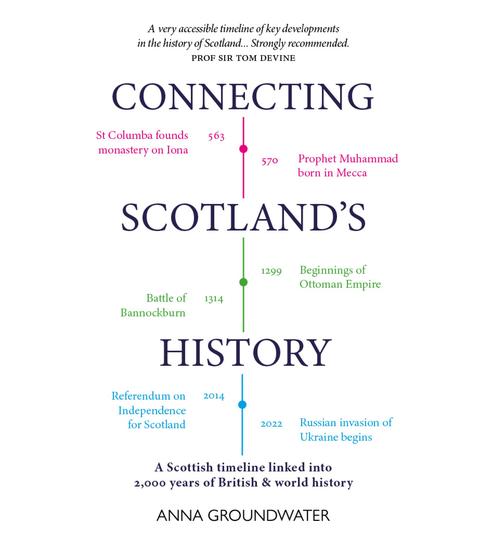
  • Connecting Scotland's History - A Scottish History Timeline Linked into 2000 Years of World History - cover

    Connecting Scotland's History -...

    Anna Groundwater

    • 0
    • 0
    • 0
    What was happening elsewhere in the world when Robert the Bruce was outlawed and Mary Queen of Scots lost her head? When Genghis Khan was on the warpath and Ivan the Terrible was the Russian czar, what was happening in Scotland? Find the answers to these questions in 2,000 years of Scottish history presented alongside what was happening in the rest of the world.
    By placing events in Scotland in relation to those elsewhere, we can see what is different or distinctive about Scotland's experience. Simultaneously we can also see where movements in Scottish history were part of wider cultural or political change in Europe and beyond. John Knox's fiery sermons of the 1560s were connected into a wider Protestant Reformation, but they also represented a singularly Scottish version of a European phenomenon.
    Connecting Scotland's History also gives us a history of 'many Scotlands'. We see the hybrid nature of a country where multiple peoples have come together in a distinctively Scottish mixture. From the Gaels, Picts and Norse people to more recent influxes from England, Ireland, continental Europe and beyond, Scotland's history tells us of internal connections as well as connections between Scotland and the wider world.
    Zum Buch
  • Darkest Hour - How Churchill Brought England Back from the Brink - cover

    Darkest Hour - How Churchill...

    Anonym

    • 0
    • 0
    • 0
    “McCarten's pulse-pounding narrative transports the reader to those springtime weeks in 1940 when the fate of the world rested on the shoulders of Winston Churchill. A true story thrillingly told. Thoroughly researched and compulsively readable.”—Michael F. Bishop, Executive Director of the International Churchill Society 
    From the acclaimed novelist and screenwriter of The Theory of Everything comes a revelatory look at the period immediately following Winston Churchill’s ascendancy to Prime Minister 
    “He was speaking to the nation, the world, and indeed to history....” 
    May, 1940. Britain is at war. The horrors of blitzkrieg have seen one western European democracy after another fall in rapid succession to Nazi boot and shell. Invasion seems mere hours away. 
    Just days after becoming Prime Minister, Winston Churchill must deal with this horror—as well as a skeptical King, a party plotting against him, and an unprepared public. Pen in hand and typist-secretary at the ready, how could he change the mood and shore up the will of a nervous people? 
    In this gripping day-by-day, often hour-by-hour account of how an often uncertain Churchill turned Britain around, the celebrated Bafta-winning writer Anthony McCarten exposes sides of the great man never seen before. He reveals how he practiced and re-wrote his key speeches, from ‘Blood, toil, tears and sweat’ to ‘We shall fight on the beaches’; his consideration of a peace treaty with Nazi Germany, and his underappreciated role in the Dunkirk evacuation; and, above all, how 25 days helped make one man an icon. 
    Using new archive material, McCarten reveals the crucial behind-the-scenes moments that changed the course of history. It’s a scarier—and more human—story than has ever been told.
    Zum Buch
  • Portuguese Empire and the Americas The: The History and Legacy of Portugal’s Exploration and Colonization in the New World - cover

    Portuguese Empire and the...

    Editors Charles River

    • 0
    • 0
    • 0
    By the start of the 15th century, ships were now much larger and able to support long distance travel with a minimum number of crew aboard. With that, the Portuguese started exploring the west coast of Africa and the Atlantic under orders from Prince Henry the Navigator. At this point, Europeans had not yet been capable of navigating completely around Africa since the ships being built were not yet fully capable of being able to sail very far from the coast and navigation in open waters was difficult, but the Portuguese continued pushing down the western African coast looking for ways to bypass the Ottomans and Muslims of Africa who had been making overland trade routes difficult. In 1451, Prince Henry the Navigator helped fund and develop a new type of ship, the caravel, that featured triangular lateen sails and would be able to travel in the open ocean and sail against the wind. In 1488, Bartholomew Diaz rounded the southern tip of Africa, named the Cape of Good Hope by King John of Portugal, and entered the Indian Ocean from the Atlantic.  
    	One explorer, Christopher Columbus, sought funding from the Portuguese to search for a passage to Asia by sailing westwards, but he was rejected. At this time in the late 15th century, Portugal’s domination of the western African sea routes prompted the neighboring Crown of Castile and the Catholic monarchs in modern Spain to search for an alternative route to south and east Asia (termed Indies), so they provided Columbus with the funding he required. Ultimately, Columbus discovered the Americas in 1492, and European settlements would soon follow. At the same time, when it became clear Columbus hadn’t landed in Asia, it was understood by everyone that this was not necessarily the route the Europeans were searching for, the Portuguese continued to send explorers around the world in several directions in an attempt to reach the East Indies. 
    Zum Buch