Join us on a literary world trip!
Add this book to bookshelf
Grey
Write a new comment Default profile 50px
Grey
Subscribe to read the full book or read the first pages for free!
All characters reduced
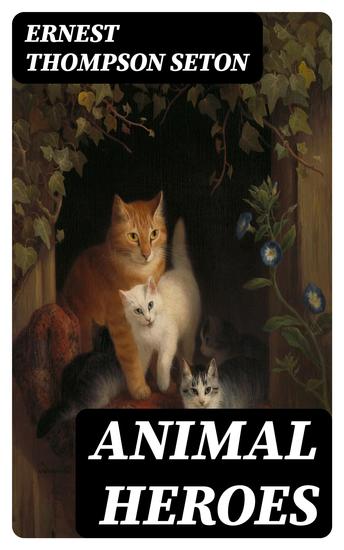
Animal Heroes - cover

Animal Heroes

Ernest Thompson Seton

Publisher: DigiCat

  • 0
  • 0
  • 0

Summary

In "Animal Heroes," Ernest Thompson Seton masterfully weaves together the realms of zoology and storytelling, recounting the lives of remarkable animals that exhibit extraordinary intelligence, courage, and spirit. Through a blend of vivid narrative and keen observation, Seton employs a naturalistic style, immersing readers in the trials and triumphs of his animal subjects. The book embodies the early 20th-century revival of interest in nature literature, reflecting the burgeoning movement towards wildlife conservation and the reverence for the natural world, making it a foundational text in this genre. Seton, a prominent figure in the early conservation movement and a founder of the Boy Scouts of America, drew upon his own deep appreciation for animals, honed during his extensive travels across North America. His background as a naturalist and artist allows him to create not just a narrative, but a heartfelt homage to the creatures he portrays. Seton's compassion for his subjects stems from a profound understanding of their lives, inspiring readers to see the world from an animal's perspective and fostering empathy for all living beings. "Animal Heroes" is a must-read for nature enthusiasts, animal lovers, and anyone who appreciates finely crafted tales of heroism. Seton's engaging prose and relatable themes invite readers to ponder the often-overlooked narratives of the animal kingdom while promoting a message of respect and stewardship towards nature. This book not only entertains but also educates, making it an essential addition to any literary collection.
Available since: 09/16/2022.
Print length: 135 pages.

Other books that might interest you

  • Artificial Intelligence - Machine Learning and Data Science in the 21st Century - cover

    Artificial Intelligence -...

    Victor Servings

    • 0
    • 0
    • 0
    The principle of artificial intelligence has been around since the 1970s. Originally, the primary objective was for computers to make choices with no input from people. However, it never ever caught on, partially because system administrators could not find out how to utilize all the information. Even if some could understand the value in the data, it was really difficult to utilize, even for engineers. 
      
    On top of that, the challenge of extracting data from the simple databases of 3 decades ago was huge. Early AI applications would spit out reams of data, most of which wasn't sharable or adaptive to different business needs.
    Show book
  • The AI Mirror - How to Reclaim Our Humanity in an Age of Machine Thinking - cover

    The AI Mirror - How to Reclaim...

    Shannon Vallor

    • 0
    • 0
    • 0
    For many, technology offers hope for the future—that promise of shared human flourishing and liberation that always seems to elude our species. Artificial intelligence (AI) technologies spark this hope in a particular way. They promise a future in which human limits and frailties are finally overcome—not by us, but by our machines. Yet rather than open new futures, today's powerful AI technologies reproduce the past. Forged from oceans of our data into immensely powerful but flawed mirrors, they reflect the same errors, biases, and failures of wisdom that we strive to escape. Our new digital mirrors point backward. They show only where the data say that we have already been, never where we might venture together for the first time. 


    To meet today's grave challenges to our species and our planet, we will need something new from AI, and from ourselves. 


    Shannon Vallor makes a wide-ranging, prophetic, and philosophical case for what AI could be: a way to reclaim our human potential for moral and intellectual growth, rather than lose ourselves in mirrors of the past. Rejecting prophecies of doom, she encourages us to pursue technology that helps us recover our sense of the possible, and with it the confidence and courage to repair a broken world. Vallor calls us to rethink what AI is and can be, and what we want to be with it.
    Show book
  • Peaceful Sleep Music - 4 Hours of Calming Tunes for Deep Relaxation - cover

    Peaceful Sleep Music - 4 Hours...

    Sleeptime Publications

    • 0
    • 0
    • 0
    Let Gentle, Soothing Music Guide You Into Deep, Restful Sleep 
    Struggling to quiet your mind at night? Do stress and distractions keep you from fully unwinding? When silence isn’t enough, let peaceful, ambient music ease you into deep relaxation and restorative sleep. 
    This audiobook features four hours of calm, immersive melodies designed to create the perfect sleep environment.What’s Inside: 
    ✅ Nature’s Embrace – Soft, flowing harmonies inspired by the serenity of the natural world. 
    ✅ Suspended in Space – Ethereal, weightless melodies that feel like floating in the cosmos. 
    ✅ Liminal Dreamland – Gentle, dreamlike compositions that blur the line between waking and sleep. 
    ✅ Blissful Dreams – Warm, comforting tones to help you drift into deep, uninterrupted rest. 
    ✔️ Fall asleep faster and stay asleep longer 
    ✔️ Reduce stress and quiet an overactive mind 
    ✔️ Enhance relaxation, meditation, or deep focusPress play now and let the tranquil melodies carry you into peaceful sleep.
    Show book
  • On Time Causality and the Block Universe  - Scientific answers to our deepest questions - cover

    On Time Causality and the Block...

    Anthony C Proctor

    • 0
    • 0
    • 0
    May of us harbour deep questions on subjects such as the origin of the universe, the concepts of time and causality, the nature of consciousness and free will, the mind-body problems of philosophy, the relationship between mathematics and physics, and more. Conventional answers will usually be from fundamental physics (often deeply mathematical) or philosophy (often very abstract). This work takes a different view of reality by substituting mathematical determinism for causal determinism, thereby making it clear why mathematics so adequately describes our observations and measurements. It then deconstructs many aspects of experience - all of which taint our supposedly objective study of the universe - to see how they emerge from a timeless block universe. Subjects such as quantum theory, change, choice, probability, thermodynamics, and consciousness all have to be disassembled. The conclusion is consistent with both mathematics and experience, provides an answer that is immune from the question of 'first cause', and yet does not lead to further questions, albeit in an unexpected way.
    Show book
  • The Resilient Mind - Executive Functions Emotion Regulation And Mental Health in Children And Adolescents - cover

    The Resilient Mind - Executive...

    Brittany Forrester

    • 0
    • 0
    • 0
    "The Resilient Mind" is a vital guide illuminating the crucial role of executive functions, emotion regulation, and mental health in shaping the well-being of children and adolescents. Drawing on cutting-edge research and practical insights, this book equips parents, educators, and mental health professionals with actionable strategies to nurture resilience and promote positive mental health in young minds. Through real-life examples and practical techniques, it offers invaluable tools for fostering robust cognitive skills, emotional regulation, and adaptive behaviors essential for navigating life's challenges.
    Show book
  • Epidemics - cover

    Epidemics

    Hippocrates

    • 0
    • 0
    • 0
    The term "epidemic" is used to describe the spread of a disease or condition to a large number of people. The word "epidemic" is derived from the Greek word "epi", meaning "upon", and "demos", meaning "people". Hippocrates, a Greek physician who lived in the fourth century BC, was one of the first to use the term "epidemic". He used it to describe the spread of disease through a population. Read in English, unabridged.
    Show book