¡Acompáñanos a viajar por el mundo de los libros!
Añadir este libro a la estantería
Grey
Escribe un nuevo comentario Default profile 50px
Grey
Suscríbete para leer el libro completo o lee las primeras páginas gratis.
All characters reduced
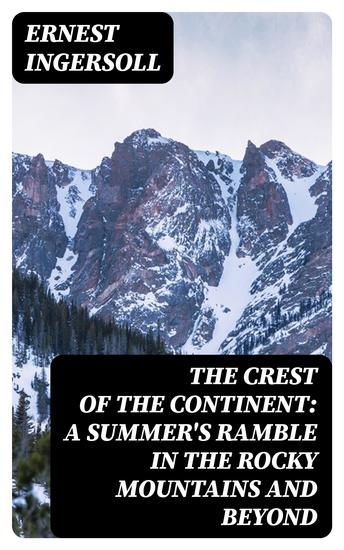
The Crest of the Continent: A Summer's Ramble in the Rocky Mountains and Beyond - cover

¡Lo sentimos! La editorial o autor ha eliminado este libro de nuestro catálogo. Pero no te preocupes, tenemos más de 500.000 otros libros que puedes disfrutar.

The Crest of the Continent: A Summer's Ramble in the Rocky Mountains and Beyond

Ernest Ingersoll

Editorial: DigiCat

  • 0
  • 0
  • 0

Sinopsis

Ernest Ingersoll's 'The Crest of the Continent: A Summer's Ramble in the Rocky Mountains and Beyond' presents a resplendent narrative of travel and discovery woven into the majestic tapestry of the Rocky Mountains. Ingersoll's literary style is both lyrical and precise, a hallmark of the naturalist writing of his time which focused on capturing the grandeur of the American landscape. Within the broader literary context, the book serves as a vivid chronicle of the American West during the late 19th century, infused with a spirit of adventure and a deep appreciation for the natural world. As a special edition reproduced by DigiCat Publishing, this tome is not just a travelogue but a cultural artifact, providing insights into the values and curiosities of a bygone era in American exploration.nnIngersoll, an esteemed naturalist, and writer, was driven by a profound zeal for the great outdoors and a desire to document the untouched landscapes of America. His impetus for crafting this particular narrative likely stemmed from an era of intense national fascination with the West, as well as his own personal quest for understanding and documenting the richness of the continent's flora, fauna, and geology. This background, along with his journalistic expertise, rendered Ingersoll exceptionally well-suited to the task of creating a work that not only informed but also inspired an appreciation for the natural wonders of the Rockies and beyond.nn'The Crest of the Continent' is highly recommended for enthusiasts of natural history, American studies, and the intrepid spirits fascinated by the allure of exploration. Readers will find themselves transported through Ingersoll's vivid descriptions, gaining a deeper understanding of both the physical grandeur and the historical significance of the Rocky Mountains. This book is a timeless tribute to the enduring beauty of America's wilderness, an essential read for those yearning to connect with the nation's past and the spirit of adventure that defines it.
Disponible desde: 04/09/2022.
Longitud de impresión: 389 páginas.

Otros libros que te pueden interesar

  • Danger Stalks the Land - Alaskan Tales of Death and Survival - cover

    Danger Stalks the Land - Alaskan...

    Larry Kaniut

    • 0
    • 0
    • 0
    Alaska is like no other state and few countries; men experience greater risk in her arms. This one-of-a-kind anthology captures the spine tingling adventures of daring men and women who venture into Alaska's vast wilderness and look death in the eye. Danger Stalks the Land relates gripping episodes of animal attacks, avalanches, aircraft disasters, fishing, hunting, and skiing accidents, and chronicles risky climbs and reckless mountaineering amid Alaska's fantastic peaks. Through exhaustive research and interviews, author Larry Kaniut has captured in one volume, the terror and beauty of man's attempt to explore a vast and unforgiving land.
    Ver libro
  • Parikrama - A Journey of Deity Worship - cover

    Parikrama - A Journey of Deity...

    Yashomatinandana Dasa

    • 0
    • 0
    • 0
    Parikramā means pilgrimage. This book is a compilation of all the places of Pilgrimage in Europe, Prayag, Ayodhya, Varanasi, Navadvipa, Jagannatha Puri and Vrindavana that I have personally visited. In these specific places are unique and wonderful deity forms of Kṛṣṇa called arca-vigraha. It is to contemplate, remember and deepen the connection to Kṛṣṇa, the Supreme Lord, whom I worship in the form His arca-vigraha, or bonafide Deity form.  
    The beautiful Śrīmad Bhāgavatam (11.27.44-45) describe the festival of Deity Worship: 
    “Singing along with others, chanting loudly and dancing, acting out My transcendental pastimes, and hearing and telling stories about Me, the devotee should for some time absorb himself in such festivity. The devotee should offer homage to the Lord with all kinds of hymns and prayers, both from the Purāṇas and from other ancient scriptures, and also from ordinary traditions. Praying, “O Lord, please be merciful to me!” he should fall down flat like a rod to offer his obeisances.” 
    Deity Worship, or Arcana, is a festival for the senses, because one can see the Supreme Lord, touch His Lotus Feet, dress Him, feed Him and offer everything to Him. Especially recommended for the neophyte, Deity Worship goes hand-in-hand with the other eight limbs of devotional service, namely hearing, chanting, remembering, serving His lotus feet, offering prayers, being a servant, making friends and surrendering everything for the pleasure of the Lord. 
    Writing about Kṛṣṇa is also sravanam, kirtanam, Kṛṣṇa Smaranam, and it helps to grasp the unlimited beauty of the Lord. In 2023/24 I already compiled a book about ARCANA, Deity Worship, while being trained as a Vedic priest. This freely available book is meant for the pleasure of my Guru, Śrīla Prabhupāda and everyone who can't make the journey to Śrīdhāma Māyāpur to learn the science of Bhakti-Yoga.
    Ver libro
  • The Minotaur at Calle Lanza - cover

    The Minotaur at Calle Lanza

    Zito Madu

    • 0
    • 0
    • 0
    A "hauntingly effective" surrealist travel memoir about the mysterious transformations that may lurk inside us all (Library Journal, starred review). 


    Venice, 2020. As a pandemic rages across the globe, Zito Madu finds himself in a nearly deserted city, its walls and basilicas humming with strange magic. As he wanders a haunted landscape, we see him twist further into his own past: his family's difficult immigration from Nigeria to Detroit, his troubled relationship with his father, the sporadic joys of daily life and solitude, his experiences with migration, poverty, foreignness, racism, and his own rage and regret. But as it is with all labyrinths, after finding its center, will he come away unscathed, or will he transform into the gripping, fantastical monstrousness that's out to consume him whole? 


    With nods to Italo Calvino and Jorge Luis Borges, this surrealist debut memoir takes us into the labyrinth of memory and the monsters lurking there.
    Ver libro
  • Ancient Greece’s Most Famous Oracles: The History of the Oracles at Delphi and Dodona - cover

    Ancient Greece’s Most Famous...

    Editors Charles River

    • 0
    • 0
    • 0
    In ancient Greece, “no other practice was so universal than the consultation of oracles.” These holy sites were found in 260 locations around the Greek-speaking world, and they were considered the “most satisfactory means of ascertaining the future.” These sanctuaries were “set apart from the profane, ordinary world” and were in the beginning restricted to natural locations where the divine was thought to be “especially present.” They were set aside for special spiritual functions, and a state of purity was generally required of its participants. A historical tendency toward providing haven for criminals was based on the fear of shedding blood in a holy place, and the “fear that the evil magic would emanate from his curse.” 
    The Oracle of Delphi was one of the greatest religious institutions in Greece and one which played a significant role not only in the formation and collective decisions of Hellenic localities and city-states but also in the personal lives of Greeks known and unknown. The site was dedicated to the god Apollo, and the Greeks believed the god spoke his oracles through his prophetess known as the Pythia. The judgments and decisions rendered by the oracle were so important to the Greeks that they often put them above all other interests, even security threats posed by the likes of the Persians, and Delphi was popular even amongst outsiders. Many authors of antiquity mention the oracle for one reason or another, and there even survive epigraphic collections that preserve the god’s words on stone. 
    The Oracle of Dodona was the oldest of all, and it was one of the few dedicated to Zeus and his consort goddess Dione. The oracular utterances heard at the oracles are generally referred to as “smokiness” in Greek, but at Dodona, the answers came in natural sounds and other peripheral phenomena.
    Ver libro
  • Kindergarten at 60 - A Memoir of Teaching in Thailand - cover

    Kindergarten at 60 - A Memoir of...

    Dian Seidel

    • 0
    • 0
    • 0
    Teaching kindergarten in Thailand wasn’t the job Dian Seidel had in mind when, at age sixty and craving adventure, she convinced her husband that they should try working abroad. But coping with rambunctious children, sweltering heat, and Covid-19 turned out to be the challenge she needed. Struggling to understand Thai culture, their school, and their marriage, could she learn Thailand’s essential lesson: mai pen rai, don’t worry, keep cool? 
    Part travel memoir and part second act story, the multiple award-winning Kindergarten at 60 is a retirement tale like none other. With gentle humor and polished prose, Seidel explores universal themes via the adventures of everyday life. Job-hunting retirees confront age restrictions. A couple navigates 24/7 togetherness for the first time in their lives. Professionals accustomed to working with adults are overwhelmed, and charmed, by a passel of two-, three-, and four-year-olds. An introvert struggles to forge cross-cultural and cross-generational friendships. Americans face the challenges of the five-tone Thai language and five-alarm Thai chilies. 
    Seidel’s heartwarming story offers a unique perspective on contemporary Thailand and introduces readers to an unforgettable cast of characters at Pathum Thani Prep. Join the journey, meet the kids, and experience Kindergarten at 60.
    Ver libro
  • Ancient Egyptian Festivals - Celebrations of Deity and Life - cover

    Ancient Egyptian Festivals -...

    Omar Khalil

    • 0
    • 0
    • 0
    Festivals played a central role in the cultural and religious life of ancient Egypt. These grand celebrations were not just an occasion for communal enjoyment but were deeply tied to the spiritual and societal fabric of the civilization. They served as a means of honoring gods and goddesses, ensuring the prosperity of the land, and reinforcing the divine order, which was vital for the Egyptians. The festivals helped to maintain cosmic balance and provided a way for the people to connect with the divine. 
    The ancient Egyptians viewed the natural and spiritual worlds as intricately linked. Their gods were believed to control all aspects of life, from the annual flooding of the Nile to the harvests and the afterlife. Therefore, festivals were seen as essential in securing divine favor and maintaining order. These events allowed the people to express their devotion, offering prayers, sacrifices, and rituals to appease the gods. For instance, the Festival of Opet, one of the most significant, symbolized the renewal of the king’s power and his bond with the gods. It was an opportunity for the people to reassert their allegiance to the pharaoh, who was seen as the living deity on earth. 
    In addition to reinforcing the divine relationship, festivals also played a key role in community cohesion. The ancient Egyptians, despite the challenges of life, were brought together by shared rituals and celebrations. This unity was expressed in grand processions, feasts, music, and dance, where the people could experience a sense of collective identity. These events transcended social status and served as a reminder of the interconnectedness of all people under the divine. Festivals were not just for the elite but were a part of the communal life, extending to all citizens, from farmers to nobles.
    Ver libro