Join us on a literary world trip!
Add this book to bookshelf
Grey
Write a new comment Default profile 50px
Grey
Subscribe to read the full book or read the first pages for free!
All characters reduced
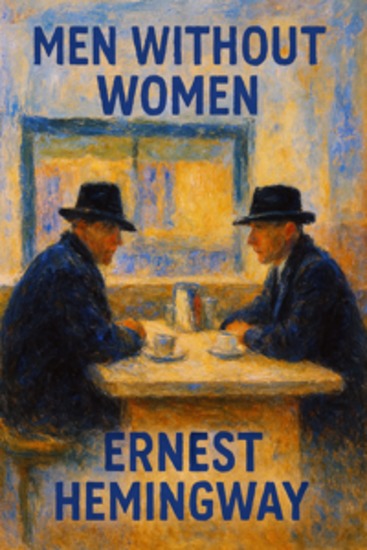
Men Without Women (Classicus Edition) - cover

Men Without Women (Classicus Edition)

Ernest Hemingway

Publisher: Classicus

  • 0
  • 0
  • 0

Summary

Men Without Women showcases Ernest Hemingway at the height of his powers, delivering fourteen taut, unforgettable short stories that reveal the stark truths of human experience. From the quiet menace of “The Killers,” where two hitmen wait in a small-town diner, to the fraught, elliptical conversation about abortion in “Hills Like White Elephants,” Hemingway’s writing is spare, unflinching, and charged with subtext. Each story strips life to its essentials, capturing moments of violence, longing, and fragile connection with unrelenting honesty.      A defining work of twentieth-century literature, this collection explores the emotional chasms between men and women, the aftershocks of war, and the struggles of those living on society’s margins. Hemingway’s trademark style—lean, understated, and richly suggestive—invites readers to read between the lines, finding meaning in what is left unsaid. The stories resonate with themes of loss and alienation, offering glimpses of human vulnerability beneath tough exteriors.      Men Without Women is an essential volume for lovers of literary fiction and modernist writing alike. This edition brings together some of Hemingway’s most celebrated and studied stories in a single, beautifully crafted collection. Whether you’re encountering his work for the first time or returning to appreciate its artistry anew, you’ll find in these pages the raw power and timeless appeal that made Hemingway one of the most influential authors of all time.
Available since: 07/01/2025.

Other books that might interest you

  • Another Freak - From their pens to your ears genius in every story - cover

    Another Freak - From their pens...

    Mary Angela Dickens

    • 0
    • 0
    • 0
    The bookshelves of British literature are incredible collections that have gathered together centuries of very talented authors.  From these Isles their fame spread and whilst among their number many are now forgotten or neglected their talents endure.  Among them is Mary Angela Dickens.
    Show book
  • A Legend of Old Egypt - From their pens to your ears genius in every story - cover

    A Legend of Old Egypt - From...

    Boleslaw Prus

    • 0
    • 0
    • 0
    Aleksander Głowacki who wrote under the nom de plume Boleslaw Prus was born on 20th August 1847 at Hrubieszów in the Kingdom of Poland, at that time, controlled by the Russian Empire. 
    At three his mother died and then at nine his father.  Female relatives helped raise him but at 15 he joined the Polish uprising against the might of Imperial Russia.  Wounded on the battlefield, arrested and imprisoned, he was later released into the care of a relative and resumed secondary school and then Warsaw University but poverty forced him to leave after two years.  At some point he developed agoraphobia which often caused problems. 
    In 1869, he enrolled in the Forestry Department at Puławy but was soon sacked and so he began a system of self-education that led to work as a newspaper columnist on a wide-ranging series of topics that eventually became the ‘Weekly Chronicles’ and spanned 40 years. 
    With his finances now stabilized he married and then adopted his late brother-in-law’s son.  
    It seems he had doubts as to the scale of his talents and early on adopted the name ‘Boleslaw Prus’ for both his journalistic and literary offerings. 
    His work as a short-story writer met with much acclaim. He wrote several dozen of them, originally published in newspapers and ranging in length from micro-story to novella. His keen observation of everyday life and sense of humor are evident in them.  
    During his career he also wrote novels. After ‘Pharoah’, in 1895, he embarked on a four-month journey taking in Berlin, Dresden, Nuremberg, Rapperswil in Switzerland, where he stayed for two months, and his final destination, Paris.  Here his agoraphobia was so bad he couldn’t cross the Seine.  
    However, his writing continued and in 1911 his novel ‘Changes’, though uncompleted, began to be serialised.  It was never finished. 
    Boleslaw Prus died on 19th May 1912, at his Warsaw apartment.  He was 64.  A National Hero, thousands attended both his funeral service and interment.
    Show book
  • LAMDA Verse and Prose Anthology: Volume 20 - cover

    LAMDA Verse and Prose Anthology:...

    Exams LAMDA

    • 0
    • 0
    • 0
    This anthology presents the set selection of verse and prose pieces for Learners entering LAMDA Graded Examinations in Communication: Speaking Verse and Prose from Entry Level to Grade 8, and LAMDA Introductory Graded Examinations from Stage 1 to Stage 3 (Solo and Group).
    The collection includes 155 pieces in total: a range of celebrated poems alongside prose extracts from bestselling classic and contemporary novels. It also features original material written specifically for this anthology, including the winner and runners-up of LAMDA Learners' Poetry Prize 2023. Also included is a foreword by Joseph Coelho, Waterstones Children's Laureate 2022–24.
    For Learners taking LAMDA Examinations, this anthology offers a wide choice of themes, topics and worlds to explore. With many performance possibilities, it is a perfect resource to help Learners practise and develop their communication skills. For the general reader, it is the ideal starting point for discovering contemporary poets and novelists, such as Maya Angelou, Malorie Blackman, Sally Rooney and Michael Rosen, as well as reconnecting with celebrated writers of the past, including Jane Austen, T. S. Eliot and William Wordsworth.
    Show book
  • Katherine Mansfield - Six of the Best - Their legacy in 6 classic stories - cover

    Katherine Mansfield - Six of the...

    Katherine Mansfield

    • 0
    • 0
    • 0
    Six has always been a number we group things around – Six of the best, six of one half a dozen of another, six feet under, six pack, six degrees of separation and a sixth sense are but a few of the ways we use this number. 
     
    Such is its popularity that we thought it is also a very good way of challenging and investigating an author’s work to give width, brevity, humour and depth across six of their very best. 
     
    In this series we gather together authors whose short stories both rivet the attention and inspire the imagination to visit their gems in a series of six, to roam across an author’s legacy in a few short hours and gain a greater understanding of their writing and, of course, to be lavishly entertained by their ideas, their narrative and their way with words. 
     
    These stories can be surprising and sometimes at a tangent to what we expected, but each is fully formed and a marvellous adventure into the world and words of a literary master.
    Show book
  • The Call of Cthulhu - cover

    The Call of Cthulhu

    H. P. Lovecraft

    • 0
    • 0
    • 0
    Title: The Call of Cthulhu 
    Author: H. P. Lovecraft 
    Narrator: Jonathan Dunne 
    Original Publication: 1928 
    Public Domain: Yes 
    Series Placement: Number 34 in the Timeless Terrors series 
    Description: 
    The Call of Cthulhu by H. P. Lovecraft is the cornerstone of cosmic horror — a vast and terrifying revelation that humanity is but a fleeting whisper beneath the gaze of ancient, indifferent gods. Told through fragmented reports, journal entries, and the haunted memories of those who have glimpsed forbidden truths, it weaves a chilling investigation into the cult of Cthulhu — a monstrous being sleeping beneath the Pacific, whose awakening would end all that we know. 
    Lovecraft constructs his myth through suggestion and implication, blending mystery, anthropology, and existential terror into a narrative that expands horror beyond the human scale. This is not merely a story of monsters, but of meaning undone — where sanity erodes in the face of incomprehensible reality. 
    Narrated by Amazon bestselling horror author  Jonathan Dunne, this performance captures the story’s investigative tension and creeping dread — the inexorable uncovering of truths too vast for the mind to hold. While the text itself is in the public domain, this narration is an original performance and copyright © 2025 Jonathan Dunne. 
    Part of Timeless Terrors, a series devoted to resurrecting the masters of the macabre, The Call of Cthulhu stands as Lovecraft’s defining vision — a tale of cosmic insignificance, ancient worship, and the terrible awakening of what should forever sleep. 
    Prepare for a descent into madness, mystery, and myth — where knowledge itself is the most dangerous horror of all.
    Show book
  • When I Was Dead - From their pens to your ears genius in every story - cover

    When I Was Dead - From their...

    Vincent O'Sullivan

    • 0
    • 0
    • 0
    Vincent O'Sullivan was born on the 28th November 1868 in New York City.  He was initially educated through the New York public school system before finishing his studies in England.  As a young man he remained in London and travelled often to Paris.  
    O’Sullivan lived a very comfortable life with income from the family coffee business.  He had no real need to work but decided that a literary lifestyle was for him.   
    In 1896 he released his first volume of supernatural fiction ‘A Book of Bargains’.  Within its pages were classic stories that involved pacts with the Devil, reanimated corpses and psychic vampires. 
    Over the course of his career, he wrote a mere 10 volumes of short stories, novels, poetry together with some occasional criticism. 
    In 1909 his brother, who ran the company, entered its resources into some terribly mis-timed trades in coffee futures and ruin for both the company and the family quickly followed. 
    From now until his death O’Sullivan was destitute, life was exceedingly difficult. 
    Vincent O’Sullivan died on the 18th July 1940 in Paris.  He was 71.  He was buried in a paupers grave along with the remains of others.
    Show book