Join us on a literary world trip!
Add this book to bookshelf
Grey
Write a new comment Default profile 50px
Grey
Subscribe to read the full book or read the first pages for free!
All characters reduced
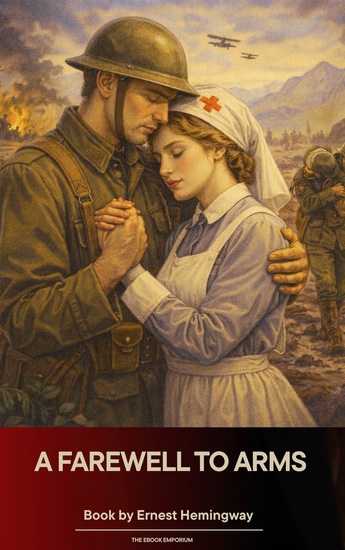
A Farewell to Arms - cover

A Farewell to Arms

Ernest Hemingway

Publisher: The Ebook Emporium

  • 0
  • 0
  • 0

Summary

Can love survive when the world is falling apart?

First published in 1929, A Farewell to Arms is one of Ernest Hemingway's most powerful and enduring novels. Set against the brutal realities of World War I, the story follows Frederic Henry, an American ambulance driver serving in the Italian army, whose life is transformed by his love for Catherine Barkley.

As war brings chaos, injury, and disillusionment, Hemingway explores the fragile hope of love in a world ruled by violence and chance. Written in his signature spare and direct style, the novel delivers deep emotional impact through restraint, honesty, and unforgettable moments of tenderness and loss.

More than a war story, A Farewell to Arms is a meditation on courage, fate, and the human need for connection in the face of suffering.

Inside this eBook, you'll experience:

A classic World War I novel grounded in realism

A tragic and deeply moving love story

Hemingway's iconic minimalist prose style

Themes of bravery, disillusionment, and endurance

Widely studied and celebrated as a cornerstone of modern literature, A Farewell to Arms remains essential reading for anyone drawn to classic novels, war fiction, and timeless love stories.

Say goodbye to illusions—and discover a novel that still speaks with quiet power. Buy now and experience one of Hemingway's greatest works.
Available since: 01/23/2026.
Print length: 144 pages.

Other books that might interest you

  • A Spectre Haunting - cover

    A Spectre Haunting

    China Miéville

    • 0
    • 0
    • 0
    In 1848, THE COMMUNIST MANIFESTO was published by two émigrés from Germany. Marx and Engels' apocalyptic vision of an insatiable system that penetrates every corner of the world reduces every relationship to that of profit, and burst asunder the old forms of production and of politics. It is still a recognisable picture of our world – the vampiric energy of the system being once again highly contentious. 
     
    The Manifesto is a text that shows no sign of fading into antiquarian obscurity. Its ideas animate in different ways the work of writers like Yanis Varoufakis, Adam Tooze, Naomi Klein and the journalist Owen Jones. 
     
    China Mieville is not a writer who has been hemmed in by conventional notions of expertise or genre, and this is a strikingly imaginative take on Marx and what his most haunting book has to say to us today.
    Show book
  • Secret Bloodlines - cover

    Secret Bloodlines

    Raphael Terra

    • 0
    • 0
    • 0
    This audiobook has been recorded using Text to speech (TTS). 
     
    We watch the news. We see war, disease, poverty, man against man. We see billions of poor people, displaced by the power brokers. We see the super rich getting richer. Many simply see the news, they don't understand or even try to. They don't know the bigger picture, the truth about what is really happening out there. 
     
    The truth is, what happens out there, affects us all. And all of those world events are happening, not by chance, but by design. All of our lives are being affected by just a few men. Those men are members of an elite group. Their ancestors plotted and schemed just as they do today. Their goals are short and long term. 
     
    They affect all levels of society. Lawmakers and enforcers, religious and political leaders, movie makers and media moguls, industrial giants and pharmaceutical murderers. 
     
    All around the world they work. Plotting and scheming, scheming and plotting. Nobody dares to speak out against them. Most don't even know. Through clever manipulation, marketing, propaganda and force, they control the world. These are not the people you're thinking of. These are not always the politicians who are often pawns themselves. 
     
    These people are members of a long line, a golden thread through history that stretches back thousands of years and can be traced through their own bloodline.
    Show book
  • The Rise and Fall of a Medieval Family - The Despensers - cover

    The Rise and Fall of a Medieval...

    Kathryn Warner

    • 0
    • 0
    • 0
    The Despensers were a baronial English family who rose to great prominence in the reign of Edward II (1307-27) when Hugh Despenser the Younger became the king's chamberlain, favorite, and perhaps, lover. He and his father Hugh the Elder wielded great influence, and Hugh the Younger's greed and tyranny brought down a king for the first time in English history and almost destroyed his own family. 


    The Rise and Fall of a Medieval Family tells the story of the ups and downs of this fascinating family from the thirteenth to the fifteenth centuries, when three Despenser lords were beheaded and two fell in battle. We begin with Hugh, Chief Justiciar of England, who died rebelling against King Henry III and his son in 1265, and end with Thomas Despenser, summarily beheaded in 1400 after attempting to free a deposed Richard II, and Thomas's posthumous daughter Isabella, a countess twice over and the grandmother of Richard III's queen. 


    From the medieval version of Prime Ministers to the (possible) lovers of monarchs, the aristocratic Despenser family wielded great power in medieval England. Drawing on the popular intrigue and infamy of the Despenser clan, Kathryn Warner's book traces the lives of the most notorious, powerful, and influential members of this patrician family over a 200 year span.
    Show book
  • Ancient Empires - A History of Etruscans and Phoenicians - cover

    Ancient Empires - A History of...

    Kelly Mass

    • 0
    • 0
    • 0
    This bundle consists of 3 short books, which are about the following subjects: 
    Subject 1: Nineveh was an age-old Assyrian city in Upper Mesopotamia, near Mosul in modern-day northern Iraq. It was the capital and biggest city of the Neo-Assyrian Empire, and the world's biggest city for some decades, and is on the eastern bank of the Tigris River. It's now a prevalent name for the portion of Mosul that's on the Tigris' eastern bank, and it is also the name of the nation's Nineveh Governorate. 
    It was the world's largest city for about fifty years till it was sacked by a union of its previous subject tribes, including but not limited to the Babylonians, Medes, Persians, Scythians, and Cimmerians, in the year 612 BC, following a severe period of civil dispute in Assyria.  
    Subject 2: The term "Phoenicians" describes the people living in Phoenicia, a sometimes-forgotten civilization that was age-old and remarkable. Let's check out the tradition, the history, and the specifics of Phoenicia. 
    Phoenicia was a thalassocratic (a state with mostly maritime worlds) society that thrived in the eastern Mediterranean's Levant area, mainly in modern-day Lebanon. It was fixated the coast of Lebanon, with some seaside parts of modern-day Syria and Galilee included for good procedure, varying as far north as Arwad and as far south as Acre and perhaps Gaza. 
    Subject 3: At its peak, the Etruscan society of age-old Italy covered circa what's now Tuscany, western Umbria, and northern Lazio, and areas of what's now the Po Valley, Emilia-Romagna, south-eastern Lombardy, southern Veneto, and small parts of Campania. 
    The first proof of an Etruscan society might be traced back to around 900 BC.
    Show book
  • Beyond Good and Evil - cover

    Beyond Good and Evil

    Friedrich Nietzsche

    • 0
    • 0
    • 0
    "Beyond Good and Evil" by Friedrich Nietzsche is a thought-provoking and challenging work that explores fundamental questions about morality, truth, and the nature of existence. In this book, Nietzsche offers a scathing critique of traditional morality and the idea of objective truth, arguing instead for a new ethical framework that is based on the individual will to power. Drawing on a wide range of philosophical and cultural influences, Nietzsche takes readers on a journey of self-discovery that challenges many of our most deeply held assumptions about the world. With its bold and original ideas, "Beyond Good and Evil" is a classic of Western philosophy that continues to inspire and challenge readers today.
    Show book
  • Qing Dynasty - China's Last Empire and the Dawn of Modernity - cover

    Qing Dynasty - China's Last...

    Rolf Hedger

    • 0
    • 0
    • 0
    The Qing Dynasty, China’s last imperial dynasty, emerged from the northeastern frontier, led by the Manchu people. Before establishing their rule over China, the Manchus were a semi-nomadic group descended from the Jurchens, who had previously ruled northern China under the Jin Dynasty. In the early 17th century, Nurhaci, a formidable leader, laid the foundation for Manchu power by unifying various Jurchen tribes and adopting administrative and military structures inspired by the Ming Dynasty. His successor, Hong Taiji, continued these efforts, formally establishing the Qing Dynasty in 1636. However, the conquest of China was still incomplete, as the Ming Dynasty continued to rule the heartland. 
    The decline of the Ming Dynasty provided an opportunity for the Qing to assert their dominance. By the early 17th century, the Ming government was weakened by internal corruption, peasant uprisings, and economic distress exacerbated by famine and mismanagement. The most devastating of these rebellions was led by Li Zicheng, a former postal worker turned insurgent, whose forces overran Beijing in 1644. The fall of the Ming capital marked a critical turning point. With the Ming emperor dead and the central government in disarray, a Ming general, Wu Sangui, faced a difficult choice: resist the rebel forces or seek outside aid. He chose the latter, opening the gates of the Great Wall at Shanhai Pass to the advancing Qing army. The Manchus, under the leadership of Prince Dorgon, seized the moment, swiftly capturing Beijing and declaring the establishment of Qing rule.
    Show book