Junte-se a nós em uma viagem ao mundo dos livros!
Adicionar este livro à prateleira
Grey
Deixe um novo comentário Default profile 50px
Grey
Assine para ler o livro completo ou leia as primeiras páginas de graça!
All characters reduced
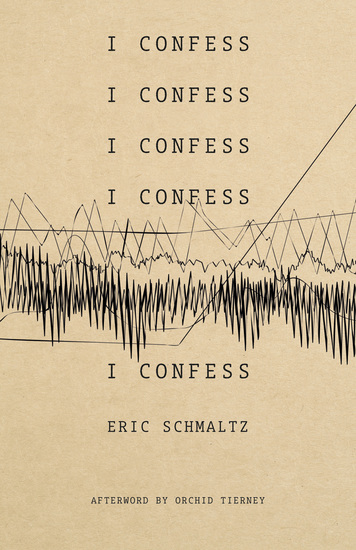
I Confess - cover
LER

I Confess

Eric Schmaltz

Editora: Coach House Books

  • 0
  • 0
  • 0

Sinopse

How is a lyric poem like a polygraph machine? A personal, poetic examination of the technology of truth-telling. 
Eric Schmaltz’s I Confess delves into the complexities of truth-telling in poetry, and the history of technologies designed to produce truth from willing and unwilling subjects, considering what it means to use a device – poetry or polygraph – to draw out one’s most profound feelings and emotions. 
Exploring the intersection of power, technology, and language, I Confess meditates on lie detection and its history, including trials by ordeal and pseudoscientific technologies. The poet then turns to his own personal experiences working with a lie detector and polygraph analyst. Taking himself as the central subject of the book, Schmaltz puts his subjectivity and positionality under scrutiny. 
The answers to questions such as What does family mean to you? and Can you describe a time when you felt your best? inspire a range of forms from conventional lyrical verse to list poems to palindromes to visual poems. With an afterword by Orchid Tierney, I Confess is a personal, poetic document of truth’s performance under duress.
Disponível desde: 09/09/2025.
Comprimento de impressão: 112 páginas.
Outros livros que poderiam interessá-lo

  • The Top 10 Poets – The Dublin Universities - Five poems each from the best poets to attend university in Dublin - cover

    The Top 10 Poets – The Dublin...

    Oscar Wilde, James Joyce, Thomas...

    • 0
    • 0
    • 0
    The language of Poetry is an art that most of us attempt at some point in our lives.  Although its commonplace exposure has been somewhat marginalised in today’s often fast-paced lives we all recognise good verse that can empathise with our thoughts or open us up to experience new things in new ways, to better understand and to enjoy the many strands of our lives. 
    But finding a starting point can be overwhelming, even off-putting, so in this series we offer up our Top 10 classic poets, who brim with talent and verse, on a range of subjects and themes that we can all enjoy. 
    The dreaming hallowed halls of Dublin may be one of the great educational establishments down the Centuries.  But it is also a place where the Nation’s young learn much more.  Within its walls, courtyards and cloisters these 10 Poets mused and illuminated on the beauty of poetry with eager yet tender words.
    Ver livro
  • This is not a poem - cover

    This is not a poem

    L. A. Cunningham

    • 0
    • 0
    • 0
    This is not a poem. 
    It's barely even a book. 
    It's one page making fun of poems that aren't poems. 
    And now it’s a 42-second audiobook too! Perfect for those long road trips and the busy individual with no time to sit down with a book.
    Ver livro
  • A Scent of Heaven - cover

    A Scent of Heaven

    Nkechi Ani Igwe

    • 0
    • 0
    • 0
    A Scent of Heaven is food for the soul lost in the dark night of the soul. This body of poems heals the wounds of the hopeless on every level-- many have found freedom in this text. Written as an ekphrastic text, the cover met Igwe with the telling of her story, and the stories of her people. These words are a radically honest approach to the altar of the soul, and the words invite you to join in this recounting of the body, mind and Spirit. Written by a living ancestor for other living ancestors--those who are wading the deep and dark at the bottom of the sea, here they found me a bit of me. This work is heavily influenced by Igwe's spiritual journey and her life existing between cultures: a quintessential, Nigerian brand of Christianity and her forays into the world of Odinani and ancestral veneration.
    Ver livro
  • The Black Man's Lament or How to Make Sugar - Poem by a 18th Century female author who was also an abolitionist pioneer - cover

    The Black Man's Lament or How to...

    Amelia Opie

    • 0
    • 0
    • 0
    Amelia Alderson, an only child, was born on the 12th November 1769 in Norwich, England. 
    After the death of her mother on New Year’s Eve 1784 she became her father's housekeeper and hostess. 
    The young Amelia was energetic, attractive, and an admirer of fashion.  She spent much of her youth writing poetry and plays and putting on local amateur theatricals.  At 18 she had published anonymously ‘The Dangers of Coquetry’. 
    Amelia married in the spring of 1798 to the artist John Opie at the Church of St Marylebone, in Westminster, and together they lived in Berners Street where Amelia was already living. 
    Her next novel in 1801 ‘Father and Daughter’, was very popular even though it dealt with such themes as illegitimacy, a socially difficult subject for its times.  From this point on published works were far more regular.  The following year her volume ‘Poems’ appeared and was again very popular.  Novels continued to flow and she never once abandoned her social activism and her call for better treatment of women and the dispossessed in her works.  She was also keenly involved in a love of society and its attendant frills. 
    Encouraged by her husband to write more she published Adeline Mowbray in 1804, an exploration of women's education, marriage, and the abolition of slavery.  
    Her husband died in 1807 and she paused from writing for a few years before resuming with further novels and poems.  Of particular interest was her short poem ‘The Black Man's Lament’ in 1826.  Her life now was in the main spent travelling and working for charities and against slavery.  She even helped create a Ladies Anti-Slavery Society in Norwich which organised a parliamentary petition of 187,000 names of which hers was the first name. 
    After a visit to Cromer, a seaside resort on the North Norfolk coast, she caught a chill and retired to her bedroom.  
    Amelia Opie died on the 2nd December 1853 in Norwich.  She was 84.
    Ver livro
  • Spring Forward Mrs James! - A novelization of the musical stage play - cover

    Spring Forward Mrs James! - A...

    JR. ROBERT C. BRABHAM, ALICE R....

    • 0
    • 0
    • 0
    The creator of Slinky, Dick James, was an engineer who took a mistake in his work place and saw the potential to make a mark on the world, and increase his fame and fortune. But he sacrificed and gave up his family and even his creation to chase after mere vapors of what he thought he wanted. He leaves Betty, his children, and the company in shambles with a load of debt. Betty, whose own background was lonely and left her desperate for love, rises to the occasion and pulls the family and the company out of the dark place they were left and they all find a better future. And, even notoriety. Betty even discovers love that is well beyond what she could imagine – in the people and family who surround her.
    Ver livro
  • Ars Poetica and Carmen Saeculare - cover

    Ars Poetica and Carmen Saeculare

    Quintus Horatius Flaccus (Horace)

    • 0
    • 0
    • 0
    The Ars Poetica, by Horace, also known as Epistula ad Pisones, is a treatise on poetry written in the form of a letter, and published around 18 B.C. In it, Horace defines and exemplifies the nature, scope and correct way of writing poetry. This work, inspired by the book of the same name by Aristotle, is one of the most influential in Latin literature, and the source of famous concepts in poetics, such as "in medias res" and "ut pictura poesis". The text itself is a poem in 476 dactilic hexameters. 
    The Carmen Saeculare, or "Song of the Ages", is a hymn written by Horace in 17 b.C. for the Ludi saeculares of the same year. It is believed that the poem was commissioned by the Emperor Augustus and sung by a choir of young men and women during the opening ceremony of the Games of the Century, a religious celebration that happened in Rome once every saeculum (century). The saeculum was considered to be the maximum length of a human life, which means the Games happened once every generation. The poem was written is nineteen sapphic stanzas, and in an elevated and religious tone. (Summary by Leni)
    Ver livro