¡Acompáñanos a viajar por el mundo de los libros!
Añadir este libro a la estantería
Grey
Escribe un nuevo comentario Default profile 50px
Grey
Suscríbete para leer el libro completo o lee las primeras páginas gratis.
All characters reduced
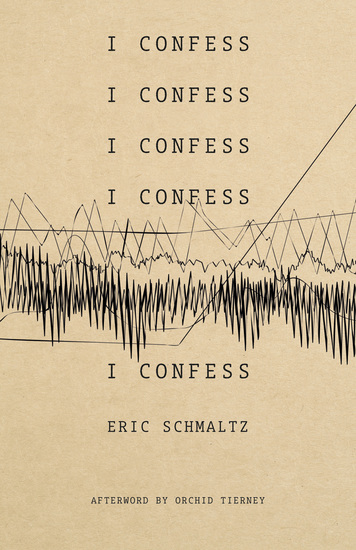
I Confess - cover

I Confess

Eric Schmaltz

Editorial: Coach House Books

  • 0
  • 0
  • 0

Sinopsis

How is a lyric poem like a polygraph machine? A personal, poetic examination of the technology of truth-telling. 
Eric Schmaltz’s I Confess delves into the complexities of truth-telling in poetry, and the history of technologies designed to produce truth from willing and unwilling subjects, considering what it means to use a device – poetry or polygraph – to draw out one’s most profound feelings and emotions. 
Exploring the intersection of power, technology, and language, I Confess meditates on lie detection and its history, including trials by ordeal and pseudoscientific technologies. The poet then turns to his own personal experiences working with a lie detector and polygraph analyst. Taking himself as the central subject of the book, Schmaltz puts his subjectivity and positionality under scrutiny. 
The answers to questions such as What does family mean to you? and Can you describe a time when you felt your best? inspire a range of forms from conventional lyrical verse to list poems to palindromes to visual poems. With an afterword by Orchid Tierney, I Confess is a personal, poetic document of truth’s performance under duress.
Disponible desde: 09/09/2025.
Longitud de impresión: 112 páginas.

Otros libros que te pueden interesar

  • Legends of the Caucasus - cover

    Legends of the Caucasus

    David Hunt

    • 0
    • 1
    • 0
    The Caucasus has an extremely rich folk literature, almost unknown among English speakers, which includes myths, legends, magical tales, anecdotes and proverbs. The one hundred and one legends included in this book reflect the cultures of fourteen different ethnic groups - their dynamism and the matters that concerned them: survival against external dangers, the risk of starvation and the persistence of the family or clan as a coordinated group. Descended from an oral tradition, much of their knowledge was retained in memories and passed down the generations. Yet, with the introduction of the alphabet, the way of life they portray is rapidly becoming extinct. An incomparable collection, Legends of the Caucasus conveys the poetry and romance of these swiftly vanishing tribes.
    Ver libro
  • A Spring Harvest - Edited by JRR Tolkien - cover

    A Spring Harvest - Edited by JRR...

    Geoffrey Bache Smith, Charles...

    • 0
    • 0
    • 0
    The poems of this book were written at very various times, one (“Wind over the Sea”) I believe even as early as 1910, but the order in which they are here given is not chronological beyond the fact that the third part contains only poems written after the outbreak of the war. Of these some were written in England (at Oxford in particular), some in Wales and very many during a year in France from November 1915 to December 1916, which was broken by one leave in the middle of May. “The Burial of Sophocles,” which is here placed at the end, was begun before the war and continued at odd times and in various circumstances afterwards; the final version was sent me from the trenches. Beyond these few facts no prelude and no envoi is needed other than those here printed as their author left them. J. R. R. T.
    Ver libro
  • Panic Response - cover

    Panic Response

    John McCullough

    • 0
    • 0
    • 0
    *SHORTLISTED FOR THE 2021 FORWARD PRIZE FOR BEST SINGLE POEM*
    From the mercurial mind of award-winning poet John McCullough comes his darkest and most experimental book to date. Panic Response puts personal and cultural anxiety under the microscope. It is full of things that shimmer, quiver and fizz: plankton glowing at low tide; brain tissue turning to glass; a basketball emerging from the waves, covered in barnacles. These are poems of uncertainty but also of hope, which move beyond the breathlessness of panic towards luminescence and solidarity.
    Ver libro
  • Top 10 Poets The - Oxford University - Five poems each from the best poets to attend Oxford university - cover

    Top 10 Poets The - Oxford...

    Percy Bysshe Shelley, Oscar...

    • 0
    • 0
    • 0
    The language of Poetry is an art that most of us attempt at some point in our lives.  Although its commonplace exposure has been somewhat marginalised in today’s often fast-paced lives we all recognise good verse that can empathise with our thoughts or open us up to experience new things in new ways, to better understand and to enjoy the many strands of our lives. 
    But finding a starting point can be overwhelming, even off-putting, so in this series we offer up our Top 10 classic poets, who brim with talent and verse, on a range of subjects and themes that we can all enjoy. 
    The dreaming spires of Oxford may be one of the great educational establishments of the Centuries.  But it is also a place where the Nation’s young learn much more.  Within its walls, courtyards and cloisters these 10 Poets mused and illuminated on the beauty of poetry with eager yet tender words.
    Ver libro
  • Tumbling for Amateurs - cover

    Tumbling for Amateurs

    Matthew Gwathmey

    • 0
    • 0
    • 0
    SHORTLISTED FOR THE 2023 FIDDLEHEAD POETRY BOOK PRIZEA reimagining of an instructional text on tumbling supports poems about the amateurishness of being human.  
    Tumbling for Amateurs is a reimagining of James Tayloe Gwathmey’s 1910 book of the same name, published as part of Spalding’s Athletic Library. Bookended with “Propositions” on why tumbling is a skill that everyone should learn and “Extracts from Letters of Support,” each verso poem in this collection pairs with a recto illustration based on drawings from the source text. In the spirit of William Blake’s Songs of Innocence and of Experience, word and image work for each other, creating something more than just an instructional manual.  
    Tumbling is, well, a metaphor for everything. And we all are, well, amateurs. Experimentation abounds in these poems and manipulated pictures. There are anaphoras, list sonnets, erasures, palimpsests and concrete poems, all working from tumbling’s limited vocabulary and central focus of acrobatics and gymnastics. In this experimentation of form and text is a search for the lyric, for an emotional connection when one isn’t always possible, in bodies, in movement, in desire. “We measure our lives by what our bodies can do.”  
    “We have no other way to touch each other. / Really no other way to touch each other. / We seek this particular exercise because / we have no other way to touch each other." Like the tumbling acts from which they spring, Gwathmey's poems are delightfully performative. They leap, loop, and reconfigure familiar forms into fresh and acrobatic new intimacies. Slyly queering his source text — an early 20th century tumbling manual for young men salvaged from the dusty closet of family history — Gwathmey transforms instruction into seduction as he conducts a tender and playful archeology of desire." – Suzanne Buffam, author of A Pillow Book 
    "Matthew Gwathmey’s poems, springboarding from a genre of fitness manual popular in the early twentieth century, tumble us into the present through tests gamily set for body and mind. As ripped as his gymnast protagonists—evoked so fetchingly in the book’s illustrations—Gwathmey writes a poetry eschewing the lyrical in favour of a stripped-down, athletic language that gives shape to 'what must remain / nameless.' There’re so many ways to read ourselves into Tumbling for Amateurs. Go toe to toe with these poems and they’ll tone up your grip on what poetry is."
      – John Barton, author of Lost Family 
    "Gwathmey's poems go together like a troupe, somersaulting through the vocabulary of the way a body moves. They turn the still past into this moving present." – Paul Legault, author of The Tower
    Ver libro
  • Selections From Through The Looking Glass and What Alice Found There - cover

    Selections From Through The...

    Lewis Carroll

    • 0
    • 0
    • 0
    A selection of poems by Lewis Carroll, as published by Macmillan and Co. 1972 in London. Includes popular poetry from the original publication such as Jabberwocky, Tweedledum and Tweedledee, and The Walrus and The Carpenter.
    Ver libro