Join us on a literary world trip!
Add this book to bookshelf
Grey
Write a new comment Default profile 50px
Grey
Subscribe to read the full book or read the first pages for free!
All characters reduced
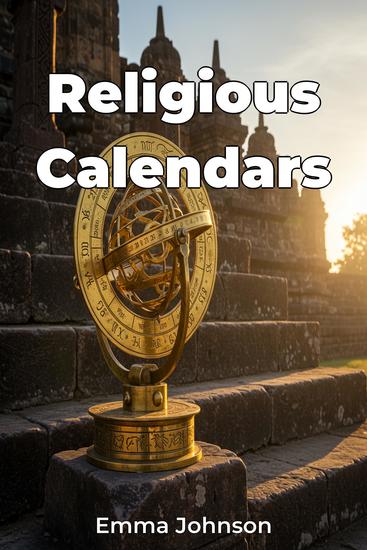
Religious Calendars - cover

Religious Calendars

Emma Johnson

Translator A AI

Publisher: Publifye

  • 0
  • 0
  • 0

Summary

Religious Calendars explores how religion profoundly influences our understanding of time by examining the diverse timekeeping systems used across various faiths. It reveals how calendars aren't just about marking days, but are integral to defining sacred moments, festivals, and life cycle events, reflecting core values and historical experiences.

 
Delving into Jewish, Christian, Islamic, Hindu, and Buddhist traditions, the book uncovers the intricate methodologies used to reconcile lunar and solar cycles, showcasing how cultural adaptations have shaped their evolution. For example, the Jewish lunar calendar connects to agricultural cycles and historical events like Passover, while the Islamic lunar calendar dictates a fixed cycle of religious observances.

 
This exploration isn't just historical; it extends to the modern world, considering the impact of globalization and secularization on these traditional systems. The book adopts a comparative approach, highlighting both the commonalities and differences in how cultures make sense of time within a divine context.

 
By drawing upon primary religious texts, historical documents, and insights from fields like anthropology and astronomy, Religious Calendars provides a comprehensive and interdisciplinary perspective. The book progresses from foundational principles to detailed analyses of specific calendars, culminating in discussions about their contemporary relevance and adaptation.
Available since: 03/06/2025.
Print length: 64 pages.

Other books that might interest you

  • Right This Way - A History of the Audience - cover

    Right This Way - A History of...

    Robert Viagas

    • 0
    • 0
    • 0
    When you sit down at a play, movie, or concert—or even in front of the TV or scrolling on your phone—you are taking part in one of the oldest and most mysterious forms of human behavior. Being part of an audience is an age-old experience that we all crave, one that has evolved from amphitheaters to screens. Right This Way is a pop history of audiences through the ages. Playbill editor Robert Viagas unfolds the unique aspects of what he calls “audiencing” with stories from the age of the Greeks to the world of Zoom. He walks through the different types of audiences and the history of their responses, what science has to say about how our brains respond to what they see and the reactions of the people around them, and why, during COVID-19, people risked a deadly virus to be part of a crowd. Right This Way explores what the audience experience brings us and how it may evolve in the 21st century.
    Show book
  • Leo Tolstoy: A short biography - 5 Minutes: Short on time – long on info! - cover

    Leo Tolstoy: A short biography -...

    5 Minutes, 5 Minute Biographies,...

    • 0
    • 0
    • 0
    Leo Tolstoy, Russian nobleman and most famous author: Life and work in a short biography! Everything you need to know, brief and concise. Infotainment, education and entertainment at its best!
    Show book
  • The Invention of Amsterdam - a history of Europe's greatest city in ten walks - cover

    The Invention of Amsterdam - a...

    Ben Coates

    • 0
    • 0
    • 0
    An essential guide to one of the world's most remarkable, and often misunderstood, cities by the author of Why the Dutch Are Different. 


    When Ben Coates injures his leg and needs to rebuild his strength by walking, he finds himself presented with an exciting opportunity: to rediscover the city he has been working in for over a decade, at a slower pace. He devises ten walks, each demonstrating a different chapter of Amsterdam's history, from its humble beginnings in the early 1200s as a small fishing community through two Golden Ages, fueled by the growth of the Dutch colonial empire, two world wars, and countless reinventions. 


    Join Coates as he meanders past beautiful townhouses and glittering canals, dances at Pride celebrations, witnesses the King's apology at Keti Koti, attends a WW2 memorial, gets high at a coffee shop, walks through the red-light district, and gazes in awe at Rembrandt paintings, all the while illuminating modern Amsterdam by explaining its past. 


    Blending travelogue and quirky history, The Invention of Amsterdam is an entertaining and sharply observed portrait of a fascinating and complicated city.
    Show book
  • Arthashastra or The Playbook of Material Gain - Pragmatic and amoral tips on how to gain defend and expand power from India’s greatest philosopher - cover

    Arthashastra or The Playbook of...

    Chanakya

    • 0
    • 0
    • 0
    Truly radical "Machiavellianism", in the popular sense of that word, is classically expressed in Indian literature in the Arthashastra of Kautilya (written long before the birth of Christ, ostensibly in the time of Chandragupta): compared to it, Machiavelli's The Prince is harmless.— Max Weber, Politics as a Vocation (1919)Chanakya's treatise, written while turning a farmhand into the emperor of the largest empire India had ever seen, focuses on how to manage an empire, covering everything from domestic policy and personal rights to assassination and the dirtier arts of politics. This is not, as with Plato’s Republic, a work of theory. Chanakya’s guidance is entirely practical, and is based on both his education and his experience building an empire. It lacks the philosophical ponderings and moralizing of its equivalent Western works (such as The Prince, The Republic or Leviathan) and instead focuses on how one deals with the messiness of the world in practice.People will occasionally refer to Chanakya as an Indian Machiavelli, but this does some discredit to Chanakya. The Prince is a satire, and focused around exposing the tactics and inhumanity of Cesare Borgia. Arthashastra is a manual for every aspect of statecraft, and while it deals in the unethical it does so only because that is, after all is said and done, one of the options available to a ruler.If you're after a totally pragmatic analysis of leadership, stripped of moralising and focused on what works and how to deal with real-world issues, this is the book for you.
    Show book
  • Attila The Hun And The History Of Hungary: 2 Books In 1 - The Scourge Of God & The Birth Of Hungary - cover

    Attila The Hun And The History...

    HISTORY FOREVER

    • 0
    • 0
    • 0
    ★ Did you know that Hungary once was considered one of the greatest powers in Central Europe? ★ 
    ★ Did you know that Attila The Hun was one of the greatest barbarian rulers in history? ★ 
    THIS BOOK INCLUDES 2 MANUSCRIPTS: 
    BOOK 1 - HUNGARIAN HISTORY: HUNGARY IN WORLD WAR 1 & 2, THE GOLDEN AGE OF FOOTBALL, THE WORST INFLATION EVER RECORDED AND THE COLLAPSE OF COMMUNISM 
    BOOK 2 - ATTILA THE HUN: THE SCOURGE OF GOD: A BRIEF HISTORY OF ATTILA AND THE HUNS TAKING OVER CENTRALL EUROPE (TODAYS HUNGARY) AND INVADING ROME 
    ★ GET THIS BOOK NOW AND DISCOVER WHAT IT TAKES TO BE A HUN TODAY! ★ 
    In book 1 you will discover;Austria-Hungary in World War 1The Hungarian Romanian War - 1919The Hungarian Soviet RepublicThe Treaty of Trianon - 1920Hungary Joining the Axis PowersHungary Attacking the USSR - 1941The German Invasion of Hungary - 1944Hungary before the Revolution of 1956The Hungarian Revolution of 1956The Golden Age of Hungarian footballWorst Inflation In World HistoryThe Collapse of Communism in Hungary 
    In book 2 you will discover;Why Attila was The Most Evil Men In HistoryAttila and the Huns OriginHow Attila took over GneissesHow Attila took over ConstantinopleWhy Attila went against the VisigothsBattle of the Catalaunian PlainsHow Attila Invaded the Western Roman EmpireHow Attila Broke RomeSeveral Disturbing Facts about Attila and the Huns 
    ★ GET THIS BOOK NOW AND DISCOVER WHAT IT TAKES TO BE A HUNGARIAN! ★
    Show book
  • Afghanistan War - cover

    Afghanistan War

    Introbooks Team

    • 0
    • 0
    • 0
    Unlike the war in Iraq which had entered its last stage, the war in Afghanistan appears to have several open ends. The security situation in Afghanistan has deteriorated greatly and no comprehensive political outcome has yet arrived. By early 2009, several members of Congress, the officials of the administration and the outside experts had concluded that the efforts known as the America’s “other war” required great national attention. In the inaugural address speech, the US President Barrack Obama had stated that the United States would forge a hard-earned peace in Afghanistan.  
    For the Afghanistan government, the war was an existential struggle for survival against the Taliban and other insurgents as well as the long-term efforts for the establishment of sustainable security and great stability. For the US government, the war in Afghanistan was concerned about the security of both Afghanistan and the surrounding regions. The concern also included the denial of the safe heaven to the terrorists and in ensuring the stable and constructive regional security balance. For the regional states which included Russia and India as well as the immediate neighbors of Afghanistan including Pakistan and Iran, the war in Afghanistan is critical as it can have a powerful impact on the future security and the balance of influence and power in the region. For the individual members of the NATO Alliance, the war might be the combination of defeating the terrorist networks, proving themselves as efficient NATO members, ensuring the regional stability and demonstrating the relevance of the Alliance of the security challenges of the 21st century.  
    Looking ahead, the United States government faces several operational and strategic decisions about the further engagement of Afghanistan in war. Some of the decisions include: 
    Clarification of the national interests of the United States in Afghanistan and the surrounding regions. 
    The definition of the clear strategic objectives which are based on the specified national interests. 
    The determination of the military, economic and diplomatic approaches which need to be adopted and what resources are committed to supporting the various kinds of approaches. 
    The prioritization of the war in Afghanistan war in comparison to the imperatives of the national securities which would include the war in Iraq and the preparation to meet the potential threats.  
    The helping of the marshal in a coordinated application of the international efforts.  
    The United States has argued over the security of Afghanistan since decades. As the world is working on building the national security in Afghanistan and the neighboring areas along with the local defense forces, there is still a great need to redouble the efforts at building up and strengthening the Afghan human capital and the proper institution of governance that would be able to stand up on its own one day as an effective and independent government.
    Show book