Junte-se a nós em uma viagem ao mundo dos livros!
Adicionar este livro à prateleira
Grey
Deixe um novo comentário Default profile 50px
Grey
Assine para ler o livro completo ou leia as primeiras páginas de graça!
All characters reduced
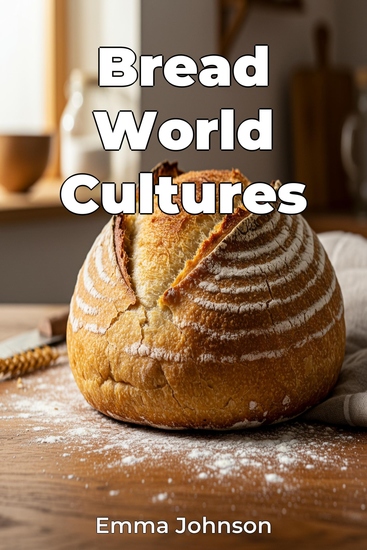
Bread World Cultures - cover
LER

Bread World Cultures

Emma Johnson

Tradutor A AI

Editora: Publifye

  • 0
  • 0
  • 0

Sinopse

"Bread World Cultures" embarks on a fascinating journey through the world of bread, revealing its historical, cultural, and culinary significance. This exploration of world cultures examines how breadmaking reflects a culture's agricultural practices, technological advancements, and social structures. The book delves into the evolution of flatbreads, sourdoughs, and leavened loaves, tracing their roots across global culinary traditions. Did you know that bread production mirrors societal changes, from the Fertile Crescent to modern bakeries?

 
The book's thematic approach begins with the origins of breadmaking and fundamental ingredients. It progresses through flatbreads in the Middle East and Asia, sourdough variations in Europe and North America, and the impact of commercial yeast worldwide. By examining these diverse forms, the book reveals the intricate connections between societies and how techniques have traveled across geographical boundaries. The cultural significance of bread is highlighted, showing how this seemingly simple food connects disparate cultures.
Disponível desde: 27/02/2025.
Comprimento de impressão: 62 páginas.

Outros livros que poderiam interessá-lo

  • Theodor Fontane: A short biography - 5 Minutes: Short on time – long on info! - cover

    Theodor Fontane: A short...

    5 Minutes, 5 Minute Biographies,...

    • 0
    • 0
    • 0
    Theodor Fontane, German poet and novelist: Life and work in a short biography! Everything you need to know, brief and concise. Infotainment, education and entertainment at its best!
    Ver livro
  • Moors The: The History of the Muslims Who Lived in North Africa and Europe during the Middle Ages - cover

    Moors The: The History of the...

    Editors Charles River

    • 0
    • 0
    • 0
    The term Moor is a historical rather than an ethnic name. It is an invention of European Christians for the Islamic inhabitants of Maghreb (North Africa), Andalusia (Spain), Sicily and Malta, and was sometimes use to designate all Muslims. It is derived from Mauri, the Latin name for the Berbers who lived in the Roman province of Mauretania, which ranged across modern Algeria and Morocco. Saracen was another European term used to designate Muslims, though it usually referred to the Arabic peoples of the Middle East and derives from an ancient name for the Arabs, Sarakenoi. The Muslims of those regions no more refer to themselves by that term than those of North Africa call themselves Moors. Maghreb, or al-Maghreb, is a historical term used by Arabic Muslims for the territory of coastal North Africa from Alexandria to the Atlantic Coast. It means “The West” and is used in opposition to Mashrek, “The East,” used to refer to the lands of Islam in the Middle East and north-eastern Africa. The Berbers refer to the region in their own language as Tamazgha. In a limited, precise sense it can also refer to the Kingdom of Morocco, the proper name of which is al-Mamlakah al-Maghribiyyah, “Kingdom of the West.” 
    The history of the Spanish Peninsula is closely bound to that of the Moors. The term “Spain” was not in wide use until the region was united by the monarchs of Aragon and Castile, and the Moors called the lands they ruled in the Iberian Peninsula Al-Andalus, traditionally thought to be an Arabic transliteration of Vandal, the Germanic tribe which briefly ruled the region in the early fifth century. The English name Andalusia derives from the Spanish Andalucia, which is still used by Spain to name its southern region. Not surprisingly, three religions attempting to coexist during medieval times resulted in nearly incessant conflicts.
    Ver livro
  • The Prince - cover

    The Prince

    Niccolo Machiavelli

    • 0
    • 0
    • 0
    Machiavelli needs to be looked at as he really was. Hence: Can Machiavelli, who makes the following observations, be Machiavellian as we understand the disparaging term? 1. So it is that to know the nature of a people, one need be a Prince; to know the nature of a Prince, one need to be of the people. 2. If a Prince is not given to vices that make him hated, it is unsusal for his subjects to show their affection for him. 3. Opportunity made Moses, Cyrus, Romulus, Theseus, and others; their virtue domi-nated the opportunity, making their homelands noble and happy. Armed prophets win; the disarmed lose. 4. Without faith and religion, man achieves power but not glory. 5. Prominent citizens want to command and oppress; the populace only wants to be free of oppression. 6. A Prince needs a friendly populace; otherwise in diversity there is no hope. 7. A Prince, who rules as a man of valor, avoids disasters, 8. Nations based on mercenary forces will never be solid or secure. 9. Mercenaries are dangerous because of their cowardice 10. There are two ways to fight: one with laws, the other with force. The first is rightly man's way; the second, the way of beasts. Support us at https://manifoldmedia.net/donate
    Ver livro
  • Vasco da Gama: A short biography - 5 Minutes: Short on time - long on info! - cover

    Vasco da Gama: A short biography...

    5 Minutes, 5 Minute Biographies,...

    • 0
    • 0
    • 0
    Vasco da Gama, discoverer and surveyor of the globe: Life and work in a short biography! Everything you need to know, brief and concise. Infotainment, education and entertainment at its best!
    Ver livro
  • About Man and God and Law - The Spiritual Wisdom of Bob Dylan - cover

    About Man and God and Law - The...

    Stephen Daniel Arnoff

    • 0
    • 0
    • 0
    About Man and God and Law is the story of how Bob Dylan sparked a revolution of the spirit and why it matters today. 


    Many of our assumptions about empathy, sensual pleasure, and the essence of work, community, country, race, and the divine have germinated in Bob Dylan's need to know what's blowing in the wind and how it feels. Tracing his work and vision through themes that have shaped religious and cultural history for millennia, Stephen Daniel Arnoff uncovers how Bob Dylan has re-enchanted ancient questions of meaning and purpose throughout popular culture, inspiring a pantheon of prophetic musicians along the way. This field guide to Dylan's spiritual wisdom aims to make good on the promise that if we look closely enough at his body of work—precisely at a moment when the world we thought we knew seems like uncharted territory—we can open up our eyes to see not only where we really are, but where we need to go.
    Ver livro
  • The Art Of War - The Classic Work With Comprehensive Annotations From The Greatest Chinese Commentators - cover

    The Art Of War - The Classic...

    Lionel Giles, Sun Tzu

    • 0
    • 0
    • 0
    There are many versions of this work in English, and it is included as a useful reflection once one has pondered Daoism’s key texts. The title is properly ‘'Sun Tzu's Military Method'. It was written at the time of the Dao and Zhuang Zi, several centuries before the Lieh Tzu. For fifteen hundred years, it was part of China’s canonical strategic anthology, which became known as the Seven Military Classics.In modern Anglophone culture it is often the only strategic text someone has read, supplanting and exceeding the previous dominant strategic text (von Clausewitz’s On War, 1832, tr. 1874). Leaders from Mao Zedong and Takeda Shingen to Võ Nguyên Giáp and Norman Schwarzkopf Jr. have explicitly acknowledged the book’s influence on them. This translation is notably the second major version of it in English. It follows a translation by Everard Ferguson Calthrop that Giles found deeply contemptible, as one can see from the introduction. It is important to note that most scholars do not consider the Art of War one of the classic Daoist texts. While it is a product and application of the philosophy, it is more of an exegetical monograph than a consideration of the philosophical underpinnings of Daoism. Much like the Zhuang Zi, it takes the core ideas and realizes them in specific practical situations. It does so with such certainty that many contest it as a ‘true’ Daoist work. As you will see from the discussions embedded elsewhere, the key Daoist texts value contradiction and paradox far too much to be as procedurally simple as the Art of War is.It is not clear that this criticism is fair, however. A much kinder perspective is that Daoism’s great failure is in its apparent lack of any utilitarian or social value. While Confucianism provides a balance, Sun Tzu’s work attempts to build a more practical version of Daoism than the key texts allow for.
    Ver livro