¡Acompáñanos a viajar por el mundo de los libros!
Añadir este libro a la estantería
Grey
Escribe un nuevo comentario Default profile 50px
Grey
Suscríbete para leer el libro completo o lee las primeras páginas gratis.
All characters reduced
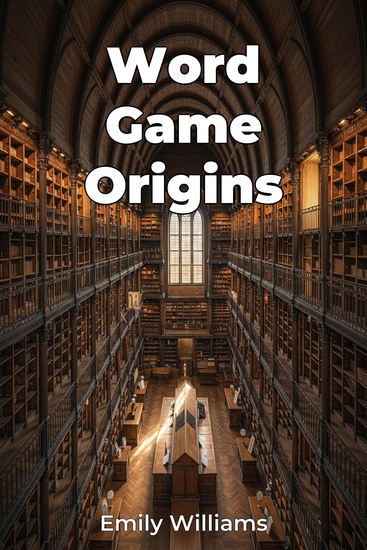
Word Game Origins - cover

Word Game Origins

Emily Williams

Traductor A AI

Editorial: Publifye

  • 0
  • 0
  • 0

Sinopsis

Word Game Origins explores the fascinating history and evolution of word games, revealing their significant impact on language acquisition, cognitive development, and cultural heritage. Going beyond mere entertainment, the book argues that games like Scrabble, anagrams, and word searches have played key roles in shaping our understanding and appreciation of language. Intriguingly, the book traces how early forms of linguistic puzzles were used in ancient civilizations for both education and amusement, later adapting across cultures to reflect unique linguistic traits. 

 
The book begins by laying a foundation of linguistic principles and cognitive processes before diving into specific games. Each chapter examines the historical roots, gameplay mechanics, and cultural impact of games like Scrabble and word searches. By drawing on historical documents, linguistic analyses, and game studies research, Word Game Origins connects language arts, history, and cognitive science, demonstrating how these games are powerful tools for learning, socializing, and cognitive enhancement.
Disponible desde: 31/03/2025.
Longitud de impresión: 63 páginas.
Otros libros que te pueden interesar

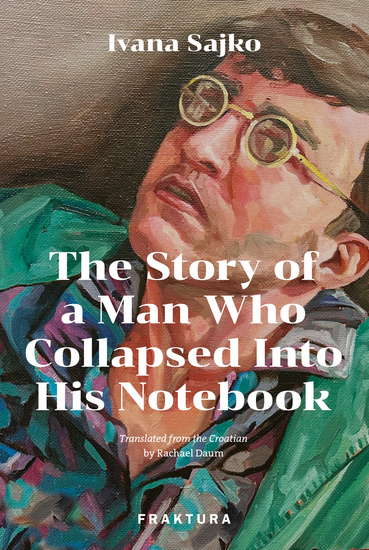
  • The Story of a Man Who Collapsed Into His Notebook - cover

    The Story of a Man Who Collapsed...

    Ivana Sajko

    • 0
    • 2
    • 0
    . . . I’ve forgotten how to travel, how to surrender to the favor and misfortune of the rails, how one says goodbye, how long one actually stands facing backward watching Point A swiftlydisappearing, and after that how long does he continue standing standing standing . . . I open my notebook, but I have no answer, I write: “traveling from Point A to Point B, from a littleseaside town to Berlin, I gaze out the window at the unfinished houses on the outskirts, warehouses in the industrial zone, stunted trees along the river with plastic bags hanging fromtheir branches like bats . . .”
     
    Sajko teases out the mental state and personal history of the protagonist, posing departure as a major theme that serves as a touchstone not only for our region [of Southeastern Europe] but also for the times we are living in. —Antonela Marušić, Novosti
     
    This is a stylistically superb novel, very readable. . . . And although this is a deeply personal text, it functions much more broadly, giving expression to the experiences, doubts, fears and all things encountered not only by this one, but a whole series of generations. —Matija Prica, booksa.hr
     
    The Story of a Man Who Collapsed Into His Notebook is about departures, childhood, the end of a relationship and the vanishing possibility in today’s world of fleeing to a better place. Written in the first person, each chapter a single sentence, the novel is an internal soliloquy of self-examination, an excavation of a life punctuated by upheaval and loss, hope and disillusionment, ambition and failure. The reader joins the narrator on his journey, both on the train and in his mind—from disjointed memories triggered by his departure from home, through attempts to put his relationships and experiences in some kind of order to find meaning in them and perhaps assign blame, to confronting his most painful memories—finally arriving with him at his destination with a sense of clarity and the possibility of a new beginning.
    Ver libro
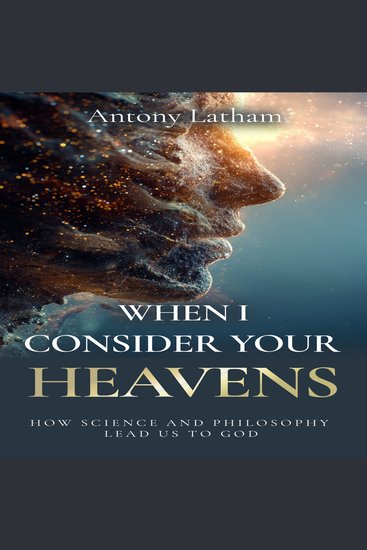
  • When I Consider Your Heavens - How Science and Philosophy Lead Us to God - cover

    When I Consider Your Heavens -...

    Antony Latham

    • 0
    • 0
    • 0
    In this thought-provoking book, Antony Latham shows how science and philosophy provide evidence for the existence of God. There was a beginning of the universe, which requires an explanation beyond itself. The exquisite fine-tuning of the physical laws necessary for life has all the hallmarks of design. Paleontology and biology show unmistakable signs of an intelligence behind life. Consciousness and free-will, inexplicable in purely physical terms, point to something beyond the material. The philosophy of beauty and morality leads us to an author of both. He argues that the universe is ‘open’—not simply the interaction of matter and energy, but a realm where miracles can happen. The evidence for the greatest miracle in history, the resurrection of Jesus, is carefully presented. 
    About the Author: 
    Antony Latham is a retired family doctor with nine years of experience working in hospitals in East Africa. He has authored books on Darwinism and the philosophy of mind, and holds a degree in Medical Law and Bioethics. Currently, he chairs the Scottish Council on Human Bioethics. He and his wife have four children and three grandchildren. They live in the Western Isles of Scotland, where he enjoys sailing and mountaineering.
    Ver libro
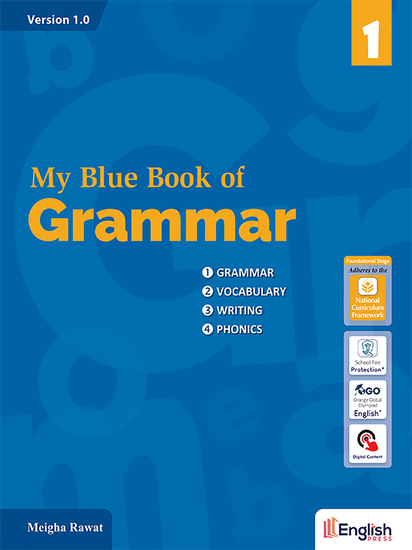
  • My Blue Book of Grammar for Class 1 - cover

    My Blue Book of Grammar for Class 1

    Meigha Rawat

    • 0
    • 0
    • 0
    A Grammar Series That Uses the Functional Approach
    
    KEY FEATURES 
    - Functional approach to grammar teaching, using exemplars to illustrate the usage before defining the structure and rules
    - Vocabulary taught through language-in-use to build the learners’ vocabulary through use rather than memorisation of rules
    - Contemporary topics to inculcate 21-century skills amongst learners
    - Use of literature to help learners understand how grammar is used in text
    - A comprehension section comprising texts from different genres so that learners may relate grammar to different types of works produced in English
    - Phonics in Grades 1 and 2 to teach the very basis of language
    - Uniquely stylised illustrations
    - Activities such as puzzles, crosswords, word grids and games to aid the facilitator in using the concept of ‘flipped classroom’
    - Periodic tests to help the learners self-assess the acquisition of concepts
    - Digital component to cater to a technology-driven classroom
    
    DESCRIPTION: 
    My Blue Book of Grammar is a course that has been conceptualized and designed keeping in mind the increasingly dynamic role of the English language in today’s world. Especially in our country, where English serves as the lingua franca, a grammar course has to offer not only an exposition of the pedagogy but also the exhibition of the utility of that pedagogy. The aim of a grammar series should be to encourage the development of competency amongst learners, even though their proficiency levels may vary. While the level of exposure to English of all learners may be different, a grammar series should aid in the development of a certain level of confidence amongst the learners, with the end result being that they are able to converse without hesitation in English. 
    
    WHAT WILL YOU LEARN
    - Understand grammar concepts
    - Learn how to use different vocabulary concepts taught through language-in-use 
    - Learn 21-century skills 
    - Develop deeper understanding of and appreciation for literature
    - Have clearer pronunciation through a better understanding of phonics
    
    WHO THIS BOOK IS FOR: 
    School students of Grades 1
    
    TABLE OF CONTENTS
    GRAMMAR
    1. Nouns
    2. Singular and Plural 
    3. Pronouns 
    4. Full Stop and Capitals 
    5. Verbs 
    6. Is and Are 
    7. Conjunction – and 
    8. Conjunction – but 
    9. Prepositions 
    10. Adjectives 
    VOCABULARY
    11. Three Magic Words 
    12. Compound Words 
    13. Missing Letters 
    14. Naming the Place 
    15. Opposites 
    16. Naming the Colours 
    Test Paper 1
    WRITING
    17. My Favourite Animal
    18. All About Me 
    19. My Favourite Toy 
    20. My Favourite Thing 
    21. My Grandparents 
    22. Joining Sentences 
    23. Making Sentences Using Prepositions 
    24. My School Building 
    PHONICS
    25. Consonants C and K 
    26. Plurals 
    27. fr Sound 
    28. S Blends – sk, sl and sn 
    29. S Blends – st, sw and sp 
    30. ph Words 
    31. th Sound 
    32. oo sound 
    33. tr sound 
    34. Digraphs – ch, sh and wh 
    35. Long and short a and e 
    36. Long and short i, o and u 
    Test Paper 2 
    Orange Global Olympiad – English Sample Paper
    Ver libro
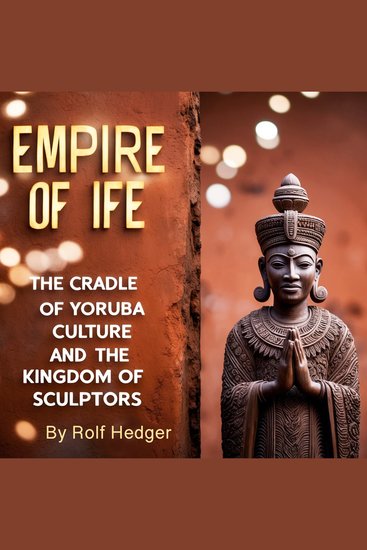
  • Empire of Ife - The Cradle of Yoruba Culture and the Kingdom of Sculptors - cover

    Empire of Ife - The Cradle of...

    Rolf Hedger

    • 0
    • 0
    • 0
    The origins of Ife are deeply rooted in mythology, oral traditions, and historical accounts, making it one of the most revered ancient cities in West Africa. Ife is often referred to as the cradle of the Yoruba civilization, a place where culture, religion, and governance took form. The story of its beginning is intertwined with Yoruba cosmology, particularly the legend of Oduduwa, who is considered the progenitor of the Yoruba people. 
    According to Yoruba mythology, Olodumare, the Supreme Being, entrusted Oduduwa with the sacred task of creating the earth. He descended from the heavens with a chain, a handful of earth, and a rooster. Upon reaching the watery expanse that covered the world, he spread the earth on the surface, and the rooster scattered it, forming the first landmass. This sacred land became known as Ile-Ife, meaning “The Land of Expansion.” Over time, Oduduwa and his followers established a kingdom that became the center of Yoruba civilization, laying the foundation for its political, spiritual, and artistic traditions. 
    Beyond mythology, historical and archaeological evidence suggests that Ife was already a flourishing city-state by the 9th century, possibly earlier. It grew as a hub of trade, attracting merchants and artisans from different parts of West Africa. Its strategic location allowed for the exchange of goods, ideas, and cultural practices, contributing to the city’s rapid development. The city’s early rulers, often referred to as the Oonis, played a crucial role in consolidating power and maintaining the harmony between religious and political institutions. The Ooni of Ife, regarded as both a king and a divine figure, acted as the intermediary between the people and the gods, reinforcing Ife’s status as a sacred city.
    Ver libro
  • Family Abolition - Capitalism and the Communizing of Care - cover

    Family Abolition - Capitalism...

    M.E. O’Brien

    • 0
    • 0
    • 0
    For some of us, the family is a source of love and support. But for many others, the family is a place of private horror, coercion, and personal domination. In a capitalist society, the private family carries the impossible demands of interpersonal care and social reproductive labor. Can we imagine a different future? 


    In Family Abolition, author M. E. O'Brien uncovers the history of struggles to create radical alternatives to the private family. O'Brien traces the changing family politics of racial capitalism in the industrial cities of Europe and the slave plantations and settler frontier of North America, explaining the rise and fall of the housewife-based family form. From early Marxists to Black and queer insurrectionists to today's mass protest movements, O'Brien finds revolutionaries seeking better ways of loving, caring, and living. Family Abolition takes us through the past and present of family politics into a speculative future of the commune, imagining how care could be organized in a free society.
    Ver libro
  • Thank You For Voting - The Maddening Enlightening Inspiring Truth About Voting in America - cover

    Thank You For Voting - The...

    Anónimo

    • 0
    • 0
    • 0
    In this concise, lively look at the past, present, and future of voting, a journalist examines the long and continuing fight for voting equality, why so few Americans today vote, and innovative ways to educate and motivate them; included are checklists of what to do before election day to prepare to vote and encourage others. 
    Voting is a prized American right and a topic of debate from the earliest days of the country. Yet in the 2016 presidential election, about 40 percent of Americans—and half of the country’s young adults – didn’t vote. Why do so many Americans choose not to vote, and what can we do about it?  
     
    The problem, Erin Geiger Smith contends, is a lack of understanding about our electoral system and a need to make voting more accessible. Thank You for Voting is her eye-opening look at the voting process, starting with the Framers’ perspective, through the Equal Protection amendment and the Voting Rights Act, to the present and simple actions individuals can take to increase civic participation in local, state, and national elections. 
    Geiger Smith expands our knowledge about our democracy—including women’s long fight to win the vote, attempts to suppress newly enfranchised voters' impact, state prohibitions against felons voting, charges of voter fraud and voter suppression, and other vital issues. In a conversational tone, she explains topics that can confuse even the most informed voters: polling, news literacy, gerrymandering and the Electoral College. She also explores how age, race, and socioeconomic factors influence turnout. 
    Ultimately, Thank You for Voting offers hope. Geiger Smith challenges corporations to promote voting, and offers examples of how companies like Patagonia and Walmart have taken up the task in a non-partisan way. And she reveals how get-out-the-vote movements—such as television star Yara Shahidi’s voting organization, Michelle Obama’s When We All Vote campaign, and on-the-ground young activists—innovatively use technology and grassroots techniques to energize first-time voters.  
    Supplemental enhancement PDF accompanies the audiobook.
    Ver libro