Join us on a literary world trip!
Add this book to bookshelf
Grey
Write a new comment Default profile 50px
Grey
Subscribe to read the full book or read the first pages for free!
All characters reduced
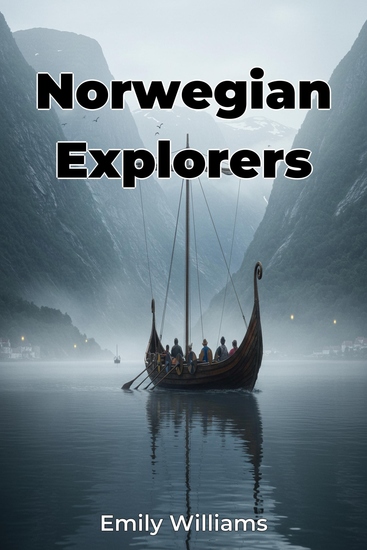
Norwegian Explorers - cover

Norwegian Explorers

Emily Williams

Translator A AI

Publisher: Publifye

  • 0
  • 0
  • 0

Summary

Norwegian Explorers explores the compelling history of Norwegian seafarers and their profound impact on global exploration and European maritime history. Driven by geographical realities, societal ambitions, and individual courage, these explorers navigated uncharted waters, leaving an indelible mark on our understanding of the world. The book highlights intriguing facts, such as the Vikings' surprisingly advanced navigational skills, which allowed them to reach North America centuries before Columbus, and the incredible scientific contributions of polar explorers like Fridtjof Nansen.

 
This book takes a multifaceted approach, progressing chronologically from the Viking voyages to the polar expeditions of the 19th and 20th centuries, and finally to the commercial and scientific expeditions that charted new territories. It examines the historical context, technological advancements like maritime technology, and the interplay of economic, scientific, and nationalistic motivations behind Norwegian exploration. By examining primary accounts and offering fresh translations, Norwegian Explorers provides a comprehensive and engaging narrative valuable to anyone interested in history, geography, or Scandinavian culture.
Available since: 03/20/2025.
Print length: 50 pages.

Other books that might interest you

  • Laws of Ancient World Vol 1: Mesopotamia - Code of Ur-Nammu Code of Lipit-Ishtar The Code of Hammurabi The Murder Case in Nippur - cover

    Laws of Ancient World Vol 1:...

    Andreas Asimis

    • 0
    • 0
    • 0
    Despite all of the imperfections present throughout Ancient Mesopotamian legislation, these laws of the ancient world are a priceless treasure influencing the history of judicial science.
    In ancient Mesopotamia, a written set of laws adopted by a ruler or his kingdom was quickly established as the foundational governing document. The emergence of royal decrees came about due to the special conditions surrounding the establishment and development of multiple federations due to war, coups, conquests, the formation of territorial and political treaties, the rise or fall in power of a particular ruler, or the rising supremacy of one ethnic group or another. 
    Contents:
    Chapter 1. Sources of Law: Mesopotamia
    Chapter 2. Code of Ur-Nammu (2100-2050 BC)
    Chapter 3. Code of Lipit-Ishtar (c.1870-1860 BC)
    Chapter 4. Code of Hammurabi
    Chapter 5. Judicial Precedent: The murder case in Nippur
    Show book
  • WORKBOOK & SUMMARY for How to Win Friends and Influence People by Dale Carnegie - cover

    WORKBOOK & SUMMARY for How to...

    BOOK TIGERS

    • 0
    • 0
    • 0
    Would you like to have more friends? 
    Would you like to be able to influence personal and business relationships to your advantage? 
    This book will show you exactly how to do it! 
    We all want friends and successful business relationships, but sometimes it can be challenging, especially if we are not from the same backgrounds. Knowing how to deal effectively with different people and having the confidence to interact effectively with them is a key skill for all of us if we want to get on in life and it can be learned quite quickly when you have the right tools at your disposal. 
    Inside the pages of the Workbook and Summary, of How to Win Friends and Influence People by Dale Carnegie, you will find out how he accomplished his goals and can help you reach yours, with chapters about:The fundamentals of dealing with othersHow to get people to like youMaking a great first impressionLearning the art of conversationAvoid making enemiesAdmitting your mistakes and when you are wrongDeveloping leadership qualitiesAnd much more… 
    This how to win friends and influence people book is a great place to start if you want to make serious changes in your life that will change the way you interact with the people you come into contact with. 
    It provides top tips on influencing others and getting them to see you as someone they would want to know, giving you the best chances of ultimate success in whatever you do! 
    Disclaimer: This is an UNOFFICIAL Workbook and summary, not the original book. 
    It is designed to record all the key points of the original and will provide you with an overview before or after reading the original.
    Show book
  • Roman Architecture - Building the Empire's Legacy - cover

    Roman Architecture - Building...

    Rogan Fish

    • 0
    • 0
    • 0
    Roman architecture emerged as a distinctive style that blended elements from earlier civilizations, primarily Greek and Etruscan influences. As Rome expanded from a small settlement into a powerful empire, its architectural identity evolved, incorporating new techniques and materials that allowed for grander and more functional structures. The early foundations of Roman architecture set the stage for innovations that would shape the empire’s urban landscape for centuries. 
    One of the most significant influences on Roman architecture came from the Etruscans, a civilization that dominated central Italy before Rome’s rise. The Etruscans were skilled builders who introduced techniques such as the use of the arch and vault, both of which would later become hallmarks of Roman engineering. Etruscan temples, with their high podiums and deep porches, also served as models for early Roman religious structures. Another major influence was Greek architecture, which Romans admired and adapted to suit their needs. The Greeks provided inspiration in the use of columns, decorative friezes, and symmetrical design, elements that were later integrated into Roman temples, public buildings, and monuments. 
    Roman architectural development was also shaped by advancements in building materials and construction techniques. The early Romans initially built using wood and mudbrick, but as they refined their skills, they transitioned to more durable materials like stone and concrete. The introduction of concrete was a groundbreaking innovation, allowing for stronger and more flexible structures. Unlike the Greeks, who relied heavily on marble, the Romans preferred concrete for its affordability and adaptability, enabling them to construct larger and more complex buildings, such as amphitheaters, aqueducts, and domes.
    Show book
  • Philosophers of Individual Rights and Society - The Role of Rights Ethics and Political Thought in Human Society (3 in 1) - cover

    Philosophers of Individual...

    Hector Davidson

    • 0
    • 0
    • 0
    This book consists of the following three titles: 
    - Ayn Rand: Ayn Rand, born Alisa Zinov'yevna Rosenbaum in 1905 in St. Petersburg, Russia, had a formative early life that significantly influenced her later philosophical ideas. Growing up in a middle-class Jewish family, Rand experienced the upheavals of the Russian Revolution and the subsequent rise of Bolshevism. These events deeply affected her worldview and instilled in her a strong opposition to collectivism and authoritarianism. 
    - John Stuart Mill: John Stuart Mill, a British philosopher and political economist, remains one of the most influential thinkers of the 19th century. Born in 1806, Mill was exposed to rigorous intellectual training from an early age, particularly through his father, James Mill, a prominent utilitarian philosopher. This early exposure shaped Mill's understanding of the world, leading him to become a key figure in the development of utilitarianism, a moral theory that evaluates actions based on their ability to promote the greatest happiness for the greatest number of people. 
    - Mary Wollstonecraft: Mary Wollstonecraft was a pioneering British writer and philosopher whose ideas on women’s rights and education laid the foundation for modern feminism. Born on April 27, 1759, in Spitalfields, London, she grew up in a time when society severely restricted women's opportunities. Despite these limitations, Wollstonecraft’s determination, intellect, and relentless pursuit of knowledge allowed her to challenge the status quo and advocate for gender equality. Her life was shaped by personal struggles, societal constraints, and an unwavering belief in the power of education.
    Show book
  • I'll Be Damned - How My Young and Restless Life Led Me to America's #1 Daytime Drama - cover

    I'll Be Damned - How My Young...

    Anonymous

    • 0
    • 0
    • 0
    In this startling candid and poignant memoir, the legendary Emmy Award-winning star of The Young and The Restless, America's #1 soap opera, chronicles his amazing life, from his birth in World War II Germany to his arrival in America to his rise to humanitarian and daytime superstar for the past thirty-five years. 
    For nearly four decades, fans have welcomed the star of television’s number-one daytime show, The Young and the Restless, into their living rooms. While they’ve come to know and love the suave Victor Newman, few truly know the man behind the character, the supremely talented Eric Braeden. I'll Be Damned is his story—a startling and uplifting true tale of war, deprivation, determination, fame, and social commitment that spans from Nazi Germany to modern Hollywood.  
    Braeden’s journey from a hospital basement in Kiel to the soundstages of Los Angeles has taught him more about joy, heartbreak, fear, dignity, loss, love, loneliness, exhilaration, courage, persecution, and profound responsibility to the global community than he could have hoped to learn in several lifetimes. Growing up in the years after Germany’s defeat, Braeden knew very little about the atrocities of his parents’ generation, until he arrived in America as a teenager—a discovery that horrified and transformed him. Trying to redress the wrongs of his homeland, he has dedicated his life to humanitarian work—even forming the German American Culture Society—working for decades to show the world that what we share as humans is far more important than what separates us from one another.  
    Told with openness, candor, humor, heart, and occasional raw vulnerability, I’ll Be Damned reveals a man committed to making the world a better, more loving place. I’ll Be Damned will be a treasured keepsake for Y&R fans, and is an inspiring testament to the goodness within us all.
    Show book
  • How Did Life End Up With Us? - The Secrets of Life: From Big Bang to Trump - cover

    How Did Life End Up With Us? -...

    Ss O'Connor

    • 0
    • 0
    • 0
    Why does the gene behave like a hedge fund manager? Why are mutations like a gambling scam? Why does nothing ever become top dog in life and win forever? Humans only arrived after 99.99% of the time there’s been life on earth. So what was here before us? And how did these species, and the evolutionary process that created them, end up with the unpromising creatures that were our ancestors?In this, the first book of The Secrets of Life quartet, SS O’Connor brings his outsider’s, questioning eye to reveal the great forces that lie behind life: from the laws that arose with Big Bang, through to the ‘decisions’ that organisms make to determine their chances.But how did everything come about? And what made some life forms succeed - while others would join the 99.9% of species that appeared, yet went on to become extinct? The story goes right back to our single-celled forebears - the only things that were on the planet for 80% of its existence, and then continues as it lays out the ways that successive transmissions built increasing complexity, and how the resulting species found their synergistic ways of coexisting.  In an easy-going, conversational style, O'Connor explains in lay-man's language how the gene is the great conductor of life’s orchestra, how it helped millions of life forms to refine themselves - yet why it also sees failure, death and extinctions as opportunities rather than disasters.  Last, the book tells the story of the men who unpicked the mysteries, what they meant by fitness and ‘the fittest’, but why they continued to be baffled by organisms that broke the rules by helping each other. Why would some even choose to be sterile when producing the next generation was the overriding compulsion in life? And why would the answer to this question explain why altruism is the proof for the ‘gene-based theory of evolution’ - and why cooperation was to become the strongest force in life?
    Show book