Junte-se a nós em uma viagem ao mundo dos livros!
Adicionar este livro à prateleira
Grey
Deixe um novo comentário Default profile 50px
Grey
Assine para ler o livro completo ou leia as primeiras páginas de graça!
All characters reduced
Victory Celebrations - cover
LER

Victory Celebrations

Emily James

Tradutor A AI

Editora: Publifye

  • 0
  • 0
  • 0

Sinopse

Victory Celebrations explores the profound role of societal celebrations, from sports championships to the end of wars, as powerful social rituals. These collective displays of joy are not mere outbursts but reflections of deeply ingrained cultural values and shapers of collective identity. Examining these celebrations offers insight into how societies reinforce social bonds and transmit cultural narratives. For instance, victory celebrations can solidify a new social order after political revolutions. The book delves into the historical evolution of these practices, revealing how religion, politics, and social structures have shaped celebratory rituals over time. It offers a structured approach, starting with the psychological and sociological underpinnings of victory celebrations. It progresses from examining sports, where celebrations reflect national identity, to exploring the complex emotions surrounding the end of conflicts and the ideals promoted by freedom movements. By analyzing a diverse range of historical accounts, sociological studies, and media analysis, Victory Celebrations challenges the conventional view of celebrations as superficial occurrences. It positions them as essential tools through which societies define themselves, highlighting their impact on political outcomes and their potential for both inclusion and exclusion. This interdisciplinary approach makes it uniquely valuable for understanding the hidden meanings and social functions of victory celebrations.
Disponível desde: 06/03/2025.
Comprimento de impressão: 56 páginas.


Outros livros que poderiam interessá-lo

  • Viracocha: The History and Legacy of the Inca’s Creator God - cover

    Viracocha: The History and...

    Editors Charles River

    • 0
    • 0
    • 0
    Although the Inca’s oral traditions suggested that the history of the region began with their empire, the various gods and the religious ceremonies of the peoples that inhabited the Inca’s lands before their arrival were assimilated into the Inca Empire and were incorporated into Inca religion. However, under Inca rule, all those gods were to be subordinate to those gods of the Incas themselves, so as to ensure that imperial authority was clear and without dispute among all quarters of the empire.  
    	Viracocha was the primary god in the Inca pantheon as the origin and creator of all things. His son, the god Inti, or the Sun, was married to Mama Quilla, the Moon, who was also created by Viracocha. According to one myth, Inti was the father of Manco Cápac, the founder of the Inca ruling dynasty, but it was believed by some that Viracocha himself fathered Manco Cápac. In practice, the Inca centered their religious worship on Inti, and this god's High Priest was the second most important person in Inca society. The god Inti was honored at an annual celebration held each June, and the Inti Raymi festival included sacrifices, feasts and sexual abstinence. This cosmology was imposed throughout the empire, and temples to the Sun were constructed and staffed by religious officials who were allotted farmland called “lands of the Sun.” Other local cults were provided with produce from these lands as well.  
    	The main temple of Inca religion was the Coricancha or Sun Temple in Cuzco, in which was kept the great golden disk of the Sun. The disk was appropriated by the Spanish in 1571 and sent off to the Pope. While it has disappeared, perhaps lost somewhere during the tortuous route to Spain, it remains alive in the fabulous world of adventure story writers, New Age mystics and manufacturers of souvenirs. It became a major element in the iconography of the 19th century independence movement in South America.
    Ver livro
  • Female Fear Factory - Unravelling Patriarchy's Cultures of Violence - cover

    Female Fear Factory -...

    Pumla Dineo Gqola

    • 0
    • 0
    • 0
    "Patriarchy does not respect national boundaries. It is unabashedly promiscuous in its influences and tethers. Yet, it does use nationalism very productively."
    
    An empty street at night. A crowded bus. A lecture hall. All sites of female fear, instilled in women and those who have been constructed female, from an early age.
    
    Drawing on examples from around the world - from Uganda, Nigeria, South Africa to Saudi Arabia, the Americas and Europe, Gqola traces the construction and machinations of the female fear factory by exposing its lies, myths, and seductions. She shows how seemingly disparate effects, like driving bans, street harassment, and coercive professors, are the product of the ever-turning machinery of the female fear factory, and its use of fear as a tool of patriarchal subjugation and punishment.
    
    Female Fear Factory: Unravelling Patriarchy's Cultures of Violence is a sobering account of patriarchal violence in the world, and a hopeful vision for the work of unapologetic feminist imaginative strategies across the globe.
    Ver livro
  • Cactus Country - A Boyhood Memoir - cover

    Cactus Country - A Boyhood Memoir

    Zoë Bossiere

    • 0
    • 0
    • 0
    A STRIKING MEMOIR OF GENDERFLUIDITY, CLASS, AND THE AMERICAN SOUTHWEST 
     
    Newly arrived in the Sonoran Desert, eleven-year-old Zoë enters a world of giant beetles, thundering javelinas, and gnarled palo verde trees. In Cactus Country RV Park, Zoë has been given a fresh start and a new, shorter haircut. Although Zoë doesn’t have the words to express it, he experiences life as a trans boy—and here, others begin to see him as a boy, too. Zoë spends hot days chasing shade and freight trains with an ever-rotating pack of sunburned desert kids, and nights fending off his own questions about the body underneath his baggy clothes. 
     
    As Zoë enters adolescence, he must reckon with the sexism, racism, substance abuse, and violence endemic to the working-class men he’s grown close to, whose hard masculinity seems as embedded in the desert landscape as the cacti sprouting from parched earth. In response, Zoë adopts an androgynous style and new pronouns, but still cannot escape what it means to live in a gendered body, particularly when a fraught first love destabilizes their sense of self. But beauty flowers in this desert, too. Zoë persists in searching for answers, dreaming of a day they might leave the park behind to embrace whatever awaits beyond. 
     
    Equal parts harsh and tender, Cactus Country is a precisely rendered journey of self-determination that will resonate with anyone who’s ever had to fight to be themself. 
     
    “Cactus Country shimmers with the complexity of becoming. Zoë Bossiere writes their way into a truer story of selfhood, resisting the simpler narratives the world demanded. The result is lush, beautiful, and deeply liberating.”—Alex Marzano Lesnevich, author of The Fact of a Body
    Ver livro
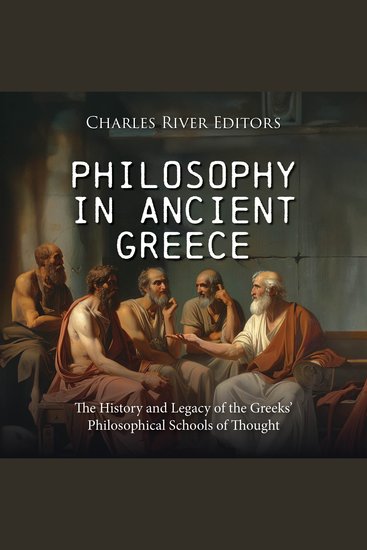
  • Philosophy in Ancient Greece: The History and Legacy of the Greeks’ Philosophical Schools of Thought - cover

    Philosophy in Ancient Greece:...

    Editors Charles River

    • 0
    • 0
    • 0
    In virtually all fields of human endeavor, ancient Greece was so much at the forefront of dynamism and innovation that the products of its most brilliant minds remain not only influential but entirely relevant to this day. In the field of medicine, the great physician Hippocrates not only advanced the practical knowledge of human anatomy and caregiving but changed the entire face of the medical profession. The great philosophers of Athens, men like Aristotle, Socrates, and Plato, interrogated themselves with startling complexity about the nature of good and evil, questioned the existence of divinity, advocated intelligent design, and went so far as to argue that all life was composed of infinitesimal particles.  
    	Although the school of philosophy started by Socrates and championed by Plato and Aristotle continues to be the most famous, other schools of thought began to branch, including the Epicureans and Cynics. In the 3rd century B.C., Stoicism arose in response to and under the influence of these older schools, combining many of the best theories from each into a more cohesive whole. With a greater flexibility and more practical application to everyday life, Stoicism quickly became a very popular school of thought, a growth made exponential by its introduction to the Romans.  
    Today, very few have heard of him, but he became a major philosophical and religious figure through the publication of his thoughts, travels, and miracles by Philostratus the Elder (c. 170-247 A.D.), written about a century after Apollonius of Tyana’s death. Philostratus the Elder’s works were based on the works of other writers (Maximus of Aegae, Damis, and Moeragenes), and miracles attributed to Apollonius were often compared to those of Jesus, who lived around the same time. 
    Ver livro
  • Wet Lesbian Sexy Surprises - 6 Erotic Stories - cover

    Wet Lesbian Sexy Surprises - 6...

    Giselle Renarde

    • 0
    • 0
    • 0
    Pure liquid gold awaits you in "Wet Lesbian Sexy Surprises," a spicy anthology of six fetish stories that explore the intoxicating allure of women who share an erotic fixation. Each tale invites you into the world of BDSM as lesbians explore their deepest desires and succumb to the pull of undeniable attractions. 
    Indulge in tantalizing encounters between roommates, strangers, and committed couples. From the sizzling tension between a security guard and a woman stuck in an underground parking garage to the complex passion between a couple on vacation, these stories offer a mesmerizing glimpse into the world of lesbian romance and fetish exploration. 
    Sapphic sexuality fuses with the arts of domination and submission as "Wet Lesbian Sexy Surprises" beckons you to explore desperate desire in six stunning encounters.  
    Read by the author
    Ver livro
  • Grande Armée and Wellington’s Scum The: The History and Legacy of the French and British Armies during the Napoleonic Wars - cover

    Grande Armée and Wellington’s...

    Editors Charles River

    • 0
    • 0
    • 0
    Nearly 50 years after Napoleon met his Waterloo, generals across the West continued to study his tactics and engage their armies the same way armies fought during the Napoleonic Era. Despite advances in military technology and the advent of railroads for transportation, all of which made defensive warfare more effective, acclaimed military geniuses like Robert E. Lee used flank attacks and infantry charges against superior numbers in an effort to win decisive victories, and it would not be until World War I that concepts of modern warfare made the Napoleonic Era of the early 19th century outdated. 
    Napoleon’s enemies would famously say he was worth 50,000 men in the field, but the simple truth is he wasn’t able to dominate Europe on his own. In fact, the subordinates and soldiers underneath him participated in several of history’s most famous battles and charted the course of Napoleon’s rise and fall. No single factor can account for these victories, which could be attributed to a combination of high morale, a truly egalitarian approach to promotion from the ranks, a radical army organization, and the inspired leadership of Napoleon, all of which combined to make the Grande Armée virtually unbeatable for the first few years of its existence. 
    The 18th century was a tumultuous period for the British army, one often overlooked in popular accounts of British history. It began with the formal unification of Britain, a period of great success for the nation's armies, which were led by one of Britain's greatest generals, the Duke of Marlborough. This was followed by a period of global activity and military reform as the British Empire expanded. Though naval power played a greater part in this success, it led to new obligations and challenges for the army. Even as the empire soared to new heights, the 18th century was one that was initially marked by triumph but ended in failure and decline. 
    Ver livro