¡Acompáñanos a viajar por el mundo de los libros!
Añadir este libro a la estantería
Grey
Escribe un nuevo comentario Default profile 50px
Grey
Suscríbete para leer el libro completo o lee las primeras páginas gratis.
All characters reduced
'Up the Country': Letters Written to Her Sister from the Upper Provinces of India - cover

'Up the Country': Letters Written to Her Sister from the Upper Provinces of India

Emily Eiden

Editorial: DigiCat

  • 0
  • 0
  • 0

Sinopsis

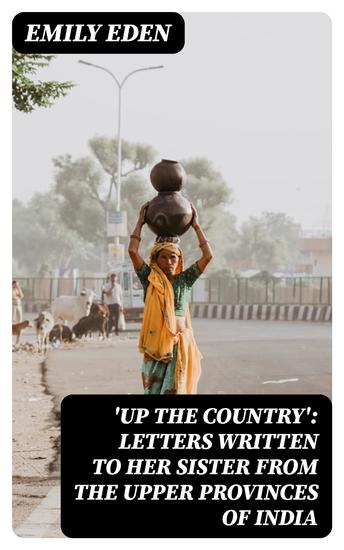
In "Up the Country: Letters Written to Her Sister from the Upper Provinces of India," Emily Eden presents a vibrant and intimate portrait of colonial India during the mid-19th century. Through a series of letters crafted with keen observational detail and a narrative style that balances personal reflection with astute social commentary, Eden encapsulates her experiences in the upper provinces. The correspondence reflects a microcosm of British colonial life, revealing the landscapes, cultural dynamics, and challenges faced by women in a foreign milieu, all while employing a voice that is both engaging and earnest. Emily Eden, a notable figure from a British aristocratic family, embarked on her journey to India as the sister of Lord Auckland, the Governor-General of India. Her aristocratic background and first-hand experiences as an educated woman in a colonial setting afford her letters a unique authenticity and depth. Eden's insights into the complexities of both British and Indian cultures stem from her privileged position, endeavoring to reconcile her identity within a rapidly changing imperial landscape. This captivating collection is highly recommended for readers interested in colonial history, women's perspectives, and travel literature. Eden's eloquent prose and vivid descriptions not only offer a glimpse into a distant world but also provoke reflections on the narratives of power, identity, and belonging in an era marked by cultural exchange and conflict.
Disponible desde: 28/05/2022.
Longitud de impresión: 269 páginas.

Otros libros que te pueden interesar

  • National Park Mysteries & Disappearances - The Pacific Northwest (Oregon Washington and Idaho) - cover

    National Park Mysteries &...

    Steve Stockton, Bill Melder

    • 0
    • 0
    • 0
    Some of the most visited national parks in the country have a dark side. 


    Aside from crowds of hikers, campers, and general tourists, there’s a dark side to many that can be found in the great states of Oregon, Washington and Idaho. From strange disappearances, grisly murders and bone-chilling paranormal hauntings and ghost sightings; these pristine locales have a lot more to offer than just serene hiking trails or camping. In this third installment of National Park Mysteries & Disappearances, Steve Stockton, along with Bill Melder, presents the listener with a side to these locations you've never heard before. 


    So, put aside your nature guidebooks, forget about the pretty leaves, and the relaxing streams as well as the miniature golf, the funnel cakes and all the other "tourist traps" and prepare for a wild ride on the dark side of these major national parks.
    Ver libro
  • His Final Tomb - A Disturbing True Story of John Jones And The Nutty Putty Cave Incident - cover

    His Final Tomb - A Disturbing...

    Daniel Turmoil

    • 0
    • 0
    • 0
    With only three days remaining until Thanksgiving, the day was graced by beautiful, sunny weather. A bright and intelligent medical student decided to embark on an adventure to explore a popular and intriguing cave, which was considered suitable for beginners. Despite everything appearing to go smoothly, a single mistake changed the course of events. Taking a wrong turn led to a tragedy that continues to evoke speculation and terror even today. This tragic incident is famously known as The Nutty Putty Cave incident.
    Ver libro
  • The Punjab - Understanding the Sikh in India Pakistan and Other Regions - cover

    The Punjab - Understanding the...

    Kelly Mass

    • 0
    • 0
    • 0
    Punjab could be mainly in Pakistan at this moment, but the Punjabi people live and have resided in India also. As disputes emerged between the Indians and Pakistani, the border has moved from one area to another. Still, the Punjabi society is probably a vital aspect of India's history. 
    Punjab is a geopolitical, cultural, and historic area in South Asia, situated in the northern area of the Indian subcontinent and incorporating parts of Pakistan and India. The area's limitations are ill-defined and based upon historic accounts. 
    With time, the geographical definition of the name "Punjab" has moved. It described a really minimal terrain between the Indus and the Sutlej rivers at the time of the Mughal Empire's 16th century reign. 
    So, if this is your cup of tea, I invite you to get started with this book. You will learn about this interesting people, who value their religion and their traditions more than anything, and who stick to old habits despite of technological advances.
    Ver libro
  • Sui Dynasty - Reunification and the Grand Canal Legacy - cover

    Sui Dynasty - Reunification and...

    Rolf Hedger

    • 0
    • 0
    • 0
    The period before the rise of the Sui Dynasty was marked by fragmentation and instability, as China remained divided between the Northern and Southern Dynasties. This era, which lasted from the late 4th century to the late 6th century, was characterized by constant warfare, shifting alliances, and a deep cultural divide between the north and south. The fall of this system set the stage for the reunification of China under the Sui Dynasty. 
    The north was ruled by a succession of non-Han Chinese states, often founded by nomadic groups that had migrated into China during the decline of the Western Jin Dynasty. The Northern Wei, established by the Tuoba clan of the Xianbei people, was the most powerful of these states. Over time, the rulers of the Northern Wei adopted Chinese customs, Confucian governance, and Buddhism, which helped stabilize their rule. However, internal struggles, court intrigue, and opposition from powerful aristocratic families led to the dynasty’s division into the Eastern and Western Wei, eventually giving rise to the Northern Qi and Northern Zhou dynasties. 
    In contrast, the Southern Dynasties were ruled by Han Chinese elites who maintained a more traditional Chinese way of life. The Eastern Jin, followed by the Liu Song, Southern Qi, Liang, and Chen dynasties, governed the southern regions, centered around the lower Yangtze River. These dynasties often suffered from weak central control, as powerful noble families exerted significant influence over the government. While the south was culturally rich and economically prosperous, political instability and frequent coups weakened its ability to resist northern invasions.
    Ver libro
  • Teotihuacan Empire - The City of the Gods and the Forgotten Giants of Mesoamerica - cover

    Teotihuacan Empire - The City of...

    Rolf Hedger

    • 0
    • 0
    • 0
    Teotihuacan, known as the "City of the Gods," remains one of the most enigmatic civilizations of ancient Mesoamerica. Its origins date back to around 400 BCE, when small settlements began to emerge in the Valley of Mexico. Over the centuries, these settlements merged, gradually forming what would become the largest and most influential city of its time. The exact reasons for its rise are still debated, but archaeologists believe that a combination of favorable geography, trade opportunities, and sociopolitical factors contributed to Teotihuacan’s emergence as a dominant power. 
    The valley’s rich volcanic soil provided fertile land for agriculture, supporting crops such as maize, beans, and squash. The region was also strategically located along key trade routes, allowing early inhabitants to engage in commerce with neighboring cultures. As the population grew, so did the need for organization, leading to the development of complex social structures. Unlike other civilizations that revolved around a single ruling dynasty, Teotihuacan appears to have been governed by a collective leadership, possibly a council of elites who controlled different aspects of city life. 
    One of the most intriguing aspects of Teotihuacan’s early history is the origin of its name. The Aztecs, who discovered the abandoned ruins centuries later, named it "Teotihuacan," meaning "the place where gods were born." This suggests that even in ancient times, the city held a sense of divine significance. Mythology and spiritual beliefs were deeply intertwined with its development, as seen in its grand temples and pyramids, which were aligned with celestial movements.
    Ver libro
  • A Suitcase Full of Koalas - cover

    A Suitcase Full of Koalas

    Fil Bufalo

    • 0
    • 0
    • 0
    A Suitcase Full of Koalas is a modern, edgy travel book set to test your wits and memory for detail. Gallivanting around London and somewhere distinctly south of the great capital in a sleepy seaside village, the author finds herself handing out tiny furry koalas to the English, to the Polish, to the Italians, in fact to anyone who cares to accept the little fellas as a gift from Australia. In her moochings over a month, she manages to meet a myriad of characters from all walks of life who practically jump off the pavements, à la Mary Poppins and Bert, and into the book.  
     
    This is a book about life and living – about the human condition and quest for feathering one’s own nest. As John Donne observed, ‘No man is an island’, but sometimes we yearn to embrace solitude and sit with ourselves and a good book. A Suitcase Full of Koalas will inevitably tickle your fancy and have you laughing on every other page. But that’s a good thing, isn’t it?
    Ver libro