¡Acompáñanos a viajar por el mundo de los libros!
Añadir este libro a la estantería
Grey
Escribe un nuevo comentario Default profile 50px
Grey
Suscríbete para leer el libro completo o lee las primeras páginas gratis.
All characters reduced
THE COMPLETE WORKS OF ÉMILE ZOLA - Enriched edition - cover

THE COMPLETE WORKS OF ÉMILE ZOLA - Enriched edition

Émile Zola

Editorial: DigiCat

  • 0
  • 0
  • 0

Sinopsis

Émile Zola's "The Complete Works of Émile Zola" offers readers an extensive exploration of the author's pioneering contributions to literature, particularly within the framework of Naturalism. This collection encompasses Zola's most significant novels, essays, and critical works, vividly portraying the complexities of human experience as shaped by environmental and social influences. Through a stark, unflinching prose style, Zola dissects the realities of life in 19th-century France, illustrating themes of class struggle, morality, and the human condition in an immersive tapestry that remains compelling and relevant. Zola, a deeply committed social realist, was influenced by his observations of the turbulent societal changes of his time, including the rise of industrialization and its impact on the working class. His dedication to revealing the often grim realities of life stemmed from his belief in literature's power as a tool for social reform. Zola's own experiences, from his humble beginnings to his passionate involvement in political and social issues, shaped his literary voice and thematic concerns, which resonate throughout this expansive collection. For readers seeking a profound understanding of human nature through vivid storytelling and social critique, "The Complete Works of Émile Zola" is an essential addition to any literary library. Zola's masterful command of narrative and his unwavering commitment to his subjects make this compilation not only a cornerstone of French literature but also an enduring reflection of society's struggles.

In this enriched edition, we have carefully created added value for your reading experience:
- A comprehensive Introduction outlines these selected works' unifying features, themes, or stylistic evolutions.
- The Author Biography highlights personal milestones and literary influences that shape the entire body of writing.
- A Historical Context section situates the works in their broader era—social currents, cultural trends, and key events that underpin their creation.
- A concise Synopsis (Selection) offers an accessible overview of the included texts, helping readers navigate plotlines and main ideas without revealing critical twists.
- A unified Analysis examines recurring motifs and stylistic hallmarks across the collection, tying the stories together while spotlighting the different work's strengths.
- Reflection questions inspire deeper contemplation of the author's overarching message, inviting readers to draw connections among different texts and relate them to modern contexts.
- Lastly, our hand‐picked Memorable Quotes distill pivotal lines and turning points, serving as touchstones for the collection's central themes.
Disponible desde: 24/12/2023.
Longitud de impresión: 926 páginas.

Otros libros que te pueden interesar

  • A Brilliant Commodity - Diamonds and Jews in a Modern Setting - cover

    A Brilliant Commodity - Diamonds...

    Saskia Coenen Snyder

    • 0
    • 0
    • 0
    During the late nineteenth century, tens of thousands of diggers, prospectors, merchants, and dealers extracted and shipped over 50 million carats of diamonds from South Africa to London. The primary supplier to the world, South Africa's diamond fields became one of the formative sites of modern capitalist production. At each stage of the diamond's route through the British empire and beyond—from Cape Town to London, from Amsterdam to New York City—carbon gems were primarily mined, processed, appraised, and sold by Jews. 


    In A Brilliant Commodity, historian Saskia Coenen Snyder traces how once-peripheral Jewish populations became the central architects of a new, global exchange of diamonds. Centuries of restrictions had limited Jews to trade and finance, businesses that often heavily relied on internal networks. Jews were well-positioned to become key players in the earliest stage of the diamond trade and its growth into a global industry. Relying on mercantile and familial ties across continents, Jews created a highly successful commodity chain that included buyers, brokers, cutters, factory owners, financiers, and retailers. 


    Working within a diasporic ethnic community that bridged city and countryside, metropole and colony, Jews helped build a flourishing diamond industry and a place for themselves in the modern world.
    Ver libro
  • 10 Biggest Battles of the Civil War The: The History of the Largest Battles in America's Deadliest Conflict - cover

    10 Biggest Battles of the Civil...

    Editors Charles River

    • 0
    • 0
    • 0
    The names of history’s most famous battles still ring in our ears today, their influence immediately understood by all. Marathon lent its name to the world’s most famous race, but it also preserved Western civilization during the First Persian War. Saratoga, won by one of the colonists’ most renowned war heroes before he became his nation’s most vile traitor. Hastings ensured the Normans’ success in England and changed the course of British history. Waterloo, which marked the reshaping of the European continent and Napoleon’s doom, has now become part of the English lexicon.  
    Americans have long been fascinated by the Civil War and its biggest battles, and this audiobook explains the campaigns and events that brought about decisive battles like Gettysburg, Second Bull Run, Chancellorsville, Chickamauga, Antietam, Murfreesboro, and more, along with what went right and wrong on both sides and the aftermath of the battles. Accounts of the battles by important leaders like Sherman and Grant are cited, along with analysis of the generals and fighting. 
    Ver libro
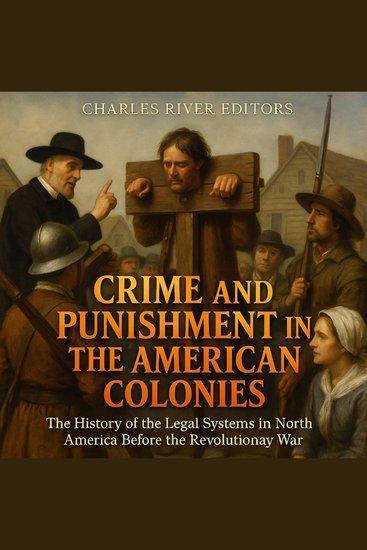
  • Crime and Punishment in the American Colonies: The History of the Legal Systems in North America Before the Revolutionary War - cover

    Crime and Punishment in the...

    Charles River Editors

    • 0
    • 0
    • 0
    Even though the colonists eventually broke free from Great Britain, plenty of British customs and practices affected the fledgling United States, particularly when it came to law. While the most notable ramifications can be found in the Fourth Amendment to the Constitution, which forbids illegal searches and seizures by the government, the extensive legal background from Britain impacted how American lawyers and courts operated as well, even as legal codes differed considerably from colony to colony because of their charters. The local codes had to broadly conform with the current laws in England, and the early equivalent of the Colonial Office examined colonial laws if someone sued. Laws found to be inconsistent with English practice were sometimes voided.  
    	On paper, the New England codes were extremely harsh, but in practice, they were often mildly enforced, if enforced at all. One law on the books was that a son could be executed if he cursed his parents, but no one was ever executed for it. Many crimes were offenses against public decorum, but there was a wide range of things considered misbehaviors. Punishments varied but tended to be either financial or public, with humiliation and shame being a large part of it.  
    	Conversely, while the New Englanders tended to base their codes on the Old Testament, in Pennsylvania, the Quaker establishment sought to reform criminals rather than punish them. Consequently, they probably had the least number of capital offenses of any place in the English-speaking world. Furthermore, over time, the list of what constituted crimes changed somewhat, as did the emphasis. The fast growth of populations brought large numbers of immigrants and indentured servants and a more complex society. Diversity increased, and the rise of slavery concentrated in (but was not limited to) the Southern colonies, bringing with it codes of law to control slaves and deal with offenses committed by them.
    Ver libro
  • Forget Me Not - Loving God's Aging Children - cover

    Forget Me Not - Loving God's...

    Elisabeth Elliot

    • 0
    • 0
    • 0
    What do we do when those we love are no longer able to care for themselves? How are we to face the brokenness and suffering of those to whom we once looked for strength? Elisabeth Elliot wrestled with these difficult questions while watching the steady erosion of her mother's memory - an erosion that seemed to devour every strong and noble attribute that made her mother who she was. This book contains insights Elisabeth gained as she struggled to find perspective.
    Ver libro
  • Legends of the Caucasus - cover

    Legends of the Caucasus

    David Hunt

    • 0
    • 1
    • 0
    The Caucasus has an extremely rich folk literature, almost unknown among English speakers, which includes myths, legends, magical tales, anecdotes and proverbs. The one hundred and one legends included in this book reflect the cultures of fourteen different ethnic groups - their dynamism and the matters that concerned them: survival against external dangers, the risk of starvation and the persistence of the family or clan as a coordinated group. Descended from an oral tradition, much of their knowledge was retained in memories and passed down the generations. Yet, with the introduction of the alphabet, the way of life they portray is rapidly becoming extinct. An incomparable collection, Legends of the Caucasus conveys the poetry and romance of these swiftly vanishing tribes.
    Ver libro
  • Empire Unraveled - cover

    Empire Unraveled

    Santiago Machain

    • 0
    • 0
    • 0
    This book charts the turbulent twilight of the Mongol imperium and the astonishing resilience of the world it rewired. Beginning with the succession crises after Kublai Khan, it follows the splintering of the Yuan, Ilkhanate, Chagatai, and the Golden Horde—revealing how court intrigue, climate shocks, and the Black Death intersected with finance, technology, and faith. Across nine deeply researched chapters, the book uncovers how postal roads became arteries for ideas as much as armies; how blue-and-white porcelain, paper finance, and siege machines moved across languages and borders; and how legal reforms and city-building created bureaucratic habits that endured long after dynasties fell.
    Ver libro