Junte-se a nós em uma viagem ao mundo dos livros!
Adicionar este livro à prateleira
Grey
Deixe um novo comentário Default profile 50px
Grey
Assine para ler o livro completo ou leia as primeiras páginas de graça!
All characters reduced
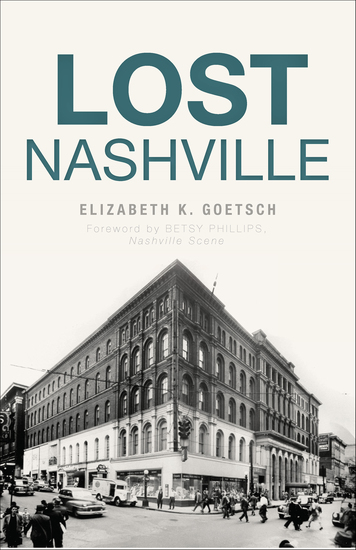
Lost Nashville - cover
LER

Lost Nashville

Elizabeth K. Goetsch

Editora: The History Press

  • 0
  • 0
  • 0

Sinopse

Nashville is chock-full of music landmarks, but there are quite a few historic structures that have been lost to time. The elegant Maxwell House Hotel served a breakfast blend that grew into the nationally known coffee brand. Public transportation first arrived in Nashville by way of horse-pulled streetcars in the 1860s. Fort Negley was the largest stone fort built during the Civil War. The Nashville Female Academy once served as the largest school for young ladies in the United States during the nineteenth century. Author Elizabeth Goetsch digs into the archives for some of the Music City's lost structures.
Disponível desde: 15/10/2018.
Comprimento de impressão: 131 páginas.

Outros livros que poderiam interessá-lo

  • The Fall of Berlin - The Final Showdown Between Nazi Germany and the Red Army - cover

    The Fall of Berlin - The Final...

    Sage Winters

    • 0
    • 0
    • 0
    In the final years of World War II, the fate of Nazi Germany seemed sealed. By early 1945, the once-feared Reich was in rapid decline. The German military was stretched thin, fighting on multiple fronts, and its once-unstoppable war machine had been crippled by continuous defeats. The Allies from the west and the Soviets from the east were closing in, their forces overwhelming the remnants of the German military. 
      
    In the East, the Red Army’s relentless advance had already pushed the Germans back hundreds of miles from the Soviet Union’s borders. The success of the Soviet offensives, especially following the victory at Stalingrad, left the Nazis reeling. Soviet General Zhukov’s forces had already crossed the Vistula River in Poland and were now bearing down on the Oder River, just a stone’s throw from Berlin. The Red Army’s advance was swift, and Hitler, from his bunker beneath the Reich Chancellery in Berlin, could no longer deny the grim reality that the capital was in imminent danger. 
      
    Despite this, Adolf Hitler refused to surrender or even entertain the thought of defeat. His obsession with holding Berlin—his “fortress”—was absolute. As Soviet forces neared the capital, he remained convinced that a miracle might still turn the tide. To his inner circle, this delusion became apparent. His judgment was clouded, and the once-great military genius was now a desperate and isolated dictator. He ordered that Berlin be fortified, even though it was clear that the city’s defenses were insufficient against the overwhelming Soviet force.
    Ver livro
  • Science in the Ancient World - cover

    Science in the Ancient World

    Dr. Jay L. Wile

    • 0
    • 0
    • 0
    This audiobook is a companion to the Science in the Ancient World Textbook. 
    While it is possible to learn a lot of science by just listening to the audiobook on it's own, the textbook is required to gain the full value from this course. 
    Science in the Ancient World is the second book in a hands-on, multilevel elementary science series that introduces scientific concepts using history as its guide. Because each lesson is built around an activity or experiment, it is engaging for all K-6 students. In addition, there are three levels of review for each lesson, so the parent/teacher can choose the depth at which each student is expected to grasp the material. The course contains roughly 90 hours of instruction, 35 of which are composed of hands-on activities. 
    The course covers the scientific work of natural philosophers who lived from about 600 BC to the early AD 1500s. It concentrates mostly on what these ancient scientists got right, but it does spend some time discussing what they got wrong, because even the mistakes that scientists make can sometimes advance our understanding of the natural world. Of course, when the students are taught something that is now known to be incorrect, they are made aware of this fact! 
    Because the course covers science as it was developed, it covers a wide range of topics including human anatomy, medicine, optics, heliocentrism, geocentrism, sound, music, magnets, how steam is used to generate power, the motion of objects through a medium, combustion, levers, pulleys, plant growth, plant anatomy, tree ring dating, the atmosphere, astronomy, the basics of graphing, plastics, density, water flow, friction, and erosion. Throughout the course, students learn that most of the great scientists who lived from AD 500 to the end of this time period were devout Christians who did science because they thought they could learn more about God by studying His handiwork.
    Ver livro

  • Italian Hours - cover

    Italian Hours

    Henry James

    • 0
    • 0
    • 0
    Immerse yourself in the enchanting world of "Italian Hours" by Henry James. This audiobook transports you to the picturesque landscapes and vibrant cities of Italy. With James' evocative prose and keen observations, you'll embark on a sensory journey through the art, culture, and history of this captivating country. The narrative offers a rich exploration of the intersection between travel, literature, and personal reflection. Through its vivid descriptions and cultural insights, it provides a window into the beauty and complexity of Italy, making it an ideal choice for those who crave a literary travel experience.
    Ver livro
  • I Do (I Think) - Conversations About Modern Marriage - cover

    I Do (I Think) - Conversations...

    Allison Raskin

    • 0
    • 0
    • 0
    "Allison Raskin’s book unpacks the questions and uncertainties around marriage that so many of us have... a must-read for anyone and everyone that may be curious about the intricacies of modern marriage.” –Nick Viall, TV Personality, Host of The Viall Files, and Bestselling AuthorFrom Just Between Us cohost and bestselling author Allison Raskin comes a witty, incisive take on modern marriage and how a new generation can navigate its uncertainties and questions.Marriage rates may be on the decline, but that doesn’t mean marriage is disappearing from society. In fact, as modern relationship norms and structures continue to evolve, the public discourse about marriage has never been louder—or more conflicted. Divorce rates, the appeal of cohabitation, seemingly infinite options for future partners, the patriarchal roots of marriage and gender roles, and economic uncertainty are just a few factors that leave a new generation of single and dating adults wondering. What does marriage even look like now? Why do people still do it? And, most importantly, is it “for me”?With conversational wit and compassion, bestselling author Allison Raskin draws on new research, interviews with licensed experts, and the stories of real-life couples to break down the many pieces of today’s “marriage conversation”—and to make the leap of faith a little less scary for Gen Z and millennial adults like herself. What emerges is a thoughtful investigation into our cultural assumptions about commitment, compatibility, divorce, meaningful partnership, the future of marriage—and what it really means to join your bank accounts.
    Ver livro
  • Curious Connected & Calm - How leaders are better together - cover

    Curious Connected & Calm - How...

    Stephanie Bown

    • 0
    • 0
    • 0
    Together is better, but only if you turn up and lean in. 
    High performing teams are teams in synergy - where the whole is greater than the sum 
    of its parts. 
    This is especially important for directors and leadership teams who face unprecedented 
    market dynamics. Their individual and organisational success depends on their capacity 
    to form bonds of trust that allow them to show up, have courage, welcome open dissent, 
    and explore new solutions to adaptive challenges. 
    In this book, high performance leadership coach Stephanie Bown explores team synergy 
    as the intersection between independent thinking and collective capacity with the goal 
    of amplifying the potential for great people to come together to achieve amazing things.
    Ver livro
  • The Holocaust - The Systematic Genocide and Its Impact on World History - cover

    The Holocaust - The Systematic...

    Sage Winters

    • 0
    • 0
    • 0
    The devastating events of World War II, particularly the Holocaust, left an indelible mark on the history of humanity. This chapter sets the stage for understanding the roots of hatred that led to one of the most horrific genocides in human history, and the role of ordinary people in shaping the course of events during the war. The Holocaust was not just an isolated act of mass murder; it was the culmination of a complex set of political, social, and cultural factors that had been brewing for decades. To grasp the magnitude of the atrocities, we must first look at the deep-seated prejudices and ideologies that laid the groundwork for such violence. 
      
    The roots of hatred can be traced back to centuries of anti-Semitism in Europe. Jews, along with other minority groups, had long been scapegoated for various societal issues. This animosity intensified during times of political and economic upheaval, particularly in post-World War I Europe, where the Treaty of Versailles created a climate of resentment and instability. The rise of Adolf Hitler and the Nazi Party capitalized on this frustration, offering a vision of a united and racially pure Germany. This vision, however, was built on a foundation of hate, exclusion, and dehumanization. 
      
    Nazi ideology emphasized the superiority of the "Aryan" race and portrayed Jews, Romani people, disabled individuals, and others as inferior and dangerous. Propaganda played a critical role in spreading these ideas, as the Nazi regime sought to indoctrinate the German public through media, education, and political rallies. Hitler's vision for Germany was one in which racial purity was paramount, and the systematic exclusion of those deemed undesirable was essential to achieving this goal.
    Ver livro