Join us on a literary world trip!
Add this book to bookshelf
Grey
Write a new comment Default profile 50px
Grey
Subscribe to read the full book or read the first pages for free!
All characters reduced
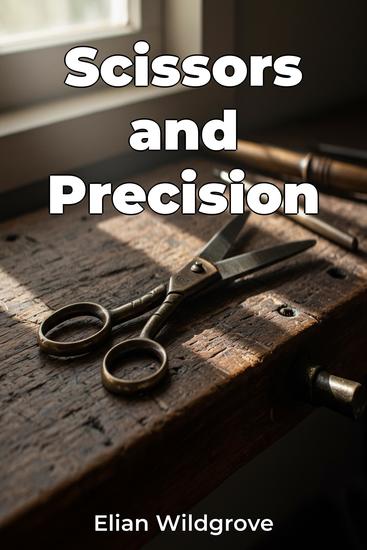
Scissors and Precision - cover

Scissors and Precision

Elian Wildgrove

Translator A AI

Publisher: Publifye

  • 0
  • 0
  • 0

Summary

Scissors and Precision explores the surprisingly rich history of scissors, revealing how this seemingly simple tool reflects broader trends in technology and human innovation. The book traces the evolution of cutting tools from rudimentary beginnings to high-precision instruments, detailing innovations in engineering design, materials science, and ergonomics. Early scissor-like devices weren't always pivoted; some were spring-operated shears. The book uniquely illuminates history through the lens of a common object. 

 
The book examines scissors' journey across historical periods and cultures, analyzing materials used in their construction, like bronze, iron, and advanced alloys, and explaining how properties affect performance. Blade geometry and pivot mechanisms are explored, highlighting the engineering intricacies. Progressing through chapters, the study moves from ancient metalworking to modern surgical applications, showing how scissor technology adapts to meet evolving societal needs.
Available since: 02/27/2025.
Print length: 60 pages.

Other books that might interest you

  • Salt - A World History: Book Summary & Analysis - cover

    Salt - A World History: Book...

    Briefly Summaries

    • 0
    • 0
    • 0
    This is a concise summary and analysis of Salt, by Mark Kurlansky. It is not the original book and is not affiliated with or endorsed by Mark Kurlansky. Ideal for those seeking a quick and insightful overview.
     
    Salt has shaped civilizations, sparked revolutions, and fueled economies throughout history. This fascinating account explores the profound impact of salt on trade, war, culture, and even language, spanning continents and centuries. From ancient China and the Roman Empire to the rise of modern economies, this book unveils how a simple mineral became a cornerstone of human development. Rich in historical detail and engaging storytelling, it reveals the hidden influence of salt in shaping the world as we know it.
    Show book
  • A Climate of Truth - Why We Need It and How To Get It - cover

    A Climate of Truth - Why We Need...

    Mike Berners-Lee

    • 0
    • 0
    • 0
    We have most of the technology we need to combat the climate crisis – and most people want to see more action.
     
    But after three decades of climate COPs, our global emissions are worse than ever. And we are accelerating into a Polycrisis of climate, food security, biodiversity, pollution, inequality and more. What, exactly, has been holding us back?
    What will it take for us to do better?
    In the search for answers that have been so elusive to date, Mike Berners-Lee looks at the challenge from new angles. He stands further back to gain perspective; he digs deeper under the surface to see the root causes; he joins up every element of the challenge; and he learns lessons from our failures of the past. He uses all these insights to identify the single point of greatest leverage for those seeking the systemic change we so desperately need. A Climate of Truth spells out why, if humanity is to thrive in the decades ahead, the most critical step is to raise standards of honesty in our politics, our media and our businesses. Not only is this possible, but each of us can have radically more impact on the issues we care about by turning our attention to this simple principle. 
    Anyone asking, ‘What can each of us do right now to help?’ will find inspiration in this practical and important book.
    Show book
  • Smart Pop Explains Peter Jackson's The Lord of the Rings and The Hobbit Movies - cover

    Smart Pop Explains Peter...

    The Editors of Smart Pop

    • 0
    • 0
    • 0
    If you're feeling lost on the way to Mordor, let Smart Pop be your guide—literally, with this handy crash course into the cinematic world of Hobbits and Orcs and Elves (oh my!) 


    It's easy for new fans to get overwhelmed by the sprawling mythology and complexity of the six films that make up Peter Jackson's epic trilogies. Unlike encyclopedias and guides that offer diehard J. R. R. Tolkien fans trivia, details, and deep dives into every on-screen moment, this first-of-its kind explainer is an easy, fun, and accessible introduction to the characters, plots, and interconnected stories that make up one of the greatest pop culture franchises of all time. 


    Smart Pop has all of your burning questions covered: Who is Frodo?; Why are there so many rings?; When did Gandalf the Grey have time to change outfits and become Gandalf the White?; Why does everyone love Gollum even though he's a bad guy?; And more! 


    As the perfect and unauthorized resource to keep on hand when rewatching the films for the first—or tenth time, or as a primer for the upcoming live action series, Smart Pop Explains Peter Jackson's The Lord of the Rings and The Hobbit Movies to you like no one could!
    Show book
  • Lean on Me - A Politics of Radical Care - cover

    Lean on Me - A Politics of...

    Lynne Segal

    • 0
    • 0
    • 0
    Longtime feminist activist and writer Lynne Segal searches for hope in her own life and in the world around her, and finds it in our intimate commitments to each other and our shared collective engagements, the two being intertwined. Issues of care, intimacy, education, alongside meaningful work, and social engagement, lie at the core of our ability to understand the world and its possibilities for human flourishing. 


    Not only does our dependence on others not disappear into self-sufficient autonomy once we leave childhood behind—only to re-emerge in very old age—but ignoring human interdependence and our lifelong need for care has been part of a massive and destructive public denial that must be resisted. 


    Segal looks at our shared lifelong dependence on care and the well-being of others. In recounting from her own life the moments of motherhood, and of being on the front line of second wave feminism, Segal draws upon lessons from more than half a century of engagement in Left feminist politics, with its underlying commitment to building a more egalitarian and nurturing world. The personal and the political combine in this rallying cry to radically transform how we approach education, motherhood, and our everyday vulnerabilities of disability, aging, and enhanced needs.
    Show book
  • Barons - Money Power and the Corruption of America's Food Industry - cover

    Barons - Money Power and the...

    Austin Frerick, Eric Schlosser

    • 0
    • 0
    • 0
    Barons is the story of seven corporate titans, their rise to power, and the consequences for everyone else. Take Mike McCloskey, chairman of Fair Oaks Farms. In a few short decades, he went from managing a modest dairy herd to running the Disneyland of agriculture. Mike benefited from deregulation of the American food industry, a phenomenon that has consolidated wealth in the hands of select tycoons, and along the way, hollowed out the nation's rural towns and local businesses. 


    Along with Mike McCloskey, listeners will meet a secretive German family that took over the global coffee industry in less than a decade, relying on wealth traced back to the Nazis to gobble up countless independent roasters. And they will learn that in the food business, crime really does pay—especially when you can bribe and then double-cross the president of Brazil. 


    These, and the other stories in this book, are simply examples of the monopolies and ubiquitous corruption that today define American food. The tycoons profiled are hardly unique: many other companies have manipulated our lax laws and failed policies for their own benefit, to the detriment of our neighborhoods, livelihoods, and our democracy itself. A fair, healthy, and prosperous food industry is possible—if we take back power from the barons who have robbed us of it.
    Show book
  • Princes in the Tower The: The History of the Mysterious Disappearances of King Edward V and the Duke of York - cover

    Princes in the Tower The: The...

    Editors Charles River

    • 0
    • 0
    • 0
    When England’s King Edward IV fell ill at Easter 1483 after coming back from a fishing trip and died shortly after on April 9, it threw a country that had already suffered a series of wars into a state of chaos. What exactly killed him is unclear, and though some people would later speculate that he had been poisoned, there is every reason to believe that he died of natural causes. Disease was common in medieval England, and doctors lacked much of the medical knowledge now taken for granted. The king's spectacular lifestyle had taken its toll, and he was significantly overweight, so it seems the lifestyle which he thought he had earned as king, and which he used to remind everyone of his status, was probably his undoing. 
    	Recognizing that death was coming, the 40-year-old Edward IV had tried to make arrangements for how the kingdom would be ruled during his son's minority. His aim was for Rivers to continue running the young king's household while Richard, Duke of Gloucester, became protector and took responsibility for running the country until Edward V was old enough to do so for himself. It was an arrangement designed to prevent any one person from gaining total authority during his son's childhood reign, and thus to protect the young king. 
    	At first, everything seemed to be going smoothly, but behind the scenes Richard was scheming. As Edward V and his guardian Rivers were travelling toward London, Richard and his substantial military retinue met them on the road. After setting Rivers and another adviser at ease through a pleasant dinner on April 29, Richard showed his true colors the next day by taking them captive and taking control of the teenaged king. His justification was the old classic of protecting a king from evil advisers. 
    	The chain of events also contributed to one of England’s most enduring mysteries, because Edward and Richard never emerged from the Tower of London.
    Show book