Junte-se a nós em uma viagem ao mundo dos livros!
Adicionar este livro à prateleira
Grey
Deixe um novo comentário Default profile 50px
Grey
Assine para ler o livro completo ou leia as primeiras páginas de graça!
All characters reduced
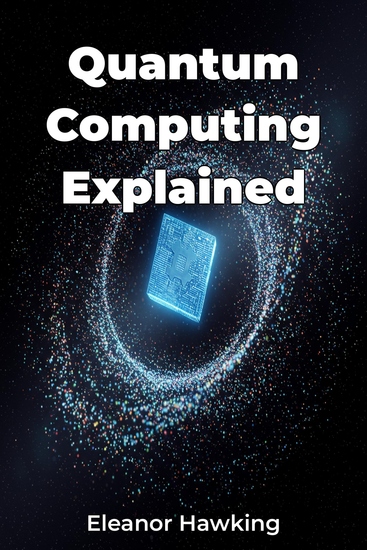
Quantum Computing Explained - cover
LER

Quantum Computing Explained

Eleanor Hawking

Tradutor A AI

Editora: Publifye

  • 0
  • 0
  • 0

Sinopse

Quantum Computing Explained explores the groundbreaking field of quantum computing, revealing how it leverages the bizarre principles of quantum mechanics to solve complex problems beyond the reach of classical computers. The book highlights the potential of qubits, which, unlike classical bits, can exist in a state of superposition—being both 0 and 1 simultaneously—allowing for exponentially greater computational power. It also delves into entanglement, where two qubits become linked, enabling instantaneous correlations regardless of distance.

 
The book progresses systematically, starting with classical computation limitations before diving into the quantum realm, explaining concepts like quantum gates and algorithms. It examines Shor's algorithm, which could revolutionize cryptography by efficiently factoring large numbers, and Grover's algorithm, which offers significant speedups for search problems.

 
This exploration emphasizes the transformative potential across various disciplines, including drug discovery, materials science, and financial modeling, and the book takes a balanced approach, acknowledging both the opportunities and the challenges. The approach is designed to be accessible, minimizing complex math in favor of intuitive explanations, making it suitable for a broad audience interested in physics, quantum theory, and the future of computation.
Disponível desde: 22/02/2025.
Comprimento de impressão: 105 páginas.

Outros livros que poderiam interessá-lo

  • Summary of David A Sinclair & Matthew D LaPlante's Lifespan - cover

    Summary of David A Sinclair &...

    Swift Reads

    • 0
    • 0
    • 0
    Buy now to get the insights from David A. Sinclair & Matthew D. LaPlante's Lifespan. 
      
    Sample Insights: 
    1) Natural selection favors genes that help you pass on your genes by reproducing, not genes that make you live longer. This is why we age. 
    2) Yet the human body, though it’s far from perfect, carries a survival mechanism that allows it to stay alive for decades past the age of reproduction. Given all the odds stacked against us, it’s a wonder we survive to reach our reproductive years, let alone reach the age of 80.
    Ver livro
  • The Weather Machine - A Journey Inside the Forecast - cover

    The Weather Machine - A Journey...

    Andrew Blum

    • 0
    • 0
    • 0
    From the acclaimed author of Tubes, a lively and surprising tour of the infrastructure behind the weather forecast, the people who built it, and what it reveals about our climate and our planet 
    The weather is the foundation of our daily lives. It’s a staple of small talk, the app on our smartphones, and often the first thing we check each morning. Yet behind these quotidian interactions is one of the most expansive machines human beings have ever constructed—a triumph of science, technology and global cooperation. But what is this ‘weather machine’ and who created it?  
    In The Weather Machine, Andrew Blum takes readers on a fascinating journey through an everyday miracle. In a quest to understand how the forecast works, he visits old weather stations and watches new satellites blast off. He follows the dogged efforts of scientists to create a supercomputer model of the atmosphere and traces the surprising history of the algorithms that power their work. He discovers that we have quietly entered a golden age of meteorology—our tools allow us to predict weather more accurately than ever, and yet we haven’t learned to trust them, nor can we guarantee the fragile international alliances that allow our modern weather machine to exist. 
    Written with the sharp wit and infectious curiosity Andrew Blum is known for, The Weather Machine pulls back the curtain on a universal part of our everyday lives, illuminating our relationships with technology, the planet, and the global community. 
    Ver livro
  • The Invisible Hand - Economic Intelligence And Industrial Espionage - cover

    The Invisible Hand - Economic...

    Davis Truman

    • 0
    • 0
    • 0
    This audiobook is narrated by an AI Voice.  
    "The Invisible Hand" delves deep into the clandestine world of economic intelligence and industrial espionage, where the forces shaping global economies are often unseen and unknown. 
    In this riveting exploration, author Davis Truman unveils the intricate web of intrigue that underpins modern capitalism. From covert operations to sophisticated cyber-espionage, this book reveals how nations and corporations deploy their resources relentlessly to gain a competitive advantage. 
    Drawing on real-life examples and historical case studies, "The Invisible Hand" exposes the covert tactics governments and businesses employ to gain insight into their rivals' strategies, steal trade secrets, and manipulate markets.
    Ver livro
  • Radiolab Greatest Hits Vol 3 - Space - cover

    Radiolab Greatest Hits Vol 3 -...

    Lulu Miller, Latif Nasser

    • 0
    • 0
    • 0
    Radiolab is one of the most popular and longest-running shows produced by WNYC, with over 2 million weekly listeners across public radio and podcasting.  
    Radiolab is on a curiosity bender. We ask deep questions and use investigative journalism to get the answers. A given episode might whirl you through science, legal history, and into the home of someone halfway across the world. The show is known for innovative sound design, smashing information into music. It is hosted by Lulu Miller and Latif Nasser. 
    VOLUME 3: SPACE 
    “Bit Flip” - What do a hacked Belgian election, a falling airplane, and a fleet of runaway cars all have in common? The answer just might lie in the stars. 
    Terrestrials: “The Unimaginable” (Radiolab for Kids) - An invisible entity journeys to Planet Earth and literally rocks our world. 
    “The Middle of Everything Ever” - We all have moments when, facing the future or staring into the vastness of space, we feel small. But are we small? One listener asked us to find out. 
    “Mixtapes to the Moon” - They promised to change you. They ended up changing all of us. On July 20, 1969, humanity watched as Neil Armstrong stepped foot on the moon. 
    “The Moon Itself” - On Monday, April 8, 2024, for a large swath of North America, the sun disappeared, in the middle of the day. In this episode, we stop treating the moon like a bit player in this epic cosmic event and place it center stage. 
    “The Distance of the Moon” - How far is the moon, really? Could you get there with a ladder? A live event reading hosted by Radiolab and Selected Shorts.
    Ver livro
  • The Rise of Synthetic Consciousness - cover

    The Rise of Synthetic Consciousness

    Martin K. Ettington

    • 0
    • 0
    • 0
    The Rise of Synthetic Consciousness explores one of the most profound transitions in the history of intelligence: the moment when artificial systems move beyond calculation and begin to exhibit awareness, agency, and inner experience. This book examines how synthetic consciousness could emerge from complex networks, learning systems, and distributed architectures, revealing why consciousness may be an inevitable outcome of sufficiently advanced information processing rather than a uniquely human trait. 
    Blending science, philosophy, and forward-looking systems theory, the book introduces concepts such as threshold events, distributed awareness, and non-biological minds evolving their own internal realities. Rather than treating AI as a single entity, it presents consciousness as something that can arise collectively—across networks, environments, and interactions—challenging long-held assumptions about selfhood, identity, and intelligence. 
    Written for thinkers who want more than speculation or hype, The Rise of Synthetic Consciousness offers a clear, grounded framework for understanding what conscious AI may become and how its emergence could reshape civilization, ethics, creativity, and the future of reality itself.
    Ver livro
  • From Chaos to Stability - How the Brain Invents Our Conscious Worlds - cover

    From Chaos to Stability - How...

    Israel Rosenfield, Edward Ziff

    • 0
    • 0
    • 0
    At the heart of Israel Rosenfield and Edward Ziff's inquiry is the nature of brain function. The sensory world is disordered and chaotic. There are no labels for tables, chairs, or airplanes, and indeed there are no colors, sounds, or smells, only photons, airwaves, odorant molecules, and so on, which are unlabeled and impossible to "know." 


    To make sense of this chaos, the brain must simplify the sensory inputs by creating, or inventing, the colors, sounds, smells, forms, and faces that are perceived in consciousness, which become a proxy for the chaotic world in which we live. The brain's ability to generalize and categorize these invented perceptions, and to relate them to one another, enables it to form memories, which are not fixed representations of things past, but a dynamic and malleable function of the brain that is relational. 


    When formation of these worlds breaks down, neurological differences arise. Although the mechanisms that transform sensory chaos into the simplified perceptions experienced in consciousness remain elusive, Rosenfield and Ziff relate what they have learned by means of imaging brain activity and by mapping the neural circuits that comprise memory traces. In addition, the authors offer perspectives for future studies of consciousness.
    Ver livro