Junte-se a nós em uma viagem ao mundo dos livros!
Adicionar este livro à prateleira
Grey
Deixe um novo comentário Default profile 50px
Grey
Assine para ler o livro completo ou leia as primeiras páginas de graça!
All characters reduced
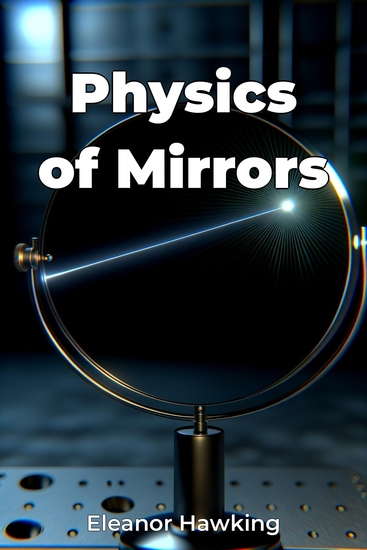
Physics of Mirrors - cover
LER

Physics of Mirrors

Eleanor Hawking

Tradutor A AI

Editora: Publifye

  • 0
  • 0
  • 0

Sinopse

Physics of Mirrors explores the seemingly simple yet complex world of mirrors, emphasizing their critical role in science and technology. The book examines the laws of reflection, diverse mirror types, and their applications, arguing that mirrors are sophisticated optical components governed by precise physical laws. Readers will discover how a deep understanding of mirror physics is essential for advancements in fields such as astronomy and medicine. For instance, the book reveals the crucial role of mirrors in telescopes, microscopes, and even medical imaging techniques like endoscopy.

 
Beginning with the fundamental principles of reflection, the book progresses through mirror categorization based on geometry, explaining the optical properties of plane, concave, and convex mirrors. It then investigates the applications of mirrors in lasers, optical fibers, and solar energy concentrators. This approach combines theoretical explanations with practical applications, providing a comprehensive understanding of mirror physics and enabling readers to apply this knowledge to real-world problems and innovative technologies.
Disponível desde: 12/02/2025.
Comprimento de impressão: 79 páginas.

Outros livros que poderiam interessá-lo

  • 10 Ways the World Could End - From Natural Disasters to Man-Made Catastrophes - cover

    10 Ways the World Could End -...

    John Harpoon

    • 0
    • 0
    • 0
    Our planet is an extraordinary place, teeming with life and natural wonders. Yet, beneath the beauty and stability of our world lies an inherent fragility that we must never overlook. From the forces of nature to the actions of humanity, numerous threats exist that could drastically alter the course of life on Earth. These dangers range from natural disasters such as volcanic eruptions and asteroid impacts to man-made catastrophes like nuclear war and the consequences of climate change. While these events may seem distant or improbable, they are very real and have the potential to affect us all in profound ways. 
    To fully grasp the magnitude of these threats, it is crucial to understand how they arise and their potential consequences. Many of the dangers that could lead to the end of the world are rooted in forces that have shaped our planet for millions of years. However, modern society faces new, unique risks that previous generations never imagined. Natural disasters, though unpredictable, are part of the Earth's natural cycles, while human actions—whether through pollution, warfare, or technological mismanagement—have introduced entirely new categories of risk. As technology advances and our global interconnectedness grows, the potential for widespread disaster becomes more complex and difficult to anticipate. 
    When examining the ways the world could end, it is essential to distinguish between natural and man-made catastrophes. Natural disasters, like earthquakes, tsunamis, and pandemics, have been occurring throughout Earth's history, long before humans arrived on the scene. These events have shaped ecosystems, driven evolutionary processes, and, at times, caused mass extinctions. On the other hand, man-made catastrophes, such as nuclear warfare or the unchecked expansion of artificial intelligence, are unique to modern civilization.
    Ver livro
  • Geology - The Earth's Secrets Understanding Rocks Minerals and Time - cover

    Geology - The Earth's Secrets...

    Mike Crawford

    • 0
    • 0
    • 0
    The Earth’s formation is a story of cosmic collisions, immense heat, and gradual cooling that set the stage for the planet we know today. Approximately 4.6 billion years ago, the solar system emerged from a vast cloud of dust and gas. This cloud, known as the solar nebula, began to collapse under gravity, forming the Sun at its center. Around this young star, particles of dust and rock started clumping together, eventually leading to the creation of planets, including Earth. 
    In its early years, Earth was a molten sphere, continuously bombarded by asteroids and comets. These impacts contributed to the planet’s mass and introduced essential elements like water. As gravitational forces compressed Earth’s interior, temperatures soared, causing heavy materials such as iron and nickel to sink toward the core while lighter elements like silicon and oxygen remained near the surface. This process, known as planetary differentiation, led to the formation of Earth’s three primary layers: the core, mantle, and crust. 
    The early atmosphere of Earth was vastly different from what it is today. Initially, it consisted of hydrogen and helium, but solar winds stripped these gases away. Volcanic activity and ongoing collisions released vast amounts of carbon dioxide, water vapor, methane, and ammonia, forming a thick and toxic atmosphere. Over time, as volcanic eruptions continued, water vapor condensed to form clouds, eventually leading to heavy rainfall that lasted for thousands of years. These rains filled low-lying areas, giving rise to the first oceans.
    Ver livro
  • Into my Hands - A Midwife’s Memoir - cover

    Into my Hands - A Midwife’s Memoir

    Catherine Rae Shields

    • 0
    • 0
    • 0
    "Into My Hands" is an intimate and inspiring memoir that delves into the life of a passionate midwife, tracing her path from childhood to her fulfilling career in midwifery. This poignant narrative was born from a transformative moment in the author's early twenties, following a traumatic birth experience with her own daughter. It was then that she resolved to put an end to birth trauma and dedicate her life to supporting women during the sacred journey of childbirth. 
    With a background as a labor and delivery nurse and a nurse-midwife, she embarked on a remarkable journey to achieve her mission. In her role, she went above and beyond to provide comfort, aid, and unwavering reassurance to mothers in their birthing moments. "Into My Hands" is not only a personal account but also a tribute to the countless mothers she had the privilege to work with, as they generously share their own unique birth stories. 
    This memoir beautifully captures the profound impact of having a midwife's skilled and caring hands present during childbirth. It's a testament to the strength, resilience, and the incredible bond that forms between midwives and the women they serve. Through this book, readers will gain a deep appreciation for the transformative power of compassionate care during one of life's most extraordinary experiences.
    Ver livro
  • Matter - The Magnificent Illusion - cover

    Matter - The Magnificent Illusion

    Guido Tonelli

    • 0
    • 0
    • 0
    What are we made up of? What holds material bodies together? Is there a difference between terrestrial matter and celestial matter? When Democritus stated that we are made up of atoms, few people believed him. Not until Galileo and Newton in the seventeenth century did people take the idea seriously, and it was another four hundred years before we could reconstruct the elementary components of matter. 


    Everything around us has very particular properties. These properties, which seem quite normal to us, are in fact very special, because the universe, whose evolution began almost fourteen billion years ago, is today a very cold environment. In this book, Guido Tonelli explains how elementary particles, which make up matter, combine into bizarre shapes to form correlated quantum states, primordial soups of quarks and gluons, or massive neutron stars. New questions that have emerged from the most recent research are answered: in what sense is the vacuum a material state? Why can space-time also vibrate and oscillate? Can elementary grains of space and time exist? What forms does matter assume inside large black holes? 


    In clear and lively prose, Tonelli takes listeners on an exhilarating journey into the latest discoveries of contemporary science, enabling them to see the universe, and themselves, in a new light.
    Ver livro
  • Quantum Physics : The Mystery of Superposition - The Building Blocks of the Universe - cover

    Quantum Physics : The Mystery of...

    Ecnal Ver

    • 0
    • 0
    • 0
    Quantum Physics: The Mystery of Superposition 
    A Strange New World 
    Imagine a universe where a single particle can be in two places at once, where light is both a wave and a particle, and where observation itself changes reality. This is the world of quantum physics, and at its center is the mystery of superposition. 
    The Beginning of the Quantum Revolution 
    This audiobook takes listeners on a journey from the roots of classical science to the groundbreaking discoveries of the 20th century. You will meet brilliant minds like Planck, Einstein, Bohr, and Schrödinger, who challenged old ideas and revealed a universe stranger than anyone expected. 
    The Core Ideas 
    Key concepts such as wave-particle duality, entanglement, and the uncertainty principle are explained in clear, simple terms. You will discover how particles can be linked across space, how measurement changes outcomes, and why the quantum world defies ordinary logic. 
    Why It Matters to You 
    Quantum physics is not only about theory. It shapes the technology you use every day, from smartphones and computers to lasers and MRI machines. The principles of superposition also power the future of quantum computing, cryptography, and sensors. 
    The Deeper Meaning 
    Beyond science and technology, quantum physics raises big questions about the nature of reality and our role as observers. Does the universe exist independent of us, or are we part of shaping it? What does it mean to live in a world of probabilities rather than certainties? 
    An Invitation to Explore 
    Quantum Physics: The Mystery of Superposition makes complex science easy to follow for beginners and lifelong learners alike. Through stories, history, and simple explanations, it opens the door to one of the most fascinating frontiers of human knowledge.
    Ver livro
  • Natural Disasters and Preparedness - Science-Based Strategies for Mitigation Emergency Response and Building Resilience in a Changing Climate - cover

    Natural Disasters and...

    Virversity Online Courses

    • 0
    • 0
    • 0
    Natural Disasters and Preparedness is a comprehensive course designed to provide students with a deep understanding of natural disasters and practical strategies for effective preparedness. Learners will gain essential knowledge to assess risks, plan responses, and help build resilient communities that enhance personal and public safety.The course covers the scientific causes and types of natural disasters, including earthquakes, hurricanes, floods, and wildfires. It explores Earth's structure, atmospheric conditions, and climate influences, while linking the increasing frequency of disasters to climate change. Students will learn to assess risks and identify vulnerable areas through hazard mapping, develop and implement disaster preparedness plans, and apply mitigation strategies to reduce impacts.Key topics include community resilience, emergency management fundamentals, and the use of technology for disaster monitoring and early warning systems. Real-world case studies provide insight into past disasters and best practices, while psychological impacts and mental health support are also addressed. The curriculum concludes with an exploration of future trends, innovations, and international cooperation in disaster mitigation.By completing this course, students will acquire critical scientific knowledge, strategic planning skills, and practical tools to respond effectively to natural disasters, support community safety, and reduce vulnerabilities in both personal and professional contexts.
    Ver livro