Join us on a literary world trip!
Add this book to bookshelf
Grey
Write a new comment Default profile 50px
Grey
Subscribe to read the full book or read the first pages for free!
All characters reduced
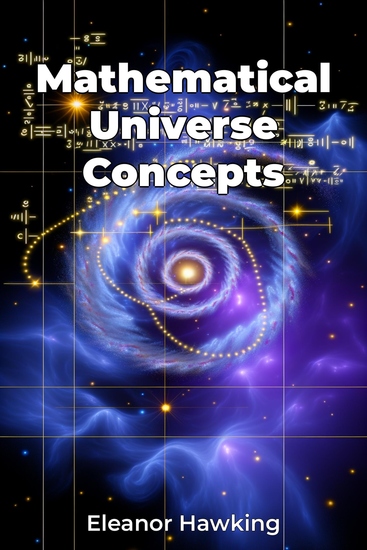
Mathematical Universe Concepts - cover

Mathematical Universe Concepts

Eleanor Hawking

Publisher: Publifye

  • 0
  • 0
  • 0

Summary

"Mathematical Universe Concepts" explores the profound relationship between mathematics and physical reality, investigating whether mathematical structures are discovered or invented. This thought-provoking work examines how abstract mathematical principles manifest in our observable universe, challenging traditional boundaries between pure mathematics and physical phenomena.

 
Through careful examination of symmetry principles, quantum theory, and complex systems, the book builds a compelling case for mathematics as a fundamental component of reality rather than just a descriptive tool. The book progresses methodically through three major sections, beginning with the mathematical foundations of space, time, and matter. Drawing from both classical and quantum physics, it demonstrates how symmetry principles govern fundamental forces and particle behavior, before culminating in an exploration of complex systems emergence.

 
Real-world evidence from particle accelerator experiments, cosmological observations, and computer simulations supports the theoretical framework, making abstract concepts tangible for readers with basic calculus knowledge. What sets this book apart is its interdisciplinary approach, connecting mathematical physics to fields like evolutionary biology and cognitive science.

 
By presenting complex ideas through carefully chosen analogies and visual representations, it makes advanced theoretical concepts accessible to educated general readers while maintaining scientific rigor. The work serves as an invaluable bridge between pure mathematics and physical sciences, offering fresh perspectives on fundamental questions about the nature of reality and the mathematical underpinnings of our universe.
Available since: 01/06/2025.
Print length: 103 pages.

Other books that might interest you

  • Data Mesh - A Comprehensive Guide to Decentralized Data Architecture - cover

    Data Mesh - A Comprehensive...

    Vincent Berry

    • 0
    • 0
    • 0
    In "Data Mesh: A Comprehensive Guide to Decentralized Data Architecture," readers are introduced to a transformative approach to data management that challenges conventional centralized systems. This essential guide delves into the principles and practices of Data Mesh, advocating for a paradigm shift towards a domain-oriented, decentralized data architecture. This book is meticulously designed for data architects, CTOs, data engineers, and any professionals involved in data-intensive industries who seek to overcome the limitations of traditional data management and unlock greater flexibility and scalability. 
    The guide starts with a thorough introduction to the core concepts of Data Mesh, including its four foundational pillars: domain-oriented decentralization of data ownership, data as a product, self-serve data infrastructure, and computational governance. Each section not only explains the theoretical aspects but also illustrates practical implementations through case studies and real-world scenarios, providing readers with a clear pathway to adopting Data Mesh in their organizations. 
    Further chapters are dedicated to the technical implementations of Data Mesh, detailing the technological stack and strategies required to support a scalable and efficient decentralized data architecture. The book also addresses common challenges and pitfalls, offering expert advice on navigating cultural shifts, integrating legacy systems, and maintaining data interoperability. 
    "Data Mesh: A Comprehensive Guide to Decentralized Data Architecture" also explores the future prospects of Data Mesh, including its role in leveraging artificial intelligence and machine learning within a decentralized framework. It outlines how Data Mesh can drive innovation, enhance data security, and improve data compliance in a rapidly evolving digital landscape.
    Show book
  • Artificial Intelligence Versus Living Mind Intelligence - cover

    Artificial Intelligence Versus...

    V.Nova

    • 0
    • 0
    • 0
    What separates a programmed machine from a conscious mind? Can artificial intelligence ever truly replicate the instinct, awareness, and depth of human thought? 
    In Artificial Intelligence Versus Living Mind Intelligence, V. Nova offers a bold and original critique of modern technological thinking. Blending philosophy, cognitive science, and decades of independent research, this groundbreaking work argues that artificial systems can process information, but they cannot perceive, intuit, or create like a living mind. 
    Nova challenges readers to rethink what intelligence really means and reveals how modern reliance on digital abstraction has disconnected us from our innate, creative capacities. Through a unique framework grounded in natural perception and timeless logic, the author explores the fundamental differences between mechanical simulation and true cognition. 
    Inside, you will discover:Why AI cannot replicate self-initiated, living intelligenceHow perception-not reflection-shapes our understanding of realityThe lost role of philosophy in shaping modern consciousnessA deep exploration of instinct, awareness, and the nature of thoughtA compelling argument for reclaiming the language of the living mind 
    If you're questioning the future of artificial intelligence, or searching for deeper insight into your own mind, this book offers a powerful, thought-provoking journey back to what makes us truly human.
    Show book
  • Fixer-Upper - How to Repair America’s Broken Housing Systems - cover

    Fixer-Upper - How to Repair...

    Jenny Schuetz

    • 0
    • 0
    • 0
    Much ink has been spilled in recent years talking about political divides and inequality in the United States. But these discussions too often miss one of the most important factors in the divisions among Americans: the fundamentally unequal nature of the nation's housing systems. 


    And this divide deepens other inequalities. Increasingly, important life outcomes—performance in school, employment, even life expectancy—are determined by where people live and the quality of homes they live in. 


    Public policies enacted by federal, state, and local governments helped create and reinforce the bad housing outcomes endured by too many people. Taxes, zoning, institutional discrimination, and the location and quality of schools, roads, public transit, and other public services are among the policies that created inequalities in the nation's housing patterns. 


    Fixer-Upper is the first book assessing how the broad set of local, state, and national housing policies affect people and communities. It proposes practical policy changes than can make stable, decent-quality housing more available and affordable for all Americans in all communities.
    Show book
  • Drift Into Failure - From Hunting Broken Components to Understanding Complex Systems - cover

    Drift Into Failure - From...

    Sidney Dekker

    • 0
    • 0
    • 0
    What does the collapse of sub-prime lending have in common with a broken jackscrew in an airliner’s tailplane? Or the oil spill disaster in the Gulf of Mexico with the burn-up of Space Shuttle Columbia? These were systems that drifted into failure. While pursuing success in a dynamic, complex environment with limited resources and multiple goal conflicts, a succession of small, everyday decisions eventually produced breakdowns on a massive scale. We have trouble grasping the complexity and normality that gives rise to such large events. We hunt for broken parts, fixable properties, people we can hold accountable. Our analyses of complex system breakdowns remain depressingly linear, depressingly componential - imprisoned in the space of ideas once defined by Newton and Descartes. The growth of complexity in society has outpaced our understanding of how complex systems work and fail. Our technologies have gotten ahead of our theories. We are able to build things - deep-sea oil rigs, jackscrews, collateralized debt obligations - whose properties we understand in isolation. But in competitive, regulated societies, their connections proliferate, their interactions and interdependencies multiply, their complexities mushroom. This book explores complexity theory and systems thinking to understand better how complex systems drift into failure. It studies sensitive dependence on initial conditions, unruly technology, tipping points, diversity - and finds that failure emerges opportunistically, non-randomly, from the very webs of relationships that breed success and that are supposed to protect organizations from disaster. It develops a vocabulary that allows us to harness complexity and find new ways of managing drift.
    Show book
  • Garbage Theology - The unseen world of waste and what it means for the salvation of every person every place and every thing - cover

    Garbage Theology - The unseen...

    Caleb Cray Haynes

    • 0
    • 0
    • 0
    What if God is very interested in your waste? What if you looked out your window and saw Jesus going through your trash can? Would that surprise you? The greatest illusion of our time comes in the form of waste. From landfills, to micro-trash, to invisible emissions, to imperceivable pollutants, to the factories and shores we never see... it's all hidden away from our sight. However, the harmful effects of this global wastefulness reach far and wide. It's touching the lives of everyone you love, every place you've been, and every single thing you can imagine. What if your faith requires a greater awareness about the things you eat, buy, and throw away? Could it be that your salvation is tied to all of God's creation and that you have the opportunity to join God's work of restoration? While addressing the environmental challenges of our time, Garbage Theology seeks to connect our Biblical call to serve and keep creation with how we live our lives today. Through personal stories extracted from years of working in the trash and recycling industry while pastoring a local church, author Caleb Cray Haynes introduces and examines a theology of consumption and waste through the lens of Scripture and our story as the people of God in the context of our current global environmental crises. Rev. Caleb Cray Haynes is the Director of Nazarenes for Creation Care, the host of The ecoChristian Podcast, and the Community and Creation Pastor at Kaleo Nashville Church. He also is a co-author of Keeping Creation, a 5-week small group study on the Biblical call to tend and serve the earth. He is a Partner with the Evangelical Environmental Network, an Ordained Elder in The Church of the Nazarene, and holds an MA in Theology: Ecology from Nazarene Theological College in Manchester, UK. He resides in Nashville, TN with his wife Emily, and two daughters Story and Daily. More at CalebCrayHaynes.com
    Show book
  • Unfireable - How to Become the Person AI Can’t Replace - cover

    Unfireable - How to Become the...

    Bryan Banks

    • 0
    • 0
    • 0
    This audiobook is narrated by an AI Voice.  Unfireable is a practical audiobook for professionals, freelancers, managers, and knowledge workers who can feel AI changing the value of their work and want to stay relevant, trusted, and hard to replace. 
     
    AI is making routine output cheaper: drafts, summaries, reports, slides, and basic analysis are no longer enough to prove value. This book shows you how to move beyond task completion and build the human leverage that still matters: judgment, trust, ownership, communication, taste, and context. 
     
    You’ll learn how to identify which parts of your work AI threatens, use AI without becoming dependent on it, communicate in ways that create trust, own outcomes instead of activity, become visible without self-promotion theater, and build a 12-week plan to increase your value in an AI-driven workplace. 
     
    This is not a book about fearing AI. It is a book about becoming the kind of person AI makes more powerful, not less necessary.
    Show book