¡Acompáñanos a viajar por el mundo de los libros!
Añadir este libro a la estantería
Grey
Escribe un nuevo comentario Default profile 50px
Grey
Suscríbete para leer el libro completo o lee las primeras páginas gratis.
All characters reduced
Understanding Animal Functions - cover

Understanding Animal Functions

Ekaaksh Deshpande

Editorial: Educohack Press

  • 0
  • 0
  • 0

Sinopsis

The illustrations in this book are created by “Team Educohack”.
 
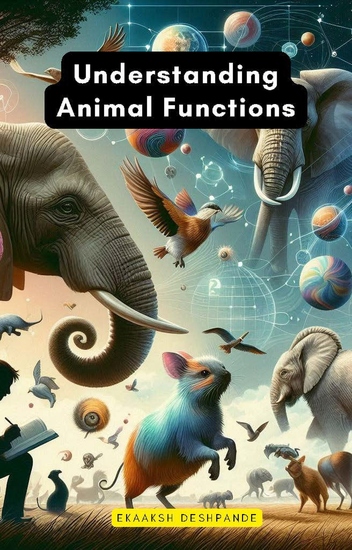
Understanding Animal Functions is an engaging and comprehensive textbook that incorporates major paradigms of animal physiology. This book is a harmonious blend of accurate information and clear explanations, slightly biased towards mammals, but also shining a light on other vertebrates and invertebrates like molluscs and arthropods.
 
We follow a time-honored approach to bookmaking, ensuring pedagogical relevance. This textbook aligns with the academic curricula of various institutions and is targeted at graduate and undergraduate students and their instructors. The content integrates animal physiology with disciplines such as ecology, genetics, and evolutionary and molecular biology.
 
We emphasize the importance of physiology in an animal’s life, discussing developments and processes like migration, endogenous rhythms, and adaptations to extreme conditions. The book excludes parasitism and pathological aspects to focus on these core topics.
 
With its engaging narrative and illustrative visuals, Understanding Animal Functions enhances the learning experience, making complex concepts accessible and interesting.
Disponible desde: 03/01/2025.
Longitud de impresión: 292 páginas.
Otros libros que te pueden interesar

  • Planet X Hypothesis The: The History and Legacy of the Theory that the Solar System has a Hidden Planet - cover

    Planet X Hypothesis The: The...

    Editors Charles River

    • 0
    • 0
    • 0
    Naturally, as technological advances and the creation of flying aircraft became realities, the sighting of UFOs increased, as did the interest in potential contact with aliens. While incidents like the one at Roswell led to conspiracies and a craze among those who insisted the government was hiding proof of extraterrestrials’ existence, governments across the world were actually secretly studying UFO sightings by the mid-20th century. 
    Given all of that, it was hardly groundbreaking for scientists in the 19th century to have plenty of heated debates about their imperfect knowledge of astronomy. One particular argument was over whether there was a hidden planet beyond Neptune, dubbed by the theory’s original proponent, Percival Lowell, as Planet X. When Pluto was discovered in 1930, at the start of the Great Depression, scientists originally thought this new world, in the extreme cold at the outer edge of the Solar System, would solve a decades-old mystery regarding the orbit of Uranus, the seventh planet from the Sun. But soon, scientists realized that Pluto, at one point considered the 9th planet, was too small to explain the discrepancies found. Thus, some researchers began looking for the next planet, or Planet X. 
    Throughout our modern culture, “X” has remained the proverbial symbol of mystery. On the maps of buried pirate treasure, “X” is supposed to mark the spot where treasure seekers are to dig. In public schools, teenagers learn the utility of “X” as a variable in algebraic equations or as an axis in the Cartesian coordinate system. And “X” is also a Roman numeral symbolizing the quantity of 10, the highest value which can be counted on the fingers, and the next value beyond “9,” the largest single digit. The search for “Planet X,” then, is a quest rich with symbolism and mystery, rooted in history, astronomy, and astrology.
    Ver libro
  • Rewiring Democracy - How AI Will Transform Our Politics Government and Citizenship (Strong Ideas) - cover

    Rewiring Democracy - How AI Will...

    Bruce Schneier, Nathan E. Sanders

    • 0
    • 0
    • 0
    In this advisedly optimistic book, Rewiring Democracy, security technologist Bruce Schneier and data scientist Nathan Sanders cut through the AI hype and examine the myriad ways that AI is transforming every aspect of democracy—for both good and ill.The authors describe how the sophistication of AI will fulfill demands from lawmakers for more complex legislation, reducing deference to the executive branch and altering the balance of power between lawmakers and administrators. They show how the scale and scope of AI is enhancing civil servants' ability to shape private-sector behavior, automating either the enforcement or neglect of industry regulations. They also explain how both lawyers and judges will leverage the speed of AI, upending how we think about law enforcement, litigation, and dispute resolution.Whether these outcomes enhance or degrade democracy depends on how we shape the development and use of AI technologies. Powerful players in private industry and public life are already using AI to increase their influence, and AIs built by corporations don't deliver the fairness and trust required by democratic governance. But, steered in the right direction, AI's broad capabilities can augment democratic processes and help citizens build consensus, express their voice, and shake up long-standing power structures.
    Ver libro
  • Race for Nuclear Weapons during World War II The: The History and Legacy of Both Sides’ Efforts to Build an Atomic Bomb - cover

    Race for Nuclear Weapons during...

    Editors Charles River

    • 0
    • 0
    • 0
    Before the Second World War, military conflicts were fought under orthodox conditions, usually termed “conventional warfare,” but several innovations had significantly changed combat, leading inextricably to the race for a nuclear weapon in the 1930s and 1940s. Conflicts had been fought by armies on horseback with guns of varying sophistication since the 16th century, but mechanized warfare and machine guns changed this calculus and set the stage for future combat by the end of World War I. Other sinister changes entered the fray during this conflict, such as chemical weapons like chlorine and mustard gas. The total warfare brought about by World War I and ensuing wars like the Spanish Civil War made the quest for the most powerful weapons somewhat necessary. 
    The Manhattan Project would ultimately yield the “Little Boy” and “Fat Man” bombs that released more than 100 Terajoules of energy at Hiroshima and Nagasaki, but as it turned out, the Axis were not far behind with their own nuclear weapons program. When the Nazis’ quest for a nuclear weapon began in earnest in 1939, no one really had a handle on how important nuclear weapons would prove to war and geopolitics. The attacks on Hiroshima and Nagasaki in August 1945, along with the Cold War-era tests and their accompanying mushroom clouds, would demonstrate the true power and terror of nuclear weapons, but in the late 1930s these bombs were only vaguely being thought through, particularly after the successful first experiment to split the atom by a German scientist. The nuclear age itself was in its infancy, barely 35 years old, but within a few short years the advent of nuclear war loomed over the world and the prospect of the enemy winning the nuclear race kept Allied leaders awake at night.
    Ver libro
  • Time Will Tell - Memories of the Future 2082 - cover

    Time Will Tell - Memories of the...

    Holly von Bonin

    • 0
    • 0
    • 0
    Explore mind-bending tales from real-life time travelers who have experienced moments beyond our reality. These intriguing narratives not only entertain but also raise questions about the fabric of time itself, captivating both skeptics and believers alike. You'll find yourself immersed in experiences that challenge your understanding of existence and perception.
    Ver libro
  • Raising the Digital Bar - Generate New Customers Every Day with Affordable Digital Marketing Strategies that WORK! - cover

    Raising the Digital Bar -...

    David Ronald Esau, Joel Mark Harris

    • 0
    • 0
    • 0
    Would you like to know how to get new customers every day?  
    Raising the Digital Bar is a must-read for business owners looking to properly set up their businesses online. The book provides a blueprint for tactics that help local and service-based businesses generate new customers every day. It’s packed with useful information, broken down into easy-to-follow, actionable steps. 
    You’ll learn how to:  
    • Get your business shown more often on Google search and map results. 
    • Efficiently advertise on Google Ads without overspending and underperforming.  
    • Boost your online presence with affordable SEO tactics. 
    But that’s not all — Raising the Digital Bar also offers advice on effective social media marketing, website design, conversion tracking, reporting, and much more. 
    Whether you’re just getting started in digital marketing or you’re looking for ways to improve your current strategy, this book has something for you. Get ready to take your small business to the next level in 2023!
    Ver libro
  • Quantum Mechanics and Quantum Information Theory - Understanding the Fundamentals and Potential Applications of Quantum Mechanics and Quantum Information Theory - cover

    Quantum Mechanics and Quantum...

    Daniel Garfield

    • 0
    • 0
    • 0
    "Quantum Mechanics and Quantum Information Theory: Understanding the Fundamentals and Potential Applications" is a comprehensive guide to the fascinating world of quantum mechanics and its potential applications in quantum information theory.  
    This book explores the fundamental principles of quantum mechanics, including wave-particle duality, superposition, and entanglement, and explains how these principles underlie the development of quantum computing, quantum cryptography, and quantum communication.  
    The book is written in a clear and accessible manner, making it suitable for both students and researchers interested in the field. Through its detailed explanations and examples, this book offers a valuable resource for understanding the exciting potential of quantum mechanics and quantum information theory.
    Ver libro