Junte-se a nós em uma viagem ao mundo dos livros!
Adicionar este livro à prateleira
Grey
Deixe um novo comentário Default profile 50px
Grey
Assine para ler o livro completo ou leia as primeiras páginas de graça!
All characters reduced
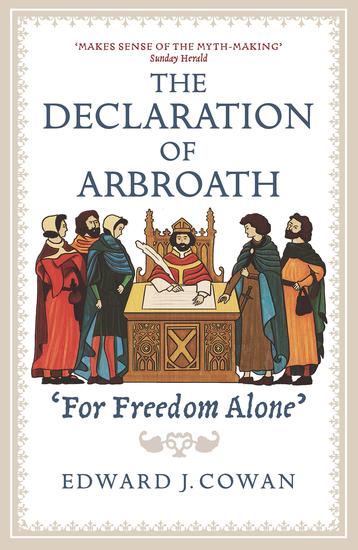
The Declaration of Arbroath - 'For Freedom Alone' - cover
LER

The Declaration of Arbroath - 'For Freedom Alone'

Edward J. Cowan

Editora: Birlinn

  • 0
  • 0
  • 0

Sinopse

The Declaration of Arbroath, 6 April, 1320, is one of the most remarkable documents to have been produced anywhere in medieval Europe. Signed by 51 Scottish nobles, it confirms Scotland's status as an independent sovereign state with the right to use military action if unjustly attacked.
Quoted by many, understood by few, its historical significance has now almost been overtaken by its mythic status. Since 1998, the US Senate has claimed that the American Declaration of Independence is modelled upon 'the inspirational document' of Arbroath. This is the first book-length study to examine the origins of the Declaration and the ideas upon which it drew, while tracing the rise of its mythic status in Scotland and exploring its impact upon revolutionary America.
Disponível desde: 05/03/2020.
Comprimento de impressão: 192 páginas.
Outros livros que poderiam interessá-lo

  • The Voice in my Head is an Asshole - How to tame your inner critic - cover

    The Voice in my Head is an...

    Darryl Blake

    • 0
    • 0
    • 0
    Are you living your life, or acting out your story? 
    Do you have an inner critic? One that misguides, bullies and torments? Giving voice to bad habits and disabling beliefs, fears, or regrets? 
    If so, you’ve met the inner asshole, and this book is for you. Especially if: 
    -       Dealing with your inner critic resembles an insane, never-ending game of whack-a-mole. A stream of consciousness that just won’t stop. 
    -       You get stuck in “replay”—lost in old arguments, insults still felt and regrets that continue to hurt. Or tormented by anxiety over what might happen in the future. 
    -       You are your own worst critic. 
    -       Your inner voices talk you into poor choices. 
    -       Racing thoughts interrupt your sleep. 
    Don’t be bullied by your inner asshole. Using the latest evidence-based research as a guide, change the patterns, mute the voices, and overcome the pull of unwanted habits. 
    Learn the secrets of world-class asshole-whisperers, today!
    Ver livro
  • Thrive - Maximizing Well-Being in the Age of AI - cover

    Thrive - Maximizing Well-Being...

    Anindya Ghose, Ravi Bapna

    • 0
    • 0
    • 0
    Artificial intelligence (AI) is a powerful general-purpose technology that is reshaping the modern economy, but misperceptions about AI stand in the way of harnessing it for the betterment of humanity. In Thrive, Ravi Bapna and Anindya Ghose counter the backlash by showcasing how AI is positively influencing the aspects of our daily lives that we care about most: our health and wellness, relationships, education, the workplace, and domestic life. In the process the authors help explain the underlying technology and give people the agency they need to shape the debate around how we should regulate AI to maximize its benefits and minimize its risks. 


    Bringing over two decades of experience with cutting-edge research, consulting, executive coaching, and advising to bear on the subject, Bapna and Ghose demystify the technology of AI itself. They offer a novel "House of AI" framework that encompasses traditional analytics, generative AI, and fair and ethical deployment of AI. Using examples from everyday life, they showcase how the modern AI-powered ecosystem fundamentally improves the emotional, physical, and material well-being of regular people across the globe. Thrive's mission is to educate the public about AI, shape realistic expectations, and foster informed discussions about a fast-emerging AI-shaped society.
    Ver livro
  • Ancient and Medieval Warfare in the West: The History of Western Europe’s Changing Military Tactics in Antiquity and the Middle Ages - cover

    Ancient and Medieval Warfare in...

    Editors Charles River

    • 0
    • 0
    • 0
    For the Greeks, a hoplite was only as strong as the hoplite next to him; without hoplites on the sides, both flanks were exposed, and heavy infantry units are not mobile. Thus, they implemented the phalanx formation, one of history’s most important military innovations. The phalanx was a line of infantry as wide across as the battlefield dictated, anything from five to 30 men deep, with each rank of men officered by a veteran. The formation also included an additional, expert file-closer at the back of each file, to keep the formation cohesive. The phalanx advanced slowly to maintain its tight formation and unit cohesion, speeding up in unison just before reaching combat.   
    	While the Roman army is rightly famed as an institution, the image of the individual legionary is also an iconic one. The uniformed, disciplined soldier of the late Republic and early Empire is one of the first things many people imagine when they think of Rome. They are the ultimate image of the ancient soldier, their arms and armor instantly recognizable. Their abilities, not only as warriors but also as engineers and administrators, have made them role models for other soldiers through the centuries. In the same vein, their commanders are still celebrated and studied, and generals the world over have tried to emulate the likes of Julius Caesar. 
    If anything, the one aspect of the Middle Ages that has been romanticized is medieval warfare. Indeed, the Middle Ages have long sparked people’s imaginations thanks to imagery of armored knights battling on horseback and armies of men trying to breach the walls of formidable castles. What is generally forgotten is that medieval warfare was constantly adapting to the times as leaders adopted new techniques and technology, and common infantry became increasingly important throughout the period. By the end of the period, warfare was radically changing thanks to the rise of gunpowder weapons and artillery. 
    Ver livro
  • Dark Psychology 10 - Master the Secrets Science of Silent Domination Subconscious Influence and Unseen Behavioral Control Techniques - cover

    Dark Psychology 10 - Master the...

    Halbert Ward

    • 0
    • 0
    • 0
    Peek Behind the Curtain:  
    Uncover and Harness Dark Psychology 101! 
    Hey there, have you heard about Dark Psychology?  
    Has anyone ever broached the subject with you?  
    Chances are, most people haven't, which is typical. In the gloomy recesses of consciousness, ideas echo and feelings swirl, this is the domain of Dark Psychology, an underappreciated subfield of psychology. Because of the associated taboos, people avoid talking about this subject. In addition to illuminating the forces, "Dark Psychology 1.0" will teach you how to harness or fight against their power.  
    Come explore the uncharted territory of subconscious influence with Halbert Ward, where your thoughts are both your weapon and your strategy. Prepare to be swept away into the shadowy realm of Dark Psychology as he grants you access to the hidden playbook of the human mind. 
    Beyond being just a book, "Dark Psychology 1.0" is your ticket to deciphering the unseen influences that mold our emotions, ideas, and deeds. Ward encourages you to think about the moral quandaries that come with Dark Psychology and to use psychological knowledge responsibly by posing ethical questions. 
    Fasten your seatbelts for a mind-bending voyage that will reveal secrets and test your perceptions. 
    Are you brave enough to flip the page? 
    Get Your Copy Now!
    Ver livro
  • Political Heroes - American Activists Like Harriet Tubman Helen Keller John Adams and Thomas Paine - cover

    Political Heroes - American...

    Kelly Mass

    • 0
    • 0
    • 0
    This book contains the following subjects: 
    1: Harriet Tubman was an abolitionist and political activist in the United States. Tubman, who was born into slavery, got away and went on to free around 70 enslaved people, which includes family members and good friends, through the Underground Railway, a network of antislavery activists and safe houses. She worked for the Union Army as an armed scout and spy throughout the American Civil War. Tubman was an activist in the women's suffrage movement in her last years. 
    2: Helen Adams Keller was an American author, handicap rights champ, political activist, and speaker who lived from June twenty-seventh, 1880 to June 1st, 1968. She was born in West Tuscumbia, Alabama, and following a bout of health problem at the age of 19 months, she lost her sight and hearing. 
    3: John Adams was the 2nd president of the United States, serving from 1797 to 1801. He was an American leader, lawyer, diplomat, author, and Founding Father. He was the first vice president of the U.S.A. and a leader of the American Revolution, which caused the nation's independence from Great Britain. Adams kept a journal and communicated with certain crucial individuals in early American history, including his marriage partner and consultant Abigail Adams and Thomas Jefferson. 
    4: Thomas Paine was a political activist, theorist, political theorist, and revolutionary who was born in England. He wrote 2 of the most popular handouts at the beginning of the American Revolution, Common Sense (1776) and The American Crisis (1776-- 1783) and helped motivate patriots to announce independence from Great Britain in 1776. His thoughts echoed the Knowledge's global human rights concepts.
    Ver livro
  • The End of America? - A Guide to the New World Disorder - cover

    The End of America? - A Guide to...

    Allan Friedman

    • 0
    • 1
    • 0
    America was the shining city on a hill. It was the country at the forefront of the world democratic order, the global policeman, the might of its military matched only by the depth of its financial reserves. America was the one the world listened to, whether it wanted to or not. So, what happened?
    Well, a lot of things. In this searing account, Alan Friedman shows how, from the disastrous Vietnam War to Barack Obama's bungled response to the Arab Spring, American intervention has ceased to be the decisive action it once was. And now, with the rise of China and Russia, coupled with America's prostration of itself following the election of Donald Trump, the decline of its authority is only hastening.
    We move now, Friedman argues, into the New World Disorder. In this dangerous and unstable world, the Washington-enforced liberal order is receding, and a new set of alliances and anxieties are in ascendence. What is America's place in this? Which powers are going to emerge as the leaders? Will the European Union count at all? One thing is for sure: the effects of the New World Disorder will challenge our Western values to breaking point.
    Ver livro