Junte-se a nós em uma viagem ao mundo dos livros!
Adicionar este livro à prateleira
Grey
Deixe um novo comentário Default profile 50px
Grey
Assine para ler o livro completo ou leia as primeiras páginas de graça!
All characters reduced
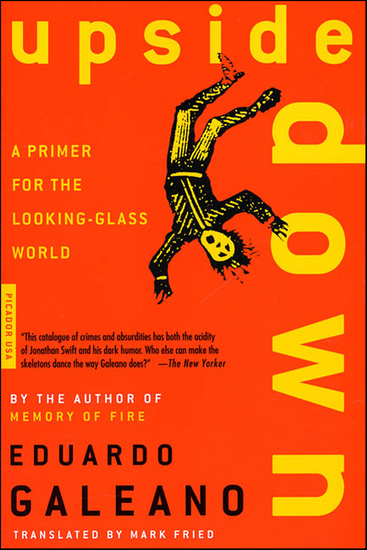
Upside Down - A Primer for the Looking-Glass World - cover
LER

Upside Down - A Primer for the Looking-Glass World

Eduardo Galeano

Tradutor Mark Fried

Editora: Metropolitan Books

  • 0
  • 0
  • 0

Sinopse

From the winner of the first Lannan Prize for Cultural Freedom, a bitingly funny, kaleidoscopic vision of the First World through the eyes of the Third.Eduardo Galeano, author of the incomparable Memory of Fire Trilogy, combines a novelist's intensity, a poet's lyricism, a journalist's fearlessness, and the strong judgments of an engaged historian. Now his talents are richly displayed in Upside Down, an eloquent, passionate, sometimes hilarious exposé of our first-world privileges and assumptions.In a series of lesson plans and a “program of study” about our beleaguered planet, Galeano takes the reader on a wild trip through the global looking glass. From a master class in “The Impunity of Power” to a seminar on “The Sacred Car” —with tips along the way on “How to Resist Useless Vices” and a declaration of “The Right to Rave” —he surveys a world unevenly divided between abundance and deprivation, carnival and torture, power and helplessness. We have accepted a reality we should reject, Galeano teaches us, one where machines are more precious than humans, people are hungry, poverty kills, and children toil from dark to dark.A work of fire and charm, Upside Down makes us see the world anew and even glimpse how it might be set right.“Galeano's outrage is tempered by intelligence, an ineradicable sense of humor, and hope.” —Los Angeles Times
Disponível desde: 06/08/2024.
Comprimento de impressão: 369 páginas.

Outros livros que poderiam interessá-lo

  • What I Wish I Said - Confessions of a Columnist - cover

    What I Wish I Said - Confessions...

    Jaime Watt

    • 0
    • 0
    • 0
    Just as they do on those television cooking contests when the bell rings and the contestants’ hands go up, at four o’clock on Friday afternoon, the column is filed—ready or not—to the columnist’s horror, discomfort, or self-satisfaction. Regardless, one exigent and unrelenting thought remains: what you wish you’d said.
    		 
    Such is the life of a weekly newspaper columnist.
    		 
    Unable to ignore the urge any longer, in What I Wish I Said: Confessions of a Columnist, author Jaime Watt has collected forty-eight of his most eye-opening, illuminating, and provocative Toronto Star columns and with humour, candour, and wit, he’s responded to each with what he wishes he’d said. The collection also features contributions from former senator and columnist André Pratte and from journalist and former editor-in-chief of the Toronto Star Michael Cooke.
    		 
    Widely regarded as Canada’s leading high-stakes communications strategist and the architect of groundbreaking campaigns that transformed politics with their boldness and creativity, Watt brings his insight to bear on some of the most vexing and consequential issues in Canadian life by reappraising his past work.
    		 
    Across six topical subject areas—civil liberties and human rights, portraits of leaders, the Liberal Party in power, the Conservative Party in opposition, the Donald Trump presidency, and the COVID-19 crisis—this subtle yet accessible collection offers a distinctive look at recent times. Whether he got it right or wrong, Watt pulls no punches when it comes to critiquing—and at times lambasting—his past columns.
    		 
    Revisiting his best and worst takes, Watt and his co-author Breen Wilkinson look at what might have been said in the columns he has been writing for more than seven years. And as he does, Watt challenges with new perspectives and ideas, inviting readers to consider what they wish they might have said, to consider how their points of views, and even their values, may have changed with time.
    Ver livro
  • The Hidden Face of Pope Francis - cover

    The Hidden Face of Pope Francis

    Paul Ariès

    • 0
    • 0
    • 0
    Why did Pope Francis canonize a priest responsible for the genocide of the Indians?
    Why does he wish to beatify the anti-Semitic French priest, Leon Dehon?  
    What are the unmentionable reasons for his papal election? 
    Pope Francis is presented as progressive and sensitive to the interests of the people, but underneath his smiles and his good words hides an authoritarian and dogmatic pope. This pope relies on very conservative movements such as Communion and Liberation or the Order of the Knights of Columbus, which are close to Opus Dei. 
    The good Pope Francis is beginning to drop his mask when he declares that Europe is undergoing a new Arab invasion (sic), when he calls on "Catholics with a sense of identity" to take to the streets, when he fights against republican secularism and demonizes atheists.
    After an overview of the financial, political and sexual scandals, Paul Ariès proceeds to a very detailed and documented analysis of the "Church of Francis," particularly in the areas of ecology and sexuality. This clear book offers a surprising insight into the best communicator the Church has known in a long time.
    Ver livro
  • The Radical Imagination of Black Women - Ambition Politics and Power - cover

    The Radical Imagination of Black...

    Pearl K. Ford Dowe

    • 0
    • 0
    • 0
    Including interviews with Black women holding political office at the national, state, and local levels, as well as focus group data, The Radical Imagination of Black Women challenges political science's current approach to political ambition by exploring how Black women decide to seek political office. Pearl K. Ford Dowe argues that ambition for Black women cannot be measured only by political candidacies and ascents of the political chain of power. Black women are uniquely positioned within their communities to influence politics and public policy, which stems from unique variables of socialization, gender and racial identity, and marginalization that shape the political attitudes of Black women. Thus, Dowe asserts that Black women's political ambition often manifests outside formal politics, in activism and community building, a process that is linked to a wider radical vision for a full democracy. This is ambition that occurs in a specific context of marginalization, and both motivation and the conditions surrounding such motivation are critical to understanding the full range of Black women's political work. By focusing on Black women's experiences in elite politics, The Radical Imagination of Black Women is a much-needed intervention in the literature on electoral ambition, women in politics, and candidates and elections.
    Ver livro
  • Grand Old Unraveling - The Republican Party Donald Trump and the Rise of Authoritarianism - cover

    Grand Old Unraveling - The...

    John Kenneth White

    • 0
    • 0
    • 0
    It didn't begin with Donald Trump. Since the time of FDR, the Republican Party has been home to conspiracy thinking, including a belief that lost elections were rigged. And when Republicans later won the White House, the party elevated their presidents to heroic status—a predisposition that eventually posed a threat to democracy. John Kenneth White proposes to explain why this happened—not just the election of Trump but the authoritarian shift in the party as a whole that led to the insurrection of January 6, 2021, and its aftermath. 


    White presents a clear and concise analysis of how the modern Republican Party came to be by tracing historical patterns that reach back to the 1930s. He argues that the rise of Republican authoritarianism has been decades in the making, going back to the desperation that took hold among party elites in the wake of twenty years of Democratic dominance between 1932 and 1952. The fear of losing that overtook the party during the Roosevelt period eventually led to an escalation of intrigue that included the rise of the John Birch Society in the 1950s and QAnon today. White traces the development of this culture of conspiracy theories within the GOP and explains how the emphasis on winning at any cost created a cult of personality and a willingness to seize power by any means necessary.
    Ver livro
  • State of the Union 1984 - cover

    State of the Union 1984

    Ronald Reagan

    • 0
    • 0
    • 0
    The 1984 State of the Union address, delivered January 25, 1984, praises “bipartisan cooperation” and says: “For a time we forgot the American dream isn't one of making government bigger; it's keeping faith with the mighty spirit of free people under God.” “Inflation has been beaten down from 12.4 to 3.2 percent…” “Real after-tax income increased 5 percent last year.” “We're seeing rededication to bedrock values of faith, family, work, neighborhood, peace, and freedom…” 
    Let us agree on goals to keep America free and secure. Our first goal is vigorous economic growth. “We can begin by limiting the size and scope of government.” The Grace Commission has 2500 recommendations to reduce wasteful spending. Also, the line-item veto which 43 of the 50 States, including California, grant their Governors is a powerful tool against wasteful spending. 
    Additional programs are proposed including a permanently manned space station. Tuition tax credits are recommended for parents who pay private school tuition to improve education by increasing competition among schools. School prayer and a law to protect unborn children from abortion are advocated, as are enterprise zones for high-unemployment areas. 
    Finally, peace is our great goal and highest aspiration. “The future is best decided by ballots, not bullets.” We will seek concerted action to combat terrorism, and work for “freer world trade, greater competition, and more open markets.” “A nuclear war cannot be won and must never be fought.”  
    Carl Sandburg said, “I see America in the crimson light of a rising sun fresh from the burning, creative hand of God… I see great days ahead for men and women of will and vision.'' 
    Audio recording courtesy of the Ronald Reagan Presidential Library. 
    AspenLeafMedia.com
    Ver livro
  • Wage Labor And Capital - cover

    Wage Labor And Capital

    Karl Marx

    • 0
    • 0
    • 0
    Originally written as a series of newspaper articles in 1847, Wage-Labor and Capital were intended to give an overview of Marx’s central theories regarding the economic relationships between workers and capitalists. These theories outlined include the Marxian form of the Labour Theory of Value, which distinguishes “labor” from “labor-power”, and the Theory of Concentration of Capital, which states that capitalism tends towards the creation of monopolies and the disenfranchisement of the middle and working classes. These theories were later elaborated in Volume 1 of Capital, published in 1867. Karl Heinrich Marx FRSA was a German philosopher, a critic of political economy, economist, historian, sociologist, political theorist, journalist, and socialist revolutionary. His best-known titles are the 1848 pamphlet The Communist Manifesto and the four-volume Das Kapital.
    Ver livro