Junte-se a nós em uma viagem ao mundo dos livros!
Adicionar este livro à prateleira
Grey
Deixe um novo comentário Default profile 50px
Grey
Assine para ler o livro completo ou leia as primeiras páginas de graça!
All characters reduced
World War II in 1941 - The History of the War’s Most Pivotal Year - cover
LER

World War II in 1941 - The History of the War’s Most Pivotal Year

Editors Charles River

Editora: Charles River Editors

  • 0
  • 0
  • 0

Sinopse

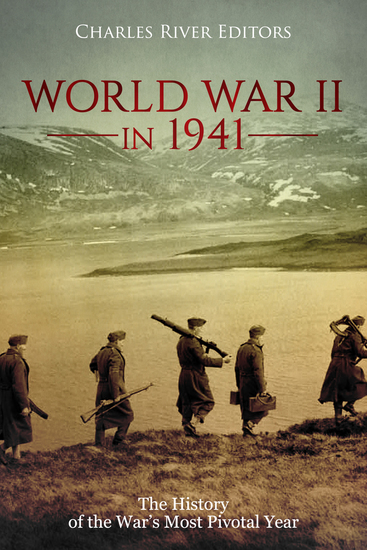
At the beginning of 1941, it was unclear whether the Allies would be able to remain in the war for much longer. British Prime Minister Winston Churchill had already immortalized the men of the Royal Air Force with one of the West’s most famous war-time quotes, but the potential of a German invasion of Britain still loomed. With the comfort of hindsight, historians now suggest that the picture was actually more complex than that, but the Battle of Britain, fought throughout the summer and early autumn of 1940, was unquestionably epic in scope. The largest air campaign in history at the time, the vaunted Nazi Luftwaffe sought to smash the Royal Air Force, but thankfully, the RAF stood toe to toe with the Luftwaffe and ensured Hitler’s planned invasion was permanently put on hold. The Allied victory in the Battle of Britain inflicted a psychological and physical defeat on the Luftwaffe and Nazi regime at large, and as the last standing bastion of democracy in Europe, Britain would provide the toehold for the June 1944 invasion of Europe that liberated the continent. For those reasons alone, the Battle of Britain was one of the decisive turning points of history’s deadliest conflict.
 
In the warm predawn darkness of June 22, 1941, 3 million men waited along a front hundreds of miles long, stretching from the Baltic coast of Poland to the Balkans. Ahead of them in the darkness lay the Soviet Union, its border guarded by millions of Red Army troops echeloned deep throughout the huge spaces of Russia. This massive gathering of Wehrmacht soldiers from Adolf Hitler's Third Reich and his allied states – notably Hungary and Romania – stood poised to carry out Operation Barbarossa, Hitler's surprise attack against the country of his putative ally, Soviet dictator Joseph Stalin.
 
Though Germany was technically Russia’s ally, Stalin had no delusions that they were friends.  Instead, he used this time to build up his forces for what he saw as an inevitable invasion.  First, on the heels of the German invasion of Poland in September 1939, Stalin had his troops invade and reclaim the land Russia had lost in World War I.  Next he turned his attention to Finland, which was only 100 miles from the newly named Leningrad.   He initially tried to negotiate with the Finnish government for some sort of treaty of mutual support.  When this failed he simply invaded.  While the giant Russian army ultimately won, the fact that little Finland held them off for three months demonstrated how poorly organized the bigger force was.
 
Stalin knew that if he could delay an invasion through the summer of 1941, he would be safe for another year, but Hitler began to plan to invade Russia by May of 1941.  Since military secrets are typically the hardest to keep, Stalin soon began to hear rumors of the invasion, but even when Winston Churchill contacted him in April of 1941 warning him that German troops seemed to be massing on Russia’s border, Stalin remained dubious. Stalin felt even more secure in his position when the Germans failed to invade the following May. 
 
What Stalin did not realize was that Hitler had simply overstretched himself in Yugoslavia and only planned to delay the invasion by a few weeks. Hitler aimed to destroy Stalin’s Communist regime, but he also hoped to gain access to resources in Russia, particularly oil.  Throughout the first half of 1941, Germany dug in to safeguard against an Allied invasion of Western Europe as it began to mobilize millions of troops to invade the Soviet Union.  Stalin even refused to believe the report of a German defector who claimed that the troops were massing on the Soviet border at that very moment. 
Disponível desde: 01/05/2025.
Comprimento de impressão: 245 páginas.
Outros livros que poderiam interessá-lo

  • Francisco de Goya: A short biography - 5 Minutes: Short on time – long on info! - cover

    Francisco de Goya: A short...

    5 Minutes, 5 Minute Biographies,...

    • 0
    • 0
    • 0
    Francisco de Goya, Spanish painting genius of the 18th century: Life and work in a short biography! Everything you need to know, brief and concise. Infotainment, education and entertainment at its best!
    Ver livro
  • Leibniz' Anthology of Maimonides' Guide - cover

    Leibniz' Anthology of...

    Lloyd Strickland, Walter Hilliger

    • 0
    • 0
    • 0
    Maimonides’ Latin translation of Moreh Nevukhim Guide for the Perplexed, was the most influential Jewish work in the last millennia (Di Segni, 2019; Rubio, 2006; Wohlman, 1988, 1995; Kohler, 2017). It marked the beginning of scholasticism, a daughter of Judaism raised by Jewish thinkers, according to historian Heinrich Graetz (Geschichte der Juden, L. 6, Leipzig 1861, p. xii). 
    Printed by Gutenberg's first mechanical press, its influence in the West went as far as the Fifth Lateran Council (1512 — 1517) "where scholars were encouraged to remove the difficulties which seemed to divide the whole of theology and philosophy (Leibniz, Théodicée, 11)." 
    For centuries, the Guide revolutionized the curriculum of school instruction by reintegrating the natural laws of thought in the sphere of faith (the fourth of which became Leibniz’ Principle of sufficient reason). 
    This complete collection of notes expounds the ideas of the Guide and features all the passages selected and rewritten by Leibniz. This first complete annotated bilingual translation of the original manuscripts in Latin serves as an entry point to the faith in conformity with Reason. 
    Rabbi Moses Maimonides' excellent book, A Guide to the Perplexed, is more philosophical than I had imagined and worthy of careful reading. The author, distinguished by his intelligence in philosophy, was well-versed in mathematics, medical art, and also in the knowledge of the sacred Scriptures. — G.W. LEIBNIZ, 1685, Leibniz’ Anthology of Maimonides’ Guide, Chapter III. 
    Rabbi Moses Ben Maimon referred to by the initials of his name as RAMBAM, also known in the past as Moseh d’Egypto (Moses of Egypt) because of his long residence there, was born in Córdoba (Spain) in 1131 4891 and left this temporal world in 1204 4964. He is the most universal Rabbi of an eternal tradition.
    Ver livro
  • A Reading of the Inaugural Address of President George Washington - cover

    A Reading of the Inaugural...

    President George Washington

    • 0
    • 0
    • 0
    George Washington (February 22, 1732 - December 14, 1799) was a Founding Father and the first president of the United States, serving from 1789 to 1797. As commander of the Continental Army, Washington led Patriot forces to victory in the American Revolutionary War against the British Empire. He is commonly known as the Father of His Country for his role in bringing about American independence. The following is a reading of President Washington's inaugural address delivered on April 30, 1789.
    Ver livro
  • The Sane Citizens Political Handbook - cover

    The Sane Citizens Political...

    Alexander Oakes, Zachariah Oakes

    • 0
    • 0
    • 0
    When it comes to politics, in today's day and age our country is more divided than ever. Furthermore, this divide has transcended politics and now determines where you are allowed to live, who you can be friends with, and even what beer you can drink. Well, if you are like me then this status quo of "us vs them" politics is far from ideal. In fact, I would go so far as to say it is a legitimate travesty that would have the founders rolling in their graves. I say this because what makes this country so special, in my view, is that our country, the United States of America, is built upon a Constitution that enshrines We the People's power over the nation-state. 
    In other words, the American people are not subjects, we are citizens, and as citizens it is our inherent right, nay, our responsibility to collectively decide how the levers of US political power are pulled because, at the end of the day, the government answers to us, not the other way around. But we can't effectively do this when we are busy dividing ourselves into teams and fighting each other, can we? 
    In essence, that is the problem that this book seeks to remedy. This is to say that The Sane Citizens Political Handbook takes some of the most divisive political issues of our time and breaks them down in a non-partisan way so that you, the sane citizen who is fed up with the current Republican/Democrat duopoly, can have a reasonable position on those issues that is grounded in logic, science, and the US Constitution, not one of the two major political parties. 
    With that said, if you, like me, are tired of party lines and political tribalism, then put on your thinking cap, crack open this book, and break free from the red and blue chains that have been systematically enslaving you.
    Ver livro
  • Crisis Convoy - The Story of HX231 A Turning Point in the Battle of the Atlantic - cover

    Crisis Convoy - The Story of...

    Sir Peter Gretton

    • 0
    • 0
    • 0
    In April 1943, Commander Peter Gretton was in charge of escorting a vital Allied trade convoy from New York to Great Britain across the North Atlantic. Over the course of the voyage, the sixty-one merchant ships of convoy HX231, along with the six ships of B7 Escort Group, were continuously shadowed and attacked by a German wolf pack of twenty U-boats. 


    With the aid of air support, the convoy and defending escort fought valiantly across hundreds of miles of ocean and, despite poor weather conditions, managed to sink and severely damage several enemy submarines. Tragically six merchant ships were torpedoed and with no rescue vessel any survivors were left stranded in the freezing waters of the Atlantic as the convoy continued on its journey. 


    Drawing on reports from both sides, Gretton details the sequence of events as convoy HX231 battled its way through a large wolf pack and offers an authoritative post-battle analysis of the strategies, decisions, and actions taken that would ultimately see the tide of war turn in favor of victory for the Allies. 


    Crisis Convoy takes the listener to the heart of the action and is a thrilling account of naval warfare during World War II.
    Ver livro
  • Capitalism - The Story behind the Word - cover

    Capitalism - The Story behind...

    Michael Sonenscher

    • 0
    • 0
    • 0
    What exactly is capitalism? How has the meaning of capitalism changed over time? And what's at stake in our understanding or misunderstanding of it? In Capitalism, Michael Sonenscher examines the history behind the concept and pieces together the range of subjects bound up with the word. Sonenscher shows that many of our received ideas fail to pick up the work that the idea of capitalism is doing for us, without us even realizing it. 


    "Capitalism" was first coined in France in the early nineteenth century. It began as a fusion of two distinct sets of ideas. The first involved thinking about public debt and war finance. The second involved thinking about the division of labor. Sonenscher shows that thinking about the first has changed radically over time. Funding welfare has been added to funding warfare, bringing many new questions in its wake. Thinking about the second set of ideas has offered far less room for maneuver. The division of labor is still the division of labor and the debates and discussions that it once generated have now been largely forgotten. By exploring what lay behind the earlier distinction before it collapsed and was eroded by the passage of time, Sonenscher shows why the present range of received ideas limits our political options and the types of reform we might wish for.
    Ver livro