¡Acompáñanos a viajar por el mundo de los libros!
Añadir este libro a la estantería
Grey
Escribe un nuevo comentario Default profile 50px
Grey
Suscríbete para leer el libro completo o lee las primeras páginas gratis.
All characters reduced
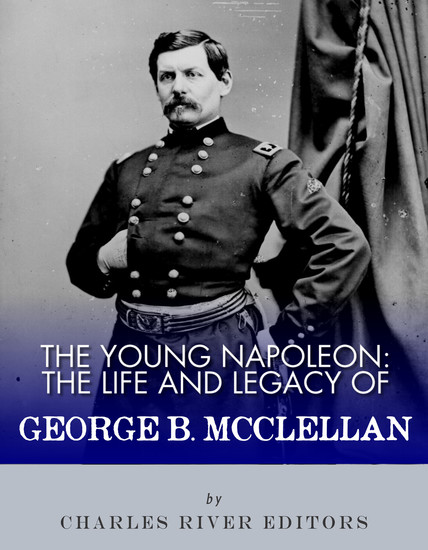
The Young Napoleon - The Life and Legacy of George B McClellan - cover

The Young Napoleon - The Life and Legacy of George B McClellan

Editors Charles River

Editorial: Charles River Editors

  • 0
  • 0
  • 0

Sinopsis

“McClellan is to me one of the mysteries of the war." – Ulysses S. Grant
 
Over the last 150 years, historians and Americans have endlessly debated over the Civil War, including its causes and the best and worst generals. Nowhere has there been a sharper debate than over the career and legacy of George McClellan, with a majority viewing him as the North’s biggest goat and a small but vocal minority insisting that McClellan was a very good general who was made a scapegoat by the Lincoln Administration and its supporters. Many members of the “McClellan Society” continue to assert that McClellan would have ended the war in 1862 without the Administration’s interference.
 
In 1861, McClellan was looked upon as a hero and even possibly a savior. Dubbed “The Young Napoleon”, the 35 year old had been a prodigy at West Point, finishing in second place in the Academy’s most famous class, the Class of 1846. After earning praise for his service in the Mexican-American War, McClellan had a short but successful career in the railroad industry and had been a foreign observer at the siege of Sevastopol during the Crimean War. At the outbreak of the Civil War, there was no question that McClellan was one of the brightest and most experienced of the North’s generals.
 
Ultimately, of course, McClellan went from hero to goat, at least in the eyes of President Lincoln, who famously wrote that McClellan “has the slows”. It was a sharp critique of McClellan’s cautious movements, but McClellan was also faulted for conservative battlefield leadership in the Peninsula Campaign and at Antietam. McClellan also constantly overestimated his opponent’s manpower, at times thinking the Confederates had double his Army of the Potomac when the exact opposite was the case. It was after Antietam and his bickering with the War Department over why he wasn’t chasing Lee’s battered Army of Northern Virginia that Lincoln finally sacked him, effectively ending his Civil War career.
 
McClellan is best remembered for 1862, but he was also a Governor of New Jersey, Lincoln’s opponent in the 1864 presidential election, and a writer seeking to reestablish his reputation before his untimely death. The Young Napoleon addresses the controversies and battles McClellan fought both on and off the field, but it also humanizes a man who was almost universally loved by the veterans of the Army of the Potomac and who wrote his most candid remarks to his wife. Along with pictures of McClellan and other important people, places and events in his life, you will learn about the “Young Napoleon” like you never have before, in no time at all.  
Disponible desde: 05/05/2025.
Longitud de impresión: 71 páginas.
Otros libros que te pueden interesar

  • A Ramble About Tallaght - History People Places - cover

    A Ramble About Tallaght -...

    Albert Perris

    • 0
    • 0
    • 0
    A fascinating history of an ancient place.
    From its first mention in legend in the Book of Invasions, through early Christian monastic settlements, castles and grand residences, Fenian raids and the Battle of Tallaght, there has been huge change in Tallaght. In more recent times it has seen car and motorcycle racing, an aerodrome, the rise and fall of a chocolate factory and a pioneering telecommunications firm. The massive population explosion and rapid modernisation towards the end of the twentieth century means this once-tiny village in Dublin's foothills is now home to over 80,000 people.
    Richly illustrated with period photographs and original drawings by Michael O'Brien, Albert Perris tells the often-surprising story of Tallaght.
    Ver libro
  • Summary of Benny Lewis's Fluent in 3 Months - cover

    Summary of Benny Lewis's Fluent...

    Falcon Press

    • 0
    • 0
    • 0
    Buy now to get the main key ideas from Benny Lewis's Fluent in 3 Months 
      
    Do you wish you had paid attention and actually learned French in high school? Is “learn Spanish” one of the New Year’s resolutions you always fail to keep? Benny Lewis’s Fluent in 3 Months (2014) can teach you how to change that. 
    A language is used for communication, and you should always strive to utilize it with other people, no matter what your skill level is. Forget the traditional learning methods, such as memorizing vocabulary lists and conjugation sheets, which are the reason many beginners get discouraged. Instead, Lewis shows you how to apply interesting methods that help you learn language quickly and start speaking it with others. The learning process should be fun and alive, just like language itself.
    Ver libro
  • Conversational Spanish for Beginners - Master Espanol Language in 60 Days with Dialogues Short Stories and Simple Vocabulary Words Learn How To Speak Mexican Spanish While Sleeping or in Your Car – Quick & Easy Methods for Kids Adults and Dummies - cover

    Conversational Spanish for...

    Damián Carabello

    • 0
    • 0
    • 0
    ¡Hola, amigo! Are you ready to unlock the vibrant world of Spanish and transform your language skills in just a few hours? "Conversational Spanish for Beginners" is your ticket to a thrilling linguistic journey that will have you chatting confidently with native speakers in no time! Imagine walking the bustling streets of Madrid, ordering tapas like a local in Barcelona, or making new friends on the beaches of Mexico – all in Spanish! This audiobook is your personal guide to making those dreams a reality. With 23 engaging chapters covering real-life scenarios, you'll learn the exact phrases and expressions you need to navigate any situation with ease. From bargaining at a market to discussing your symptoms with a doctor, you'll pick up authentic, conversational Spanish that you can use immediately. By the end of this audiobook, you'll be amazed at how much you've learned. Don't just learn Spanish – live it, breathe it, and make it your own! ¡Vamos! Your adventure starts now!
    Ver libro
  • The Gods Were Astronauts - The Extraterrestrial Identity of the Old Gods Revealed - cover

    The Gods Were Astronauts - The...

    Erich von Däniken

    • 0
    • 0
    • 0
    Bestselling author Erich von Däniken explores the evidence of ancient visitors treated as gods in religious scripture and mythology. His findings shake the foundations of both science and faith. Why do nearly all the world’s major religions share similar myths and legends? Whether it’s the Old Testament, ancient legends, or the creation myths of New Zealand’s natives, you come across similar stories everywhere. Erich von Däniken, author of the international bestseller Chariots of the Gods, believes he knows the answer—and it is as wondrous and awe-inspiring as it is controversial: The winged angels populating the Bible, the Koran, and other religious texts from cultures the world over were, in reality, extraterrestrials who visited the Earth in ages long past. Who were the gods of ancient lore? How can the contradictions in the Bible be explained? Why are the pagodas of Myanmar (formerly Burma) so amazingly similar to space-capable rockets? Erich von Däniken provides convincing new and surprising interpretations and answers that fundamentally contradict both the teachings of religion and current science. His astonishing conclusion: The gods were not metaphysical beings that humans created in their imagination, but extraterrestrial intelligences that have left their traces all over the Earth. He offers persuasive evidence that actual living beings inspired the legends that became the basis for many of our religious traditions.
    Ver libro
  • The Storming of the Bastille - Birth of the French Revolution - cover

    The Storming of the Bastille -...

    Amara Blackwood

    • 0
    • 0
    • 0
    The French Revolution did not erupt suddenly on July 14, 1789. Rather, it was the result of deep-rooted issues that had been festering for decades. The Ancien Régime, a rigid social and political structure, created vast inequalities that left the majority of the population burdened with heavy taxes and little representation. At the same time, Enlightenment thinkers challenged traditional authority, inspiring people to demand fundamental rights. Adding to these tensions was a financial crisis that left the government unable to function effectively, further alienating the common people from the monarchy. 
    Under the Ancien Régime, French society was divided into three estates. The First Estate, composed of the clergy, and the Second Estate, made up of the nobility, enjoyed numerous privileges, including exemption from most taxes. The Third Estate, which included the bourgeoisie, urban workers, and peasants, bore the financial weight of the nation. These commoners made up the vast majority of the population but had little say in political matters. Discontent grew as food prices soared, wages stagnated, and oppressive taxes drained the resources of ordinary citizens. The nobility and clergy, unwilling to relinquish their privileges, further deepened the divide between the ruling class and the people. 
    As social inequality worsened, Enlightenment ideas provided a new way of thinking. Philosophers such as Voltaire, Rousseau, and Montesquieu argued against absolute monarchy and promoted concepts such as liberty, equality, and popular sovereignty. Their writings spread widely, influencing the educated middle class and encouraging political discussions. Many began to question the legitimacy of the monarchy and the rigid class system. The belief that power should come from the people, rather than from divine right, gained traction, setting the stage for a confrontation with the old order.
    Ver libro
  • The Concentration of Power - Institutionalization Hierarchy & Hegemony - cover

    The Concentration of Power -...

    Anders Corr

    • 0
    • 1
    • 0
    Since the beginning of organized societies, power and leadership have operated in human hierarchies, which are concentrating power in an accelerating manner, according to the comprehensive analysis of Dr. Anders Corr in his book The Concentration of Power: Institutionalization, Hierarchy & Hegemony.
    		 
    “This sweeping study belongs next to Niall Ferguson and Jared Diamond in our understanding of how the world works and how it can work better.” — James Kraska, Harvard Law School
    		 
    “A must-read for legislators, military strategists, leading academics, regulators, and anyone interested in the existential threat that the concentration of economic, political, and informational power in an illiberal country like China creates for the leading democracies of the world.” - Kyle Bass, Billionaire investor
    		 
    “…erudite and realistic appraisal of 21st century power politics.” — Alex Gray, former Chief of Staff, White House National Security Council
    		 
    From The Book:
    		 
    “China’s influence in US politics has coincided with the industrialization of China, at the expense of a deindustrializing US. Global corporations, to which US politicians answer, fled high wages and environmental regulations  in the US for low wages and lax environmental standards in China. Now, the US is paying the price and might not recover sufficiently to defend itself against China’s growing military. The strategic ambitions of one nation can and have upset the United Nations and the balance between powers. Now the Western world must understand the imminent threats from the hegemonic ambitions of China.”
    		 
    Hierarchy is the  “institutionalization of power,” according to Dr. Corr’s The Concentration of Power, an institutionalization that is concentrating and accelerating over historical time, from prehistory to the present. Corr develops twelve historical theories and applies them to the greatest conflicts of the past and present, including during the age of empires, the present competition between superpowers such as the United States and China, as well as conflicts between the nation-state and emerging supranational powers such as the European Union and United Nations. Corr’s theories apply to domestic politics as well, as illustrated by the evolution of conflicts between communism, fascism, and liberal democracy. 
    		 
    Corr argues that the concentration of power acts as a ratchet. It concentrates when conditions are ripe, and force is applied. Due to mechanisms like subsidies, transfers, and corruption, however, power does not easily return to an unconcentrated state when conditions are not ripe. This dynamic dynamic of the ratchet drives international and domestic concentration of power, with no apparent end other than a global illiberal hegemon at some point in the future. 
    		 
    In sum, The Concentration of Power is a short history of the world, from the beginning to what the evidence indicates should be its logical conclusion. From politics to unions, associations, corporations, and the military, Dr. Corr analyzes them and provides readers with a sense of what the world could face if we allow hierarchy to continue its historical development toward global and illiberal hegemony. Be it in China, the United States, or the European Union, all are vying for global influence and the utilization of the structure of the United Nations to promote either the principles of human rights and democracy, or in the case of Beijing, the exact opposite. This clash between democracy and autocracy on a global level could turn into a final war of world proportions.
    		 
    No greater stakes have ever existed in world history.
    Ver libro