Join us on a literary world trip!
Add this book to bookshelf
Grey
Write a new comment Default profile 50px
Grey
Subscribe to read the full book or read the first pages for free!
All characters reduced
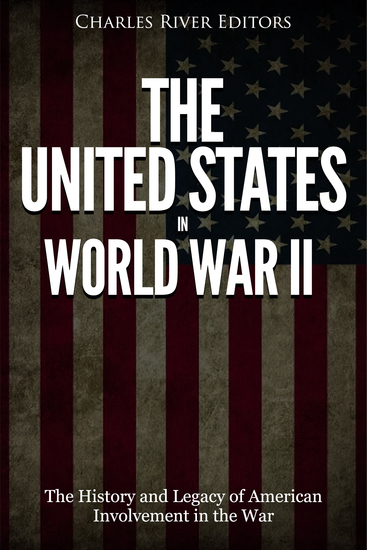
The United States in World War II - The History and Legacy of American Involvement in the War - cover

The United States in World War II - The History and Legacy of American Involvement in the War

Editors Charles River

Publisher: Charles River Editors

  • 0
  • 0
  • 0

Summary

All Americans are familiar with the “day that will live in infamy.” At 9:30 a.m. on Sunday, December 7, 1941, Pearl Harbor, the advanced base of the United States Navy’s Pacific Fleet, was ablaze. It had been smashed by aircraft launched by the carriers of the Imperial Japanese Navy. All eight battleships had been sunk or badly damaged, 350 aircraft had been knocked out, and over 2,000 Americans lay dead. Indelible images of the USS Arizona exploding and the USS Oklahoma capsizing and floating upside down have been ingrained in the American conscience ever since. In less than an hour and a half the Japanese had almost wiped out America’s entire naval presence in the Pacific.
 
The United States began 1942 determined to avenge Pearl Harbor, but the Allies, now including the Soviet Union by necessity, did not agree on the war strategy.  In 1941, both the Germans and British moved armies into North Africa, where Italy had already tried and failed to reach the Suez Canal.  The British sought American help in North Africa, where British General Bernard Montgomery was fighting the legendary “Desert Fox,” General Erwin Rommel.  At the same time, Stalin was desperate for Allied action on the European continent that could free up the pressure on the besieged Soviets. 
 
President Roosevelt had a consequential decision to make, and he eventually decided to land American forces on North Africa to assist the British against Rommel, much to Stalin’s chagrin.  While the Americans and British could merely harass the Germans with air power and naval forces in the Atlantic, Stalin’s Red Army had to take Hitler’s best shots in Russia throughout 1942.  But the Red Army’s tenuous hold continued to cripple the Nazi war machine while buying the other Allies precious time.
 
As it turned out, Roosevelt’s decision to first fight in North Africa would make an Allied invasion of the European continent possible in 1943.  As Rommel pushed east, he now had to worry about American forces to his west.  The Allies eventually gained the upper hand across North Africa after the battle at El Alamein near the end of 1942 that all but forced the Germans to quit the theater without achieving their objectives. 
 
With the Axis forced out of North Africa, the Allies had freed up its North African forces for an invasion of Western Europe.  Moreover, with North Africa as a potential staging around for that invasion, the Germans had to prepare for the possibility of the Allies invading not only from Britain but also from North Africa.  The Allies would make that decision in early 1943.
 
Despite fighting in North Africa and the Atlantic, the United States still had the resources and manpower to fight the Japanese in the Pacific.  Though the Japanese had crippled the American fleet at Pearl Harbor, its distance from Japan made an invasion of Pearl Harbor impossible, and Japan had not severely damaged important infrastructure.  Thus, the United States was able to quickly rebuild a fleet, still stationed at Pearl Harbor right in the heart of the Pacific.  This forward location allowed the United States to immediately push deeply into the Pacific theater.
 
In fact, the turning point in the Pacific theater took place in 1942 near Midway Island.  The Japanese had moved a sizable fleet intending to occupy Midway Island and draw the American navy near.  Instead, American aircraft flying from three aircraft carriers that had been away from Pearl Harbor in December 1941 got a bearing on the Japanese fleet and sunk four Japanese aircraft carriers, permanently crippling Japan’s navy.  The Battle of Midway was the first naval battle in history where the enemy fleets never saw or came into contact with each other.
 
Thus, 1942 ended with the Allies turning the tide in the Pacific and North Africa, giving them momentum entering 1943.  
Available since: 05/01/2025.
Print length: 849 pages.

Other books that might interest you

  • Steppe Nomads The: The History of the Different Nomadic Groups and Their Raids into Europe - cover

    Steppe Nomads The: The History...

    Editors Charles River

    • 0
    • 0
    • 0
    Though history is usually written by the victors, the lack of a particularly strong writing tradition from the Mongols ensured that history was largely written by those who they vanquished. Because of this, their portrayal in the West and the Middle East has been extraordinarily (and in many ways unfairly) negative for centuries, at least until recent revisions to the historical record. The Mongols have long been depicted as wild horse-archers galloping out of the dawn to rape, pillage, murder and enslave, but the Mongol army was a highly sophisticated, minutely organized and incredibly adaptive and innovative institution, as witnessed by the fact that it was successful in conquering enemies who employed completely different weaponry and different styles of fighting, from Chinese armored infantry to Middle Eastern camel cavalry and Western knights and men-at-arms.  
    	Geographically the Tatars descend from several parts of Asia, particularly Central Asia, but the Crimean region has been the nexus of several great power rivalries and numerous conflicts. Yet the Crimean Tatars endured through many of these, aligning themselves with a number of larger powers and developing a reputation as fearsome warriors. Today the Tatars are mainly linked with and live in the Volga region of the Russian Federation. Indeed, Tatarstan is a republic in modern Russia. The “Volga Tatars” are perhaps the best known of the peoples known as Tatars and today number about 5 million people.  
    	Before the Mongols rode across the steppes of Asia and Eastern Europe, the Cumans were a major military and cultural force that monarchs from China to Hungary and from Russia to the Byzantine Empire faced, often losing armies and cities in the process. The Cumans were a tribe of Turkic nomads who rode the steppes looking for plunder and riches, but they rarely stayed long after they got what they wanted. 
    Show book
  • The Psychology of Misinformation - cover

    The Psychology of Misinformation

    Sander van der Linden, Jon...

    • 0
    • 0
    • 0
    King Charles III is Dracula's distant cousin. Governments are hiding information about UFOs. COVID-19 came from outer space. These sound like absurd statements, but some are true, and others are misinformation. But what exactly is misinformation? Who believes and spreads things that aren't true, and why? What solutions do we have available, and how well do they work? This book answers all these questions and more. Tackling the science of misinformation from its evolutionary origins to its role in the internet era, this book translates rigorous research on misleading information into a comprehensive and jargon-free explanation. Whether you are a student, researcher, policymaker, or changemaker, you will discover an accessible analysis on human belief in today's world and expert advice on how to prevent deception.
    Show book
  • ASMR Whisper Before Sleep for Manifestation - cover

    ASMR Whisper Before Sleep for...

    Whispering Voice

    • 0
    • 0
    • 0
    ASMR Whisper Before Sleep for Manifestation is your perfect companion for turning your dreams into reality while you sleep. Imagine falling asleep to the calming sound of soft whispers, each one laced with powerful affirmations designed to help you manifest your deepest desires. As the soothing whispers gently guide you into a peaceful slumber, your subconscious mind begins to absorb the affirmations, setting the stage for positive changes in your life. 
    This audiobook combines the relaxing power of ASMR with the transformative process of manifestation, creating a calming environment where you can release the stress of the day and focus on what truly matters. The gentle whispers help quiet your mind, clear limiting beliefs, and plant seeds of success, abundance, and personal growth. 
    Perfect for those looking to create a life of intention and purpose, ASMR Whisper Before Sleep for Manifestation will help you align your thoughts with your goals. With each listening session, you’ll drift deeper into relaxation, while the whispers guide you toward manifesting everything you desire. Let the power of your mind work for you, all while you rest and rejuvenate.
    Show book
  • Peter the Great - cover

    Peter the Great

    Kelly Mass

    • 0
    • 0
    • 0
    From May the 7th, in 1682 till his death in 1725, Peter the Great or Pyotr Alekséyevich governed the Tsardom of Russia and ultimately the Russian Empire, collectively ruling before 1696 with his older half-brother, Ivan V.He got ports on the Azov and Baltic Seas through a series of triumphant disputes, creating the structure for the Imperial Russian Navy, ending undisputed Swedish control in the Baltic, and launching the Tsardom's development into a much larger empire that would end up being a major European force. He was the leader of a cultural revolution that saw some standard and middle ages social and political structures changed with modern-day, clinical, Westernized, and Enlightenment-based systems. Peter's reforms had a long-lasting effect on Russia, and tons of the Russian federal government's organizations can be traced back to his reign. In 1721, he changed the former title of Tsar with the title of Emperor, and he created and broadened the city of Saint Petersburg, which stayed Russia's capital till 1917.Peter the Great has had a significance influence on the structure of Russia, the history, and the future in the succeeding decades after him. Let’s see what else he did while he was alive.
    Show book
  • Moving Past Marriage - Why We Should Ditch Marital Privilege End Relationship-Status Discrimination and Embrace Non-marital History - cover

    Moving Past Marriage - Why We...

    PhD Jaclyn Geller

    • 0
    • 0
    • 0
    A must-listen for anyone who has felt they are at a disadvantage simply because they are single or unmarried. 


    Married Americans enjoy over 1,000 benefits and entitlements that are withheld from our nonmarital counterparts. Health insurance, immigration rights, tax privileges (such as the estate tax), and hiring policies favor the married. Marriage is financially supported and incentivized by the federal government. Social customs such as blockbuster weddings, subvented honeymoons, and gifts reserved for wedded couples reify matrimony as a centering norm and further the idea that "marriage is best," a commonplace in popular psychology, where marriage-averse people are often tarred as "commitment-phobes." Despite this blatant and widespread prejudice, nonmarital Americans—nonmarital people—have not galvanized as a group to demand equality and inclusion. Why? 


    Moving Past Marriage argues that it is because of our troubled relationship to history. As women's history once was, nonmarital history has been buried, so the disenfranchisement that nonmarital people share in wedlock-dominated societies, as well as our remarkable, far-ranging achievements, have been hard to spot. In recovering our own history, nonmarital people can become self-aware as a group and begin to challenge marriage-centric thinking and practice.
    Show book
  • The Pilgrim - SAS Who Dares Wins - cover

    The Pilgrim - SAS Who Dares Wins

    Colin Maclachlan

    • 0
    • 0
    • 0
    The Pilgrim is the book the MOD tried to ban. It is a rollercoaster of an autobiography of Colin Maclachlan, known for his appearances on shows like Channel 4's SAS: Who Dares Wins and Channel 5's Secrets of the SAS.His autobiography starts with his troubled childhood and escape to the military where, as a fifteen year-old boy, he grows up and matures into the SAS soldier we now recognise. Early chapters describe physical, mental and sexual abuse and Colin could easily have ended up in a home but despite the odds and with the help of both the Children's Panels, NSPCC and some diligent schoolteachers, Colin escaped to the army. Colin had to get special permission to join the army at only fifteen years of age and goes from being a young vulnerable and damaged boy to a capable soldier through preparation for the first Gulf War and joining the oldest and most senior infantry regiment in the British Army, The Royal Scots. From operations in Northern Ireland to being the Queen's Butcher to Colin's first TV cameos on Soldier Soldier and Gladiators, Colin's stories and anecdotes are both exhilarating and hilarious.Colin then describes the arduous SAS selection process, the hardest and most gruelling military selection process in the world. Colin describes in some detail what most have never even heard in this secretive world where Colin goes from a course of what seemed hundreds down to only six percent in six months! The reader is then taken on a never seen before description of life as an SAS operator. Daily life in an operational squadron and the operations, missions and training involved all described in detail. Colin was part of Mountain Troop, D Squadron who were to be involved in some of the most high-profile and dangerous missions in SAS history.
    Show book