Join us on a literary world trip!
Add this book to bookshelf
Grey
Write a new comment Default profile 50px
Grey
Subscribe to read the full book or read the first pages for free!
All characters reduced
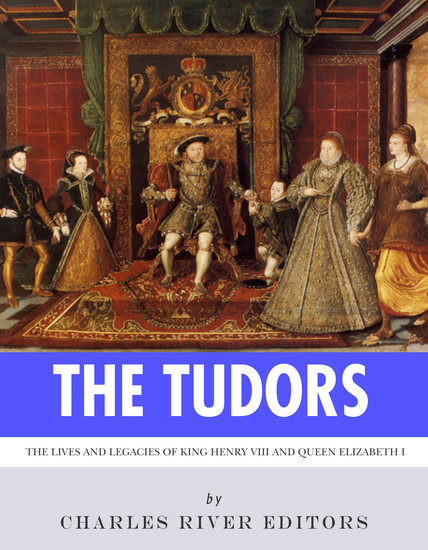
The Tudors - The Lives and Legacies of King Henry VIII and Queen Elizabeth I - cover

The Tudors - The Lives and Legacies of King Henry VIII and Queen Elizabeth I

Editors Charles River

Publisher: Charles River Editors

  • 0
  • 0
  • 0

Summary

Over 450 years after his reign, Henry VIII is still the most famous and recognizable King of England, but it’s for all the wrong reasons. Though well regarded by contemporaries as a learned king and "one of the most charismatic rulers to sit on the English throne", he is best remembered today for his gluttony and multiple marriages, particularly the gruesome way in which he was widowed on more than one occasion. Naturally, that was the focus of the popular ShowTime drama series centered around his life, The Tudors.
 
Henry VIII will probably continue to be best known for beheading some of his wives, most notably Anne Boleyn, so it is somewhat fitting that his most decisive act came as a result of a marital mishap. Sharply at odds with the Catholic Church over his attempt to dissolve his marriage with Catherine of Aragon, Henry VIII ultimately broke with the Church and established the Church of England, which forever both the religious history of England and the social hierarchy of the nation and its empire. 
 
 Though the popular perception of his reign has taken hold, King Henry VIII did not start life in any of those ways. In fact, he did not even start life as heir to the English throne. And when he did come to the throne at the age of 18, King Henry VIII’s earliest monarchical years showed his promise as a quintessential renaissance, polymath Prince. Even on the religious front, Henry VIII started out believing in the essential Catholic theology, even after the Pope and the Vatican excommunicated Henry from the Catholic Church (until then, the undisputed political as well as theological leader of Christendom, from which monarchs often needed various forms of legitimacy).
 
When Queen Elizabeth II came to the throne in 1952, many commentators heralded the beginning of her reign as the second Elizabethan age. The first one, of course, concerned the reign of Henry VIII’s second surviving daughter and middle surviving child, Queen Elizabeth I, one of England’s most famous and influential rulers. It was an age when the arts, commerce and trade flourished. It was the epoch of gallantry and great, enduring literature. It was also an age of wars and military conflicts in which men were the primary drivers and women often were pawns.


Elizabeth I changed the rules of the game and indeed she herself was changed by the game. She was a female monarch of England, a kingdom that had unceremoniously broken with the Catholic Church, and the Vatican and the rest of Christendom was baying for her blood. She had had commercial and militaristic enemies galore. In the end, she helped change the entire structure of female leadership.
 
 Elizabeth was the last Tudor sovereign, the daughter of the cruel and magnificent King Henry VIII and a granddaughter of the Tudor House’s founder, the shrewd Henry VII. Elizabeth, hailed as “Good Queen Bess,” “Gloriana” and “The Virgin Queen” to this day in the public firmament, would improve upon Henry VIII’s successes and mitigate his failures, and despite her own failings would turn out to “have the heart and stomach of a king, and a king of England too”. Indeed, that was the phrase she would utter in describing herself while exhorting her troops to fight for England against the Spanish Armada.
 
 Elizabeth often has been featured in biographies that were more like hagiographies, glossing over her fits of temper, impatience and other frailties. It is fair to say, however, that she had also inherited her grandfather’s political acumen and her father’s magnificence, thus creating not just one of the most colourful courts in Europe but also one of the most effective governments in English history. It was an age of Christopher Marlowe’s and William Shakespeare’s flourishing creativity that still enhances English as well as comparative literature.
Available since: 06/27/2025.
Print length: 58 pages.

Other books that might interest you

  • The Art of Manipulation Super Series - (5 Books in 1) A Deep Dive Into Understanding All Facets of Manipulation How to Use It to Get What You Want and How to Defend Against - cover

    The Art of Manipulation Super...

    John Mentory, Omar Johnson,...

    • 0
    • 0
    • 0
    Venture into the shadowy realms of influence and control with "The Art of Manipulation Super Series," a powerful compilation that unites five riveting books into one definitive collection. This series is designed to unveil the subtle arts of emotional and psychological manipulation, equipping you with the knowledge to wield or withstand these tactics in your daily life. 
    "Covert Emotional Manipulation Exposed!" by John Mentory reveals the unseen methods manipulators use to seize control over your feelings, decision-making, and self-esteem. This book is your shield and strategy guide against those who operate from the shadows to pull your strings. 
    In "The Art of Manipulation" by Omar Johnson, discover how manipulation can be both a tool and a weapon. Learn the nuances of steering others towards your desired outcomes or identifying when such techniques are being used against you. 
    "Why Women Manipulate Men" by Charlize Venter delves into the historical and psychological underpinnings of manipulation in the dynamic between men and women. This book seeks to answer the probing question of why manipulation has become a prevalent strategy among women through the ages and how it shapes relationships today. 
    Janice Presser's "Controlling and Manipulative Men" uncovers the traits of men who control and manipulate, guiding you through the signs, responses, and escape strategies to deal with such individuals in your life. 
    Lastly, "Defeat Manipulation 101" by HT Wyatt is your ultimate handbook for fortifying yourself against the psychological onslaught of manipulators. Claim your right to a life of dignity, respect, and autonomy.
    Show book
  • Lafayette We Are Here! - 6th June 1918: The American Marines Attack Belleau Wood - cover

    Lafayette We Are Here! - 6th...

    Jean-Michel Steg

    • 0
    • 0
    • 0
    A thrilling account of one specific First World War battle. Will appeal to military history enthusiasts, as well as general non-fiction readers.
    Show book
  • Driving Lessons - A Road Trip through American Travel Literature - cover

    Driving Lessons - A Road Trip...

    Christopher B. Strain

    • 0
    • 0
    • 0
    In Driving Lessons, Christopher B. Strain sets out on a quintessential American road trip, exploring not just the roads and byways of the country but the road trip's place in American culture. Strain dives into the well of American travel writing, illuminating fascinating aspects of the road trip, such as how race, class, and gender shape the experiences of road trippers. 


    In the summer of 1998, amid a professional crisis of confidence, Strain settled on a plan to reconnect with both himself and the country he studies. He purchased a 1972 Volkswagen Westfalia van and set off on his own cross-country odyssey. In the weeks that followed, he ruminated on his own ongoing journey alongside great journeys from the past and how they reveal the heart of the traveler as well as the landscape of the nation. 


    Visiting archives and landmarks across the United States, Strain's journey became a parallel to the stories he studied—an opportunity to see and experience the cities, national parks, and monuments that define United States history. Driving Lessons is a compelling blend of literary analysis and memoir, offering listeners an insightful and heartfelt reflection on the enduring power of the American road trip.
    Show book
  • The Collapse of Constitutional Remedies - cover

    The Collapse of Constitutional...

    Aziz Z. Huq

    • 0
    • 0
    • 0
    For years, the Supreme Court has turned a deaf ear to arguments that police officers should not be shielded by the legal doctrine of “qualified immunity” when they shoot or brutalize innocent civilians. “Qualified immunity” is just one of  
    several rules invented by judges that stop the vindication of basic rights. But aren’t courts supposed to be protectors of individual rights? In The Collapse of Constitutional Remedies, Aziz Z. Huq recounts a far more fraught history in which  
    the link between the Constitution’s system of independent courts and the protection of constitutional rights has always been tenuous.  
     
    Federal courts have created many legal concepts such as “qualified immunity” that may seem abstract, but inflict real-world harms: A bureaucrat fires her employee for testifying in a legal proceeding involving the boss’s family. Police  
    officers set a dog on a homeless man, leaving him severely wounded. A Mexican teenager is shot in the back at the US border—and dies. In all these cases, defendants walk away with minor or no penalties. Their victims had rights—but  
    no remedies thanks to rules created by federal judges.  
     
    A powerful historical account of how courts have carved a gap between rights and remedies, this book will reshape our understanding of why it’s so difficult to hold the American state to the rule of law.
    Show book
  • The Uptown Local - Joy Death and Joan Didion: A Memoir - cover

    The Uptown Local - Joy Death and...

    Cory Leadbeater

    • 0
    • 0
    • 0
    A brilliant debut memoir about a young writer—struggling with depression, family issues, and addiction—and his life-changing decade working for Joan Didion 
    As an aspiring novelist in his early twenties, Cory Leadbeater was presented with an opportunity to work for a well-known writer whose identity was kept confidential. Since the tumultuous days of childhood, Cory had sought refuge from the rougher parts of life in the pages of books. Suddenly, he found himself the personal assistant to a titan of literature: Joan Didion. 
    In the nine years that followed, Cory shared Joan’s rarefied world, transformed not only by her blazing intellect but by her generous friendship and mentorship. Together they recited poetry in the mornings, dined with Supreme Court justices, attended art openings, smoked a single cigarette before bed. 
    But secretly, Cory was spiraling. He reeled from the death of a close friend. He spent his weekends at a federal prison, visiting his father as he served time for fraud. He struggled day after day to write the novel that would validate him as a real writer. And meanwhile, the forces of addiction and depression loomed large. 
    In hypnotic prose that pulses with life and longing, The Uptown Local explores the fault lines of class, family, loss, and creativity. It is a love letter to a cultural icon—and a moving testament to the relationships that sustain us in the eternal pursuit of a life worth living. 
    Show book
  • The Mysterious Deaths of Famous Historical Figures - Unsolved Cases Strange Circumstances and Conspiracies from History - cover

    The Mysterious Deaths of Famous...

    Dale Wilson

    • 0
    • 0
    • 0
    From emperors to poets, some of history’s most influential figures met their end under strange, suspicious, or unexplained circumstances. Were they victims of foul play, secret assassinations, or just tragic coincidences? 
    This audiobook explores declassified documents, historical accounts, and forensic evidence to uncover the truth behind Napoleon’s poisoning rumors, the bizarre final days of Edgar Allan Poe, the mysterious death of Tutankhamun, and many more. 
    The Mysterious Deaths of Famous Historical Figures is a must-listen for history lovers, conspiracy theorists, and true crime fans who love unraveling history’s greatest puzzles.
    Show book