Rejoignez-nous pour un voyage dans le monde des livres!
Ajouter ce livre à l'électronique
Grey
Ecrivez un nouveau commentaire Default profile 50px
Grey
Abonnez-vous pour lire le livre complet ou lisez les premières pages gratuitement!
All characters reduced
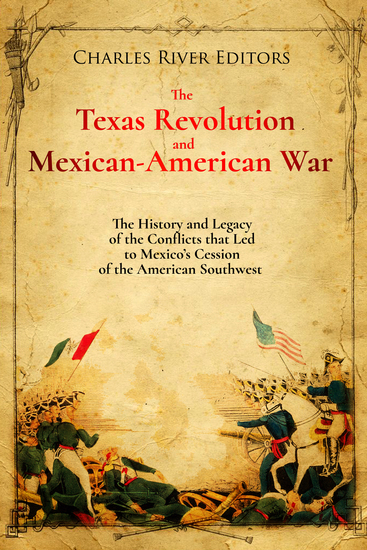
The Texas Revolution and Mexican-American War - The History and Legacy of the Conflicts that Led to Mexico’s Cession of the American Southwest - cover

The Texas Revolution and Mexican-American War - The History and Legacy of the Conflicts that Led to Mexico’s Cession of the American Southwest

Editors Charles River

Maison d'édition: Charles River Editors

  • 0
  • 0
  • 0

Synopsis

When various revolutions mostly forced the Europeans out of the continent, Texas ceased to belong to Spain and France to become a part of the Mexican Empire; later it was an independent country, and currently one of the 50 states of the United States. During a short period, rebellious Texas again separated from the U.S. to join the Confederate States of America with other secessionist states.
 
Of course, the most important war of all for Texas came in the early 19th century, and the common story heard in America is about rebellion against intolerance, oppression and Mexican cruelty. The Battle of the Alamo in particular, surrounded by legend and testimonies of heroism, is a textbook example of the fight for freedom, comparable to the Jewish defenders during the Roman siege at Masada. The words "martyrs" and "Mexican tyranny" are almost always present in the recounts, and “Remember the Alamo!” is both a slogan of self-glorification and martyrdom that remains one of the most famous phrases in America.
 
Naturally, this typical account is portrayed through rose-colored glasses. As in every story, everything depends on which side readers are positioned and whose histories they´re reading. The Texas Revolution certainly pursued freedom, but not for the tired, poor and huddled masses yearning to breathe free, the homeless or the wretched refuse of alien shores; it was rather the freedom to suck in land from a weak country and to preserve slavery in the cotton fields, added to enthusiasm for cheap land and inexhaustible natural resources.
 
The policy of manifest destiny increased tensions with Mexico in the 1840s. Mexico's northern half formed the western border of the territory bought in the Louisiana Purchase. Naturally, notions of the United States expanding to the Pacific Ocean alarmed Mexico, which held what is today the west coast of the United States.
 
However, Mexico first came to regard American expansion as a serious problem with the immigration of Americans into its northeastern territory. These Americans declared independence from Mexico and created a nation in the Mexican province of Texas. After winning independence in 1836, Texas became an independent republic.
 
Texas formally asked to be annexed by the United States in 1845. This annexation angered the Mexican government, which still considered Texas to be part of its territory. Mexico had previously warned that the annexation of Texas would cause Mexico to declare war on the United States.
 
When the annexation bill was passed by Congress, it included an additional provocation to Mexico: it claimed that the southern border of Texas was the Rio Grande. The actual territory controlled by the Republic of Texas did not extend nearly to the Rio Grande, and this border would represent a further loss of territory to the United States.
 
When a Mexican patrol attacked American cavalry in the disputed area north of the Rio Grande, President Polk went to Congress for a declaration of war. The declaration passed on May 13, 1846. The war against Mexico was unpopular with the opposition Whig party, especially in the North. Opponents of the war denounced it as a war of aggression, and denied that there had been a valid reason for war.
 
Small American military units were quickly able to occupy key points in California, including San Francisco and Los Angeles. Although California was sparsely populated, some Mexican inhabitants formed an effective resistance which was eventually put down in 1847 by American reinforcements. Subsequently, a larger American army was sent to invade central Mexico, and managed to capture the Mexican capital, Mexico City, on September 13, 1847. Although a large Mexican army was still fighting American forces in northeast Mexico and Texas, news of the capital falling caused it to retreat to try to retake the capital. After the defeat of the last Mexican army, major hostilities ended.
Disponible depuis: 04/05/2025.
Longueur d'impression: 115 pages.

D'autres livres qui pourraient vous intéresser

  • Keep Calm And Cut Him Off - 13 Reasons to "Go Silent" on Guys Who Reject or Break Up with You - cover

    Keep Calm And Cut Him Off - 13...

    Bruce Bryans

    • 0
    • 1
    • 0
    A guy who rejects or breaks up with you should no longer exist in your life. Contacting him or allowing him to stay in-touch with you will make you work harder and harder to convince him that you’re worth his love and attention, and it will compel you to play that ugly and unwinnable game called, "Chase-A-Man". 
    The best way to avoid this ugly game and break his spell over you is to cut the guy off (go "no contact" on him) for a set period of time, or in some cases, keep him cut off and out of your life indefinitely. 
    In this survival guide for women, you’re going to learn the importance of silence after a breakup or rejection, how it benefits you, and the powerful influence it has on the man who rejects you. If you want to bounce back from a bad breakup or even just improve your relationships with men in the future, this audiobook will help you rediscover your true self-worth. 
    Here’s what else you’re going to learn:The dangerous thought-process that keeps many women TRAPPED in an addictive cycle of unfulfilling sex, disappointment, and low self-esteem.Why you should never relieve a guy of the guilt he feels for treating you poorly. And why allowing him to feel guilty is actually a GOOD thing.Exactly what men think and feel when you cut them off QUICKLY.Why FORCING a man to live with his decision to leave you is crucial to reclaiming your power and potentially getting him back in the future.The dangers of staying in touch with an ex, and how it tricks you into settling for a DEAD-END pseudo-relationship.How you can better control the "MEAN GIRL" inside your head (that inner voice that likes to tell you "you’re not good, smart, or pretty enough" in some way) by finally standing up for yourself.And much, much more... 
    Get started right away and discover the power and importance of silence after a breakup or rejection.
    Voir livre
  • Redefining Racism - How Racism Became "Power + Prejudice" - cover

    Redefining Racism - How Racism...

    Joseph (Jake) Klein

    • 0
    • 0
    • 0
    Have you heard that racism requires more than just prejudice, but also “power”? 
    Have you been told the dictionary definition of racism isn’t correct? 
    Where did this all come from? And why is it being taught at your school or workplace? 
    The rabbit hole goes deeper than you might have imagined. Joseph (Jake) Klein’s Redefining Racism tells the story of the group of radical white “anti-racist” corporate and high-school educators who in the late 1960s and early 70s, taking inspiration from the anti-integrationist Marxist-Leninist Stokely Carmichael, funded by an organization seeking to pay off rioters to stop, and using manipulative techniques developed in part by U.S. intelligence’s director of the “psychological warfare center for the Far East,” created and spread the “Power + Prejudice” redefinition. And the late famed crack-addicted serial bank robber “Zombie Bandit” played a role too. 
    In tracing the history of this redefinition, Redefining Racism also tells the story of the origins of “Racism Awareness Training,” today frequently called “diversity training,” in the tradition of Robin DiAngelo and White Fragility that have taken American corporations, schools, and universities by storm. 
    Redefining Racism is the definitive rebuttal for why racism is not best defined as “Power + Prejudice” and a damning origin story for much of the modern so-called “anti-racist” movement, reminding us why the best way to be an anti-racist is to look at the content of one’s character and not the color of their skin. 
    “For anyone genuinely committed to realizing an American future where race, racism, and ‘anti-racism,’ cease to be the tools used to divide us, this is an indispensable text. With Redefining Racism, Jake Klein has provided a national service.” — Thomas Chatterton Williams, author of Self-Portrait in Black and White and Losing My Cool
    Voir livre
  • How to Have Difficult Conversations About Race - Practical Tools for Necessary Change in the Workplace and Beyond - cover

    How to Have Difficult...

    Kwame Christian

    • 0
    • 0
    • 0
    Negotiation expert Kwame Christian's motto is: "The best things in life are on the other side of difficult conversations." If we want a more equitable workplace, and a more equitable world, we have to talk to each other about race. But, for so many of us, that's easier said than done. 


    Many people avoid conversations about race because of fear: fear of discomfort, damaging important relationships, being misunderstood, "canceled," ostracized. How to Have Difficult Conversations About Race equips you with the skills you need to make these crucial conversations easier and more productive. 


    Whether you're looking to create change for yourself and other BIPOC, or a white ally seeking to support your coworkers or clients, you'll learn how to: overcome your internal barriers to talking about diversity, equity, and inclusion (DEI); work around others' barriers to productive discussion; be strategic about the outcome you want, and guide the conversation accordingly; use "Compassionate Curiosity" to connect and persuade; avoid common mistakes; and communicate more effectively over email, when you can't talk face to face. If you've ever struggled to turn that passion into persuasion, or been too afraid to speak up at work (or outside of it), this book is for you.
    Voir livre
  • Michigan's Haunted Lighthouses - cover

    Michigan's Haunted Lighthouses

    Dianna Higgs Stampfler

    • 0
    • 0
    • 0
    Michigan has more lighthouses than any other state, with more than 120 dotting its expansive Great Lakes shoreline. Many of these lighthouses lay claim to haunted happenings. 


    Former keepers like  Captain Townshend at Seul Choix Point and prankster John Herman at Waugoshance Shoal maintain their watch long after death. At White River Light Station in Whitehall, Sarah Robinson still keeps a clean and tidy house, and a mysterious young girl at the Marquette Harbor Lighthouse seeks out other companions. Countless spirits remain between Whitefish Point and Point Iroquois in an area well known for its many tragic shipwrecks. Join author and Promote Michigan founder Dianna Stampfler as she recounts the tales from Michigan's ghostly beacons.
    Voir livre
  • Cinderella La Cenicienta - cover

    Cinderella La Cenicienta

    Naomi Mcmillan

    • 0
    • 0
    • 0
    Step into a world where dreams come true, and magic is just a wish away! Follow Cinderella, a kind and gentle girl as she faces adversity from her mean stepmother and jealous stepsisters. Find out what happens when her Fairy Godmother appears, and with a flash of her magic wand turns a pumpkin into an elegant coach. Will Cinderella meet the handsome prince at the ball? What will happen when the clock strikes midnight? Presented in both English and Spanish, this dual language story will sweep you off your feet into a realm of love, kindness,  and a happily ever after ending!
    Voir livre
  • Obsessive Intrusive Magical Thinking - cover

    Obsessive Intrusive Magical...

    Marianne Eloise

    • 0
    • 1
    • 0
    'I FELT RECOGNISED ON EVERY PAGE, LEARNT SO MANY NEW THINGS, AND LAUGHED SO HARD I CHOKED ON MY WATER. READ THIS!!!' NAOISE DOLAN, AUTHOR OF EXCITING TIMES
    
    'CANDID, WITTY ... A BRAVE BOOK THAT PUTS VULNERABILITY FULLY ON SHOW'  INDEPENDENT
    
    
    Obsessive was, still is, my natural state, and I never wondered why. I didn't mind, didn't know that other people could feel at peace. I always felt like a raw nerve, but then, I thought that everyone did.
    
    Writer and journalist Marianne Eloise was born obsessive. What that means changes day to day, depending on what her brain latches onto: fixations with certain topics, intrusive violent thoughts, looping phrases. Some obsessions have lasted a lifetime, while others will be intense but only last a week or two.
    Obsessive, Intrusive, Magical Thinking is a culmination of a life spend obsessing, offering a glimpse into Marianne's brain, but also an insight into the lives of others like her. From death to Medusa, to Disneyland to fire, to LA to her dog, the essays explore the intersection of neurodivergence, fixation and disorder, telling the story of one life underpinned and ultimately made whole by obsession.
    Voir livre