Junte-se a nós em uma viagem ao mundo dos livros!
Adicionar este livro à prateleira
Grey
Deixe um novo comentário Default profile 50px
Grey
Assine para ler o livro completo ou leia as primeiras páginas de graça!
All characters reduced
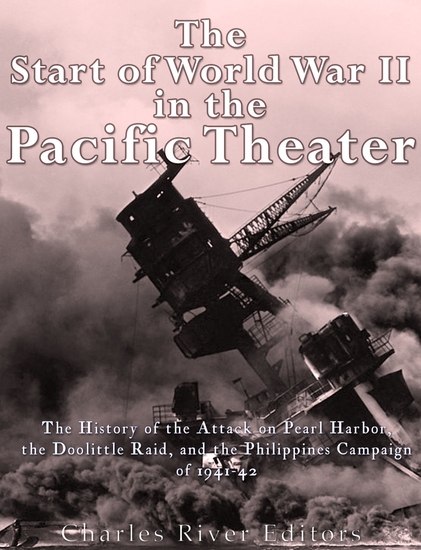
The Start of World War II in the Pacific Theater - The History of the Attack on Pearl Harbor the Doolittle Raid and the Philippines Campaign of 1941-42 - cover
LER

The Start of World War II in the Pacific Theater - The History of the Attack on Pearl Harbor the Doolittle Raid and the Philippines Campaign of 1941-42

Editors Charles River

Editora: Charles River Editors

  • 0
  • 0
  • 0

Sinopse

All Americans are familiar with the “day that will live in infamy.” At 9:30 a.m. on Sunday, December 7, 1941, Pearl Harbor, the advanced base of the United States Navy’s Pacific Fleet, was ablaze. It had been smashed by aircraft launched by the carriers of the Imperial Japanese Navy. All eight battleships had been sunk or badly damaged, 350 aircraft had been knocked out, and over 2,000 Americans lay dead. Indelible images of the USS Arizona exploding and the USS Oklahoma capsizing and floating upside down have been ingrained in the American conscience ever since. In less than an hour and a half the Japanese had almost wiped out America’s entire naval presence in the Pacific.
 
Less than 24 hours earlier, Japanese and American negotiators had been continuing their diplomatic efforts to stave off conflict in the region, but as they did, President Roosevelt and his inner circle had seen intelligence reports strongly suggesting an imminent attack - though they did not know where. The U.S. rightly believed that Japan would take action to prevent the Americans from interfering with their military activities in Southeast Asia, and American military forces in the Philippines were already bracing for a potential attack. However, as the negotiations were ongoing, the powerful Japanese carrier fleet had been surging southwards through the Pacific while maintaining radio silence, preparing to strike the blow that would ignite war in an area spanning half the globe. Navy Commander-in-Chief Isoroku Yamamoto, whose code of honor demanded that the Japanese only engage enemies after a formal declaration of war, had been given assurances that his nation would be formally at war with the United States prior to the arrival of his planes over Pearl Harbor.
 
As it turned out, those assurances were worth nothing, and Yamamoto had been misled by extremists in his government just as the Americans were misled. In fact, the Japanese would infamously deliver documents formally cutting off negotiations with the American government after the attack on Pearl Harbor had already been conducted. Far from a formal declaration of war, America was attacked without warning, plunging the world’s largest democracy into history’s deadliest conflict.
 
Pearl Harbor was unquestionably one of the seminal events in American history, and given the nature of the surprise attack, the entry of the U.S. into the war, and the lingering controversies and conspiracy theories, the attack on Pearl Harbor continues to be a highly charged and heavily debated event.
 
Those who had decoded and seen the Japanese communications in early December 1941 would not be surprised when they heard about an attack on December 7, 1941. They would, however, be astonished when they heard where that attack took place. Posted on the other side of the world, it was early on the morning of December 8 in the Philippines when American general Douglas MacArthur received news of the Japanese attack on Pearl Harbor hours earlier. With that, it could only be a matter of time before the Japanese attacked the Philippines.
 
Although MacArthur and Allied forces tried to hold out, they could only fight a delaying action, and the Japanese managed to subdue all resistance by the spring of 1942. However, in the aftermath of Japan’s successful invasion, as the nation’s military strategists began preparations for the next phase of military actions in the theater, their forces had to deal with a critical logistical problem they had not foreseen. The Japanese had to deal with large numbers of Filipino and American soldiers who had surrendered after a lengthy defense in the Bataan peninsula, but they were not prepared for so many prisoners of war because their own military philosophy emphasized rigid discipline and fighting until the end.  
Disponível desde: 02/05/2025.
Comprimento de impressão: 154 páginas.
Outros livros que poderiam interessá-lo

  • Bootstrapped - Liberating Ourselves from the American Dream - cover

    Bootstrapped - Liberating...

    Alissa Quart

    • 0
    • 0
    • 0
    An unsparing, incisive, yet ultimately hopeful look at how we can shed the American obsession with self-reliance that has made us less healthy, less secure, and less fulfilled  
    The promise that you can “pull yourself up by your bootstraps” is central to the story of the American Dream. It’s the belief that if you work hard and rely on your own resources, you will eventually succeed. However, time and again we have seen how this foundational myth, with its emphasis on individual determination, brittle self-sufficiency, and personal accomplishment, does not help us. Instead, as income inequality rises around us, we are left with shame and self-blame for our condition. 
    Acclaimed journalist Alissa Quart argues that at the heart of our suffering is a do-it-yourself ethos, the misplaced belief in our own independence and the conviction that we must rely on ourselves alone. Looking at a range of delusions and half solutions—from “grit” to the false Horatio Alger story to the rise of GoFundMe—Quart reveals how we have been steered away from robust social programs that would address the root causes of our problems. Meanwhile, the responsibility for survival has been shifted onto the backs of ordinary people, burdening generations with debt instead of providing the social safety net we so desperately need. 
    Insightful, sharply argued, and characterized by Quart’s lively writing and deep reporting, and for fans of Evicted and Nickel and Dimed, Bootstrapped is a powerful examination of what ails us at a societal level and a plan for how we can free ourselves from these self-defeating narratives. 
    Supplemental enhancement PDF accompanies the audiobook.
    Ver livro
  • A Rare Recording of Film Director DW Griffith - cover

    A Rare Recording of Film...

    DW Griffith

    • 0
    • 0
    • 0
    David Wark Griffith (January 22, 1875 - July 23, 1948), best known for directing the 1915 film "The Birth of a Nation," is considered one of the most influential figures in the history of the motion picture, pioneering many aspects of film editing and expanding the art of the narrative film. In 1919, together with Charlie Chaplin, Mary Pickford, and Douglas Fairbanks, Griffith founded the movie studio United Artists, with the goal of enabling actors and directors to make films on their own terms as opposed to the terms of commercial studios. In this 1930 recording, actor Walter Huston and director DW Griffith discuss Griffith's film "The Birth of a Nation." 
    Ver livro
  • Doing Nothing Is No Longer an Option - One Woman's Journey into Everyday Antiracism - cover

    Doing Nothing Is No Longer an...

    Jenny Booth Potter

    • 0
    • 0
    • 0
    During a bus ride with a group of fellow college students, Jenny Booth Potter came to a life-changing realization. She decided that racism in all its forms—in policies and systems, in organizations and churches, in neighborhoods and families–could no longer be tolerated. And even though Jenny didn't know what to do about racism, she was certain of one thing: doing nothing is no longer an option. That declaration Jenny made to her peers was more than seven words uttered on a bus. It was a vow, a lifetime commitment to seek racial justice.
    With candor and humility, Jenny shares her very imperfect but relentless journey of growing in awareness of racism, of reckoning with her own white privilege, and of learning how to be an antiracism advocate alongside her young family. If you're anything like Jenny was on that bus—overwhelmed by the enormity of racism and compelled to do something, but uncertain if you can actually make any difference—then this book is for you. Join Jenny and see for yourself what everyday antiracism looks like.
    Ver livro
  • Pirates - The Truth Behind the Robbers of the High Seas - cover

    Pirates - The Truth Behind the...

    Nigel Cawthorne

    • 0
    • 0
    • 0
    Pirates have an almost mythical status in the public imagination - we think of rogue heroes riding the high seas and 'X marks the spot'. But this image is flawed at best. 
     
    Using contemporary sources, Nigel Cawthorne turns the spotlight on the reality of pirate life, revealing the truth behind the legends. It gives us an insight into infamous the men and women who plundered ship and shore, including Captain Kidd, Blackbeard and Mary Read. We learn of the hazy distinction between pirates and state-approved privateers who were used to maintain empire, as well as the Port Royal pirate base in Jamaica - known as the 'wickedest city in the world'. 
     
    Including details of various pirate exploits, as well as their weapons, ships and unhappy victims, this fascinating read will divide fact from slippery fiction.
    Ver livro
  • Unequal - How extreme inequality is damaging democracy and what we can do about it - cover

    Unequal - How extreme inequality...

    David Buckham, Robyn Wilkinson,...

    • 0
    • 0
    • 0
    ‘Twenty-first-century capitalism and the democracies that enabled it are self-destructing... a sobering ― and impeccably researched ― warning of what is likely to come next’ Bruce Whitfield  
    The leading lights of the tech revolution – Gates, Bezos, Zuckerberg, Musk – have been hailed as savants and saviours of the modern age. And yet they are at the forefront of wealth inequality not seen since the heyday of the robber barons in the late 19th century, part of the slide to the First World War. Today, rampant inequality is inciting social unrest and undermining faith in the institutions of the democratic state. Citizens have been left at the mercy of unfettered capitalism – mere data subjects, endlessly surveilled, marshalled and increasingly angry and polarised. 
    The decoupling of capitalism from democracy has fostered an economic system seemingly powered by greed alone, with the marginalisation of democratic principles facilitating the rise of authoritarians and populists like Putin, Xi Jinping, Trump and Boris Johnson. 
    How has it come to this? And does the unanticipated fightback in Ukraine, with support from the West, show us the way to reclaiming the lost spirit of freedom inherent in liberal democracy?
    Ver livro
  • Father Forgive - First Time Gay - cover

    Father Forgive - First Time Gay

    Randy Manners

    • 0
    • 0
    • 0
    Graduation is tomorrow, and Alex will take his vows of priesthood Monday morning. 
      
    His friend takes him out for one last wild night on the town. Problem is, Alex has never been into the high octane lifestyle of dance clubs and fast women. He’s never been that into women at all. It’s exactly why he’s a good fit for the priesthood, right? 
      
    And then Hank showed up. He was every bit the man his old-school name warranted. And he understood. This wasn’t his kind of place, either. Hank takes the reigns and leads Alex down a new path. 
      
    Which calling will Alex follow?
    Ver livro