Begleiten Sie uns auf eine literarische Weltreise!
Buch zum Bücherregal hinzufügen
Grey
Einen neuen Kommentar schreiben Default profile 50px
Grey
Jetzt das ganze Buch im Abo oder die ersten Seiten gratis lesen!
All characters reduced
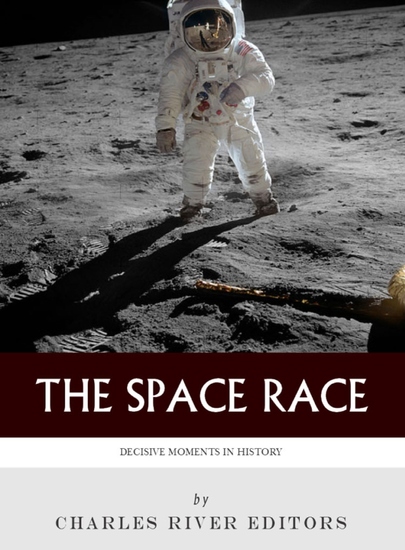
The Space Race - cover

The Space Race

Editors Charles River

Verlag: Charles River Editors

  • 0
  • 0
  • 0

Beschreibung

In the 19th century, the Scottish writer Thomas Carlyle famously wrote, "The history of the world is but the biography of great men", popularizing the “Great Man” theory that the course of history is shaped by a select few heroic individuals. While historians and others continue to debate the accuracy of the Great Man theory of history, there is no question that the course of history is permanently altered by decisive moments in time, where a different result would have produced drastically different outcomes. Charles River Editors’ Decisive Moments in History examines the events that changed history forever and set the world down the path it finds itself on today.
 
Today the Space Race is widely viewed poignantly and fondly as a race to the Moon that culminated with Apollo 11 “winning” the Race for the United States. In fact, it encompassed a much broader range of competition between the Soviet Union and the United States that affected everything from military technology to successfully launching satellites that could land on Mars or orbit other planets in the Solar System. Moreover, the notion that America “won” the Space Race at the end of the 1960s overlooks just how competitive the Space Race actually was in launching people into orbit, as well as the major contributions the Space Race influenced in leading to today’s International Space Station and continued space exploration.  
 
In fact, the Soviet Union had spent much of the 1950s leaving the United States in its dust (and rocket fuel). President Eisenhower and other Americans who could view Soviet rockets in the sky were justifiably worried that Soviet satellites in orbit could soon be spying on them, or, even worse, dropping nuclear bombs on them.  And in 1960, when Eisenhower’s administration began planning and funding for the famous Apollo program that would land the first men on the Moon in 1969, the Soviet Union was already thinking further ahead, literally. In one of the worst kept secrets of the Space Race, the Soviet Union launched two probes, Korabl 4 and Korabl 5, toward Mars in October 1960.
 
Eventually, the Space Race produced some of the most iconic moments of the 20th century, including the landing of the first men on the Moon, and in the years after the Space Race and the Cold War ended, the competition itself had helped lay the groundwork for international cooperation in space, both in terms of space exploration and aboard the International Space Station, which continues to orbit Earth today.
 
Decisive Moments in History: The Space Race covers the history of the Race and the major milestones that both nations achieved during it, while ultimately analyzing how the Space Race continues to leave a lasting legacy to this day. Along with pictures of important people, places, and events, places, you will learn about the Space Race like you never have before, in no time at all.  
Verfügbar seit: 04.05.2025.
Drucklänge: 51 Seiten.

Weitere Bücher, die Sie mögen werden

  • Decoded: Esaus and Jacobs - Using Chibueze’s Human Nature Quadrant To Precisely Understand Your Gut And When To Follow It - cover

    Decoded: Esaus and Jacobs -...

    DVM Chibueze Victor Onwugaje

    • 0
    • 0
    • 0
    If a poll were taken inquiring if you believed eggs could be Unscrambled, You’d be in the majority with the opinion that it was a rare foolishness to even consider. 
    More scientific debaters would argue cooking fudges the egg proteins, breaks its chemical bonds, causing new bonds to form. On cooling the proteins cannot return to their raw configuration. Even if they did, it’d be impossible to wield cutlery in such a way as to separate the yolk from the white. The mixing & cooking are irreversible processes. 
    As a mad Parallel thinker I disagree. 
    You simply need an uncanny understanding of the components, the various players & their compositions to reverse the several severely transformative processes undergone. 
    For You & I, Non-Unscramblers (of eggs), not simple. Yes. But I won’t bet that it is impossible, I don’t think you should. 
    This compact book bears a long lost algorithm which the author has now successfully used + taught others to use to classify People into precise groups of Esaus / Jacobs. 
    Knowledge of #DEJS will relink you to your core Animal (none of that irresponsible, hit & miss Horoscopy stuff), solving Identity issues; from Midlife crisis to confused Sexuality, teach you to Diagnose & Troubleshoot the point where things derailed, keep distressed homes, valuable friendships & partnerships alike together etc, all towards Peak Productivity… 
    (For lack of space, read complete description @ https://selar.co/DEJS444 ) 
    Paperbacks https://www.amazon.com/dp/B09NH478FX 
    All Author’s link https://linktr.ee/Pabloxen
    Zum Buch
  • The Cancel Culture Panic - How an American Obsession Went Global - cover

    The Cancel Culture Panic - How...

    Adrian Daub

    • 0
    • 0
    • 0
    In this incisive new work, Adrian Daub analyzes the global spread of cancel culture discourse as a moral panic, showing that, though its object is fuzzy, talk of cancel culture in global media has become a preoccupation of an embattled liberalism. There are plenty of conservative voices who gin up worries about cancel culture to advance their agendas. But more remarkable perhaps is that it is centrist, even left-leaning, media that have taken up the rallying cry and really defined the outlines of what cancel culture is supposed to be. 


    From French crusades against "le wokisme" via British fables of the "loony left" to a German obsession with campus anecdotes to a global revolt against "gender studies": countries the world over have developed culture war narratives in conflict with the US, and, above all, its universities—narratives that they themselves borrowed from the US. 


    Who exactly is afraid of cancel culture? To trace how various global publics have been so quickly convinced that cancel culture exists and that it poses an existential problem, Daub compares the cancel culture panic to moral panics past, investigating the powerful hold that the idea of "being cancelled" has on people around the world.
    Zum Buch
  • How AI is Transforming Education: The Good the Bad and the Future - "Transform your understanding of education with AI! Delve into its influence implications and future in this insightful audiobook" - cover

    How AI is Transforming...

    Cyrus Morrow

    • 0
    • 0
    • 0
    How AI is Transforming Education: The Good, the Bad, and the Future 
    ⭐⭐ Simplified Guide & Explanations Included ⭐⭐ 
    Are you eager to advance in your career and enhance your understanding of how artificial intelligence is reshaping education? 
    Looking for a thorough guide that covers all the essential elements of AI in education? 
    Your search ends here! 
    This guide serves as your ultimate companion for gaining insights, honing your skills, and engaging in practical exercises. With this resource, you're set for success. 
    Updated for the latest developments in education technology. 
    Key features of this insightful guide: 
    - In-depth understanding of AI's impact on education 
    - Thorough explanation of the advantages and challenges of AI in the learning process 
    - Effective strategies for leveraging AI tools in educational settings 
    Our guide stands out with its comprehensive exploration, which is crucial for your success in understanding this transformative field. Concepts are not merely touched upon; they are examined with clarity. 
    Please note that this guide is an independent resource and is not affiliated with any official educational entities, designed solely for your benefit. 
    Crafted with a clear layout and straightforward language, our guide on AI in Education ensures seamless transitions between topics. Bid farewell to complex jargon and embrace clear, precise, and technically accurate information. 
    So, why wait? Click the BUY NOW button, secure your guide, and embark on your journey to understanding the future of education transformed by AI!
    Zum Buch
  • Ancient Empires - A History of Etruscans and Phoenicians - cover

    Ancient Empires - A History of...

    Kelly Mass

    • 0
    • 0
    • 0
    This bundle consists of 3 short books, which are about the following subjects: 
    Subject 1: Nineveh was an age-old Assyrian city in Upper Mesopotamia, near Mosul in modern-day northern Iraq. It was the capital and biggest city of the Neo-Assyrian Empire, and the world's biggest city for some decades, and is on the eastern bank of the Tigris River. It's now a prevalent name for the portion of Mosul that's on the Tigris' eastern bank, and it is also the name of the nation's Nineveh Governorate. 
    It was the world's largest city for about fifty years till it was sacked by a union of its previous subject tribes, including but not limited to the Babylonians, Medes, Persians, Scythians, and Cimmerians, in the year 612 BC, following a severe period of civil dispute in Assyria.  
    Subject 2: The term "Phoenicians" describes the people living in Phoenicia, a sometimes-forgotten civilization that was age-old and remarkable. Let's check out the tradition, the history, and the specifics of Phoenicia. 
    Phoenicia was a thalassocratic (a state with mostly maritime worlds) society that thrived in the eastern Mediterranean's Levant area, mainly in modern-day Lebanon. It was fixated the coast of Lebanon, with some seaside parts of modern-day Syria and Galilee included for good procedure, varying as far north as Arwad and as far south as Acre and perhaps Gaza. 
    Subject 3: At its peak, the Etruscan society of age-old Italy covered circa what's now Tuscany, western Umbria, and northern Lazio, and areas of what's now the Po Valley, Emilia-Romagna, south-eastern Lombardy, southern Veneto, and small parts of Campania. 
    The first proof of an Etruscan society might be traced back to around 900 BC.
    Zum Buch
  • Other People’s Colleges - The Origins of American Higher Education Reform - cover

    Other People’s Colleges - The...

    Ethan W. Ris

    • 0
    • 0
    • 0
    An illuminating history of the reform agenda in higher education. 
     
    For well over one hundred years, people have been attempting to make American colleges and universities more efficient and more accountable. Indeed, Ethan Ris argues in Other People’s Colleges, the reform impulse is baked into American higher education, the result of generations of elite reformers who have called for sweeping changes in the sector and raised existential questions about its sustainability. When that reform is beneficial, offering major rewards for minor changes, colleges and universities know how to assimilate it. When it is hostile, attacking autonomy or values, they know how to resist it. The result is a sector that has learned to accept top-down reform as part of its existence. 
      
    In the early twentieth century, the “academic engineers,” a cadre of elite, external reformers from foundations, businesses, and government, worked to reshape and reorganize the vast base of the higher education pyramid. Their reform efforts were largely directed at the lower tiers of higher education, but those efforts fell short, despite the wealth and power of their backers, leaving a legacy of successful resistance that affects every college and university in the United States. Today, another coalition of business leaders, philanthropists, and politicians is again demanding efficiency, accountability, and utility from American higher education. But, as Ris argues, top-down design is not destiny. Drawing on extensive and original archival research, Other People’s Colleges offers an account of higher education that sheds light on today’s reform agenda. 
    Zum Buch
  • James I Charles I Commomwealth & Cromwells 1603-1660 - Stuarts Civil War Scaffolds Cromwell and the Odd Beheading (A Comic History of England Bk6) - cover

    James I Charles I Commomwealth &...

    Gilbert Abbott A'Beckett

    • 0
    • 0
    • 0
    Step right up for the most uproariously irreverent chapter of Gilbert Abbott A’Beckett’s Comic History of England—where crowns are comedy props and history’s biggest egos trip over their own dogma! 
    Meet James I, the "Wisest Fool in Christendom," who preached divine right while his pet favorite, the Duke of Buckingham, turned the court into a scandalous farce. Then comes Charles I, whose stubbornness cost him his crown (and his head), thanks to a Parliament with a very sharp grievance list—and a little help from the ill-fated Earl of Stafford. 
    Enter Oliver Cromwell, the Puritan party-pooper who banned Christmas, crushed Ireland, and somehow made republicanism duller than a Sunday sermon. But just when you think the chaos can’t get worse, in stumbles Richard Cromwell, his hapless son, who proved that ruling England was not a hereditary talent. Spoiler: The Republic collapses faster than a house of cards in a hurricane. 
    Narrated with wicked wit by Charles Featherstone, this uproarious installment skewers the Stuarts like a royal roast—where kings are klutzes, parliaments are punchlines, and the only thing sacred is the absurdity of power.
    Zum Buch