Junte-se a nós em uma viagem ao mundo dos livros!
Adicionar este livro à prateleira
Grey
Deixe um novo comentário Default profile 50px
Grey
Assine para ler o livro completo ou leia as primeiras páginas de graça!
All characters reduced
The Seven Wonders of the Ancient World - cover
LER

The Seven Wonders of the Ancient World

Editors Charles River

Editora: Charles River Editors

  • 0
  • 0
  • 0

Sinopse

“I have gazed on the walls of impregnable Babylon along which chariots may race, and on the Zeus by the banks of the Alpheus, I have seen the hanging gardens, and the Colossus of the Helios, the great man-made mountains of the lofty pyramids, and the gigantic tomb of Mausolus; but when I saw the sacred house of Artemis that towers to the clouds, the others were placed in the shade, for the sun himself has never looked upon its equal outside Olympus.” - Antipater
 
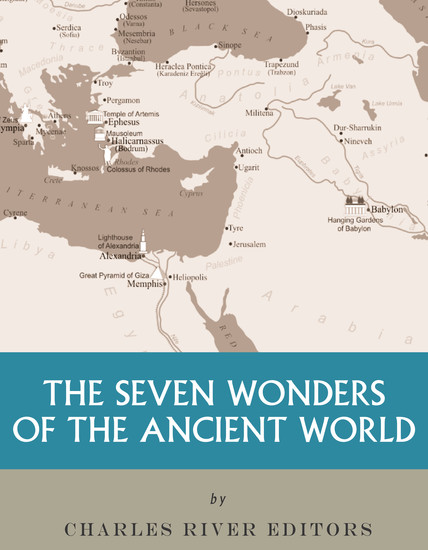
Over 2,000 years ago, two ancient writers named Antipater of Sidon and Philo of Byzantium authored antiquity’s most well known tour guides. After the two Greeks had traveled around the Mediterranean, they wrote of what they considered to be the classical world’s greatest construction projects. While there is still some question as to who actually authored the text attributed to Philo and when it was authored, their lists ended up comprising the Seven Wonders of the Ancient World, igniting interest in the ones they chose and inspiring subsequent generations to identify their era’s own Seven Wonders.
 
Naturally, the Seven Wonders of the Ancient World may be considered something of a misnomer. Only one still stands (the' Great Pyramid at Giza in Egypt), all existed in the Hellenistic culture rather than all over the world, and relatively few people saw them or visited them. They were all architectural marvels of the late Classical period and all but two were created by the Greeks. All but one were in the Mediterranean area. Even so, they represented a widespread range of works and cultures and spread out across three different continents.
 
The Seven Wonders of the Ancient World have continued to fascinate modern society, thanks in large measure to what was written about them and the fact that only one, the Great Pyramid at Giza, still survives. For that reason, speculation has revolved around the ones that didn’t. Did the Colossus of Rhodes straddle the entire harbor or was it a statue on a pedestal at the mouth of the harbor, like an ancient Statue of Liberty? How did the Babylonians successfully plant and irrigate the Hanging Gardens? How tall was the Lighthouse of Alexandria? When did Phidias construct the Statue of Zeus at Olympia?
 
The Seven Wonders of the Ancient World profiles each of the seven wonders named by Philon, discussing the history of each wonder, what was written about each wonder, what is known about each wonder, and the lingering mysteries surrounding what is not known about them. Along with historic depictions of the wonders, you will learn about the Seven Wonders of the Ancient World like you never have before, in no time at all.
 
 
Disponível desde: 28/05/2025.
Comprimento de impressão: 44 páginas.

Outros livros que poderiam interessá-lo

  • Elixir - A Parisian Perfume House and the Quest for the Secret of Life - cover

    Elixir - A Parisian Perfume...

    Theresa Levitt

    • 0
    • 0
    • 0
    For centuries, scientists believed that living matter possessed a special quality—a spirit or essence—that differentiated it from nonliving matter. But by the nineteenth century, the scientific consensus was that the building blocks of one were identical to the building blocks of the other. Elixir tells the story of two young chemists who were not convinced, and how their work rewrote the boundary between life and nonlife. 


    In the 1830s, Édouard Laugier and Auguste Laurent were working in Laugier Père et Fils, the oldest perfume house in Paris. By day they prepared the perfumery's revitalizing elixirs and rejuvenating eaux, drawing on alchemical traditions that equated a plant's vitality with its aroma. In their spare time they hunted the vital force that promised to reveal the secret to life itself. Their ideas, roundly condemned by established chemists, led to the discovery of structural differences between naturally occurring molecules and their synthetic counterparts, even when the molecules were chemically identical. 


    Scientists still can't explain this anomaly, but it may point to critical insights concerning the origins of life on Earth. Rich in sparks and smells, brimming with eccentric characters, experimental daring, and the romance of the Bohemian salon, Elixir is a fascinating cultural and scientific history.
    Ver livro
  • Empire of God - How the Byzantines Saved Civilization - cover

    Empire of God - How the...

    Robert Spencer

    • 0
    • 0
    • 0
    Western civilization is generally regarded as the child of Athens, Jerusalem, and Rome. That is, in the West, our philosophical and political thought is derived from that of the ancient Greeks; our Christian religion comes from the Jewish religion, and both of these came to us via the Roman Empire. 


    Western society has other forefathers as well: we would be unwise to give the Byzantine Empire short shrift. The ways in which it has influenced our world for the good, and indeed, created the parameters of our society at its healthiest and strongest, are insufficiently appreciated today. 


    If the United States were to last as long as the Roman Empire, including its Byzantine period, it would have to continue as an independent country until the year 2899. To maintain a unified nation state for over eleven hundred years is a remarkable achievement by any standard, and the Romans accomplished it while facing existential threats and efforts to extinguish their polity during virtually every period of their existence. Now, nearly six hundred years after the demise of the empire, its influence still resonates in a number of fields. 


    There is no arguing with success. It's time we took notice.
    Ver livro
  • On the Decay of the Art of Lying - cover

    On the Decay of the Art of Lying

    Mark Twain

    • 0
    • 0
    • 0
    In On the Decay of the Art of Lying (1880), Mark Twain offers a witty, satirical defense of lying as a necessary and even noble human art. He begins by observing that lying is a universal trait, present in everyone, but laments that it is no longer done skillfully or for virtuous reasons. Twain argues that lying, when done with good intentions—such as to protect others’ feelings or preserve harmonies, is far preferable to harsh truth-telling that causes harm. He criticizes hypocritical moralists who lie while pretending to be virtuous and instead advocates for honest acknowledgment of the role lies play in everyday life. 
    Twain calls for a revival of lying as a thoughtful, considerate act rather than a selfish or malicious one. He suggests that lying should be taught and refined, much like any other art form, so that it can serve beneficial ends. Satirizing society's pretensions and moral contradictions, Twain uses humor and irony to challenge conventional views on honesty. Ultimately, his essay is not a blanket endorsement of deceit, but a call to recognize the complexity of truth and to use lies, when necessary, with kindness and responsibility. Through this piece, Twain cleverly blurs the line between truth and fiction.
    Ver livro
  • Courageous Women of the Bible - 30 timeless lessons on faith courage wisdom and devotion - cover

    Courageous Women of the Bible -...

    Arcelio Hernández Mussio

    • 0
    • 0
    • 0
    The Bible often remembers and celebrates the names of great men of God. People like Abraham, Moses, David, Paul, Isaiah, and Elijah are well-known for their important roles in the story of God's people. These men are honored for their faith, leadership, and the key parts they played in God's plan. 
    However, as we delve into the Scriptures, we often overlook the equally significant contributions of women of God. The Bible, while rich with the stories of these men, also holds accounts of extraordinary women whose strength, wisdom, and faithfulness were crucial to the unfolding of God's narrative. For instance, Sarah's faith in God's promise of a son, Ruth's loyalty to her mother-in-law, and Mary's acceptance of her role in God's plan. Yet, these women often remain in the background, their stories less frequently told, their virtues less regularly celebrated. 
    This book is a necessary contribution to Christian literature, as it celebrates the strength and wisdom of prominent women in the Bible. In the pages you are about to read, you will get a glimpse into the lives of these extraordinary women. Their faith and actions were significant and played pivotal roles in shaping the Biblical narrative. The book is organized chronologically, starting with the Old Testament and moving through to the New Testament, to provide a comprehensive view of these women's contributions. 
    This book celebrates these 30 women, each embodying unique qualities and virtues that can guide and inspire us in our modern lives. Their stories offer timeless lessons on resilience, faith, leadership, and profound love, demonstrating that the challenges and virtues they faced are just as relevant and applicable in our lives today. Whether it is Hannah's unwavering faith, Abigail's strategic wisdom, or Ruth's selfless loyalty, these women provide powerful examples of how to live with purpose and integrity in our contemporary world.
    Ver livro
  • Third Book of John The - The World English Bible Book 64 (Unabridged) - cover

    Third Book of John The - The...

    Various Authors

    • 0
    • 0
    • 0
    The Third Book of John is the third-to-last book of the New Testament and the Christian Bible as a whole, and attributed to John the Evangelist, traditionally thought to be the author of the Gospel of John and the other two epistles of John. The Third Epistle of John is a personal letter sent by "the elder" to a man named Gaius, recommending to him a group of Christians led by Demetrius, which had come to preach the gospel in the area where Gaius lived. The purpose of the letter is to encourage and strengthen Gaius, and to warn him against Diotrephes, who refuses to cooperate with the author of the letter.
    Ver livro
  • Donald Writes No More - The Life of Donald Goines the Godfather of Street Lit - cover

    Donald Writes No More - The Life...

    Eddie Stone

    • 0
    • 0
    • 0
    For the fiftieth anniversary of his murder, this gritty, engrossing, definitive biography of the legendary Black writer Donald Goines—the Godfather of Urban Street Lit and "one of hip hop's greatest inspirations" (The Source Magazine)—is back. 


    Addict, thief, pimp, pusher, player—and most notably, groundbreaking writer. Donald Goines was all of these. 


    As a kid, Donald Goines was the product of a middle-class family. After high school, he joined the Air Force—and discovered the heroin that would rule the remainder of his life. On the streets, he turned to writing when he was straight enough to keep at it. He used the language of the streets and he wrote of its people. Goines's success was immediate and exciting. But eventually those same streets claimed him. He was murdered as he sat writing a new book. Yet his legacy continues, as a revolutionary in the literary world and also in music, with major hip-hop artists including 50 Cent, Nas, and Jay-Z all crediting Goines's novels as influences. Here is his complete story.
    Ver livro