Junte-se a nós em uma viagem ao mundo dos livros!
Adicionar este livro à prateleira
Grey
Deixe um novo comentário Default profile 50px
Grey
Assine para ler o livro completo ou leia as primeiras páginas de graça!
All characters reduced
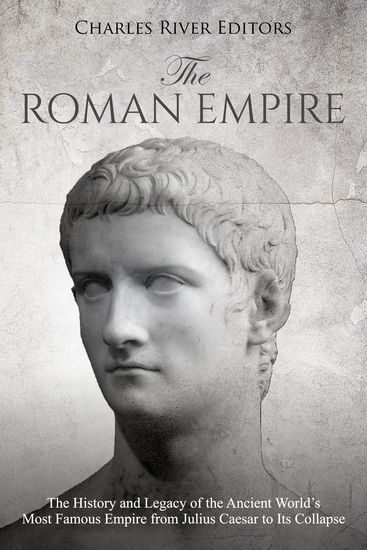
The Roman Empire - The History and Legacy of the Ancient World’s Most Famous Empire from Julius Caesar to Its Collapse - cover
LER

The Roman Empire - The History and Legacy of the Ancient World’s Most Famous Empire from Julius Caesar to Its Collapse

Editors Charles River

Editora: Charles River Editors

  • 0
  • 0
  • 0

Sinopse

The importance of Gaius Julius Caesar Augustus (or as he was known from birth, Gaius Octavius “Octavian” Thurinus) to the course of Western history is hard to overstate. His life, his rise to power, his political, and his social and military achievements all laid the foundations for the creation of an empire which would endure for almost five centuries, and whose traditions, laws, architecture and art continue to influence much of Europe and the world today. Octavian was the first true Roman Emperor, and the first man since the Etruscan Tarquins five centuries earlier to establish a successful hereditary ruling dynasty in what had been a proud Republic for over half a millennium. He was a canny strategist, an excellent orator, a fine writer, a generous patron of the arts and enthusiastic promoter of public works, but above all he was a master politician. Octavian’s great-uncle (and adoptive father) Julius Caesar was a great general, and his rival Mark Antony was a great soldier, but as a politician Octavian outmatched them all.
 
Certainly, like all men, Octavian had his defects. Like many of the most successful politicians, he could connive, plot and prevaricate with the best of them, and he made full use of the emotional pull that his late beloved great-uncle had over the legions during the course of his rise to power. His justice was also famously heavy-handed, and he was not known for his mercy towards those he defeated in battle or marginalized political opponents. Yet despite all this, he still stands in bronze on Rome’s Via dei Fori Imperiali to this day, along with the likes of Caesar, Hadrian, Trajan and Marcus Aurelius, and he is forever immortalized in all Western calendars as the patron of the month of August, which was dedicated to him when he was deified, following his death, as Divus Augustus.
 
Like his adoptive father before him, Octavian is one of those figures whom it is difficult to know exactly what to make of, because he appears, even at a distance, to be larger than life. Yet the amount of personal correspondence and contemporary writings penned by Octavian himself, as well as his friends, associates, and rivals, helps form a clear picture of the man behind the bronze statue. Indeed, he was the ruler who found Rome a city of bricks and left it a city of marble.
 
One of the most overlooked emperors was also one of the first, and he lived in chaotic times. Tiberius was born in 42 BCE, just as the Roman Republic was dissolving and a new Roman imperial power structure emerged under Octavian, who became Rome’s first emperor as Caesar Augustus. Tiberius’s life soon became caught up with Augustus’s as the emperor worked to found and establish a dynasty, but it is unclear if Tiberius ever really wanted to be part of Augustus’s plans or inherit imperial power - Tiberius was known as a man who schemed and planned, but he was also a scholar and showed a marked desire throughout his life to retreat and escape the demands of power. Partially due to this continual tension, Tiberius’s life is enigmatic in many ways.
 
Tiberius championed the Republic and seemed to desire its return, yet his acceptance of imperial power and his reign solidified Rome’s transition to an empire. He was a skilled general who showed concern for the well-being of his troops, and he displayed a remarkable patience as a military tactician. After he rose to become emperor in 14 CE, he ruled for over 22 years, which would be the longest reign of a Roman emperor over the next 100 years, but he remained suspicious of everyone and eventually chose the wrong person to trust, being eventually misled and betrayed by a man whom he thought was his closest friend. When he finally died, aged and lonely, he had become so hated that crowds celebrated his death.
Disponível desde: 01/05/2025.
Comprimento de impressão: 348 páginas.

Outros livros que poderiam interessá-lo

  • Tanker War In the Gulf - Operation Earnest Will Diplomacy and Seapower in Practice - cover

    Tanker War In the Gulf -...

    Tom Duffy

    • 0
    • 0
    • 0
    The past four decades have seen a number of United States military interventions in the Middle East, but only one of them is retrospectively seen as a success: Operation Earnest Will, the escort of Kuwaiti tankers through the Persian Gulf in 1987 and 1988. As an officer who participated in this operation who then served in the region as a diplomat, Tom Duffy offers a unique perspective on Earnest Will. He argues that the fact that Earnest Will was a limited war and that it was fought with navies was key to its success. Forty years later, this operation remains relevant to security policy, especially with regard to a potential conflict with China.This new and comprehensive account discusses every aspect of the operation, including the role of other navies in the Gulf at the time. Relevant strategic and political elements are covered, such as parallel activities in the United Nations Security Council and the role of United Nations Security Council Resolutions in ending the war.  Considering the short-, medium-, and long-term impacts of Operation Earnest Will, Duffy explains how this maritime, limited war option illustrates key concepts from classical strategic thinkers, and why it is a demonstrably effective way to advance political goals and an example to keep in mind when facing future challenges in the Middle East and East Asia.
    Ver livro
  • Battle of Kapetron The: The History and Legacy of the First Major Battle Between the Byzantine Empire and Seljuk Turks - cover

    Battle of Kapetron The: The...

    Editors Charles River

    • 0
    • 0
    • 0
    The Byzantine Empire existed for over a thousand years, with a history spanning from the division of the Roman Empire in 395 until the Ottoman conquest of Constantinople in 1453. It was formed from the previous Eastern Roman Empire, and during its long existence, the Byzantine inhabitants were very proud to call themselves Romans.  
    	However, many things changed during the long lifespan of the Byzantine Empire, starting with a Hellenization in the 6th century. The use of the Latin language diminished and Greek took its place, while the typical Roman culture gave way to a more Hellenistic one. The Hellenization of Byzantium was detrimental to the relationship with the Holy Roman Empire, and the Christian world from that point would be split in two. The subsequent strengthening of the Orthodox Church caused many civil wars and conflicts to arise during the centuries, which shattered and reshaped the territory time after time. By the end of the Byzantine Empire’s existence, the old age had weakened both the state and church, making it an easy target for invading forces.  
    	The most notable invaders were the Turkish-speaking Seljuks, led through a series of battles by Kutalmishouglu Suleiman, who supported different usurpers against the Byzantine emperor. The expansion of the Seljuks was so successful that when Suleiman died, he had put all of Bithynia under his control as well as several important harbor towns along the shores on the Asian side of Bosphorus. With that accomplishment, he had managed to separate the Byzantines living in Anatolia from their emperor in Constantinople. This immediately weakened the unity of the Byzantine Empire.  
    	Of all the conflicts that brought this state of affairs into being, few were as instrumental as the Battle of Kapetron, the culmination of one of the first major Seljuk raids into Byzantine territory.
    Ver livro
  • Thucydides - A Very Short Introduction - cover

    Thucydides - A Very Short...

    Jennifer T. Roberts

    • 0
    • 0
    • 0
    In 432 BCE the powerful city-state of Sparta on the peninsula of the Peloponnesus in southwestern Greece declared war on Athens, head of a mighty naval coalition. The war would last until Sparta finally brought Athens to its knees in 404. The Athenian aristocrat Thucydides, suspecting the magnitude of the conflict that was unfolding before his eyes, at once undertook to record its history, exploring the causes and course of the war in the context of his great interest: human nature. An introduction to Thucydides's thought and background, this book examines Thucydides's account of the war in the context both of the international situation in the classical Greek world and of the intellectual traditions of the fifth century BCE, exploring the historian's connection to prose writers like Herodotus as well as poets like Homer and the tragedians, and investigating the complex dynamics of the war that changed the Greek world forever.
    Ver livro
  • Narcissistic Fathers: Healing the Father Wound Reclaiming Inner Strength and Embracing Authentic Self-Expression - cover

    Narcissistic Fathers: Healing...

    Andy Gardner

    • 0
    • 0
    • 0
    Heal from a Narcissistic Father: Reclaim Your Life 
    Did growing up with a narcissistic father leave you hurt and confused? Do you feel lost and need help to heal? This audiobook can guide you to recovery and self-discovery. 
    This Audiobook Can Help You:Understand Narcissistic Fathers: Learn why they act the way they do.Spot Abuse: See the signs of narcissistic abuse.Heal Your Wounds: Find simple steps to start healing.Set Boundaries: Learn how to say "no" and protect yourself.Stop Self-Blame: Free yourself from guilt and self-doubt.Build Support: Make real friends who understand and help you.Break the Cycle: Learn how to stop repeating toxic patterns. 
    Why This Audiobook?Easy to Read: Simple explanations and steps that anyone can follow.Practical Tips: Real actions you can take today.Supportive: Focuses on you and your healing journey.Comprehensive: Covers everything you need to know to heal. 
    What You’ll Learn:Reveal the Truth: Understand the narcissistic father’s behavior.Family Dynamics: Learn about the relationship between a narcissistic father and his children.Healing Steps: Follow practical steps to start your healing journey.Assert Your Autonomy: Learn to set boundaries and protect yourself.Free Yourself: Overcome self-blame and guilt. 
    Ready to Change Your Life? 
    Don’t stay trapped in the past. Take control and heal from the pain of having a narcissistic father. Add this audiobook to your cart and start your journey to a better, happier you today! Start your transformation now!
    Ver livro
  • Tripped - Nazi Germany the CIA and the Dawn of the Psychedelic Age - cover

    Tripped - Nazi Germany the CIA...

    Norman Ohler

    • 0
    • 0
    • 0
    “A fleet-footed and propulsive account . . . Brilliantly sifting a massive history for its ideological through lines, this is a must-read."" — Publishers Weekly (starred review) 
    The author of the New York Times bestseller Blitzed returns with a provocative new history of drugs and postwar America, examining the untold story of how Nazi experiments into psychedelics covertly influenced CIA research and secretly shaped the War on Drugs.  
    Berlin 1945. Following the fall of the Third Reich, drug use—long kept under control by the Nazis’ strict anti-drug laws—is rampant throughout the city. Split into four sectors, Berlin's drug policies are being enforced under the individual jurisdictions of each allied power—the Soviet Union, Britain, France, and the US. In the American zone, Arthur J. Giuliani of the nascent Federal Bureau of Narcotics is tasked with learning about the Nazis’ anti-drug laws and bringing home anything that might prove “useful” to the United States. 
    Five years later, Harvard professor Dr. Henry Beecher began work with the US government to uncover the research behind the Nazis psychedelics program. Begun as an attempt to find a “truth serum” and experiment with mind control, the Nazi study initially involved mescaline, but quickly expanded to include LSD. Originally created for medical purposes by Swiss pharmaceutical Sandoz, the Nazis coopted the drug for their mind control military research—research that, following the war, the US was desperate to acquire. This research birthed MKUltra, the CIA's notorious brainwashing and psychological torture program during the 1950s and 1960s, and ultimately shaped US drug policy regarding psychedelics for over half a century. 
    Based on extensive archival research on both sides of the Atlantic, Tripped is a wild, unconventional postwar history, a spiritual sequel to Norman Ohler’s New York Times bestseller Blitzed. Revealing the close relationship and hidden connections between the Nazis and the early days of drugs in America, Ohler shares how this secret history held back therapeutic research of psychedelic drugs for decades and eventually became part of the foundation of America’s War on Drugs.
    Ver livro
  • Willem Jansz: A short biography - 5 Minutes: Short on time – long on info! - cover

    Willem Jansz: A short biography...

    5 Minutes, 5 Minute Biographies,...

    • 0
    • 0
    • 0
    Willem Jansz, Dutch explorer and discoverer of Australia: Life and work in a short biography! Everything you need to know, brief and concise. Infotainment, education and entertainment at its best!
    Ver livro