¡Acompáñanos a viajar por el mundo de los libros!
Añadir este libro a la estantería
Grey
Escribe un nuevo comentario Default profile 50px
Grey
Suscríbete para leer el libro completo o lee las primeras páginas gratis.
All characters reduced
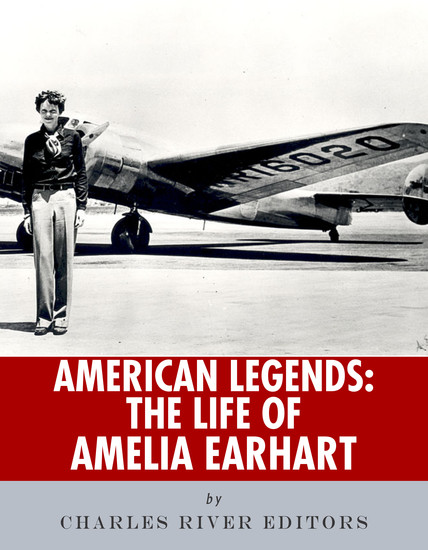
The Life of Amelia Earhart - cover

The Life of Amelia Earhart

Editors Charles River

Editorial: Charles River Editors

  • 0
  • 0
  • 0

Sinopsis

"The stars seemed near enough to touch and never before have I seen so many. I always believed the lure of flying is the lure of beauty, but I was sure of it that night." – Amelia Earhart
 
A lot of ink has been spilled covering the lives of history’s most influential figures, but how much of the forest is lost for the trees? In Charles River Editors’ American Legends series, readers can get caught up to speed on the lives of America’s most important men and women in the time it takes to finish a commute, while learning interesting facts long forgotten or never known.
 
During the early 20th century, groundbreaking technology revolutionized transportation both on the ground and in the sky, with new motors making automobiles and airplanes a reality in the 1910s. Around that same time, the feminist movement was underway in the United States, spearheaded by women seeking the right to vote, lobbying for the temperance movement, and trying to make their voices heard.
 
It was at that crossroads that flight pioneer Amelia Earhart found herself in 1919, the very year President Wilson and Congress were trying to shepherd through the 19th Amendment to the Constitution, giving women the right to vote. That year, Earhart was given a ride on a plane piloted by legendary air racer Frank Hawks, and as she recalled, "By the time I had got two or three hundred feet off the ground, I knew I had to fly."
 
Earhart’s unbridled joy for flying was only occasionally abated by a lack of finances, and a recurring sinus issue, but throughout the 1920s she was one of the few women licensed to fly, and she set an altitude record of 14,000 feet for women in 1922. In 1928, Earhart was the first woman to fly across the Atlantic Ocean, but she was disappointed that she had to do so as a passenger, complaining, “I was just baggage, like a sack of potatoes.”
 
Nevertheless, that trip made “Lady Lindy” the “Queen of the Air” in America, and Earhart was now the nation’s best known aviatrix. With her fresh face available for promoting everything from luggage to women’s clothing, Earhart was able to finance her own aviation and remain involved in promoting air travel and flying to skeptical Americans. In May 1932, Earhart finally made her solo flight across the Atlantic, for which she received the Distinguished Flying Cross from Congress, the Cross of Knight of the Legion of Honor from the French Government and the Gold Medal of the National Geographic Society from President Herbert Hoover.
 
By the mid-1930s, Earhart had set a multitude of altitude and distance records, but she wanted to attempt a circumnavigation of the world. After an ill-fated first attempt, Earhart and Fred Noonan set off on another attempt, creating one of the 20th century’s most enduring mysteries. Earhart and Noonan were to land on Howland Island, 1700 miles southwest of Hawaii, but radio transmissions ceased between the plane and authorities on the ground the morning of July 2, 1937. Earhart and Noonan had disappeared, never to be seen again, despite one of the nation’s largest and costliest manhunts to date.
 
Unfortunately, the speculation over exactly what happened to Earhart and the mystery of her disappearance have come to overshadow and obscure her many accomplishments. American Legends: The Life of Amelia Earhart looks at the theories attempting to explain her disappearance, but it also humanizes the woman whose sheer love of flying propelled her to unprecedented heights among both the clouds and her countrymen. Along with pictures of important people, places, and events in her life, you will learn about Lady Lindy like you never have before, in no time at all.
 
 
Disponible desde: 27/05/2025.
Longitud de impresión: 38 páginas.
Otros libros que te pueden interesar

  • Tales From The River - (A Foster Kid's Journey) - cover

    Tales From The River - (A Foster...

    Rik Mikals

    • 0
    • 0
    • 0
    My foster parents didn't want me but a stroke of fate intervened and an unwanted child discovered life lessons from the most unlikeliest of places on the Grand Ronde River.
    Ver libro
  • A Higher Calling - cover

    A Higher Calling

    David Weekley

    • 0
    • 0
    • 0
    This is the story of his deliverance from manic depression (known today as bipolar).  The story is set back in the early 1970s and chronicles what the hippie culture was like. David knows that he would not be alive today without an understanding of God's Word, the Bible. He could have easily taken his life without it.
    Ver libro
  • Spellbound - My Life as a Dyslexic Wordsmith - cover

    Spellbound - My Life as a...

    Phil Hanley

    • 0
    • 0
    • 0
    This program is read by the author, comedian and severe dyslexic Phil Hanley, who reveals his unlikely path to success in a story that is equal parts hilarious and heartbreaking.When Phil Hanley was in first grade, he realized something that would forever set him apart from his peers: he couldn’t read. His teachers were ill-equipped to assist him, and he slipped through the school’s cracks, year by year falling further and further behind his friends. Finally, he was diagnosed with dyslexia, a learning disability that would shape the rest of his life.Unable to pursue college or a traditional job, Phil was thrust into a life defined by unconventional twists, including a stint as a runway model in Europe. Eventually, he found himself on a stage with a microphone, a spotlight, and five minutes of jokes. Unlike so many previous pursuits, stand-up felt right to Phil, and he soon discovered that the more he worked at it, the more he got out of it—a realization that, he compellingly argues, saved his life. Spellbound is a story of humor and also of struggle and heartbreak, of constantly living in a world that sees things differently than you do, and of triumph over adversity.Hanley tells us that dyslexia can be a huge challenge, but it doesn’t spell certain condemnation (and neither can he). Just the opposite: dyslexia has been more than a blessing in his life—it’s been his North Star.A Macmillan Audio production from Henry Holt & Company.
    Ver libro
  • 20 Peculiar Facts About Albert Einstein - Exploring the Genius and Eccentricity of a Scientific Icon - cover

    20 Peculiar Facts About Albert...

    John Harpoon

    • 0
    • 0
    • 0
    Albert Einstein is widely celebrated as one of the greatest scientific minds in history, yet his brilliance was accompanied by a host of peculiar habits, unconventional beliefs, and eccentric behaviors. While most people recognize him for his groundbreaking theories, such as the theory of relativity and his famous equation, *E = mc²*, fewer are aware of the strange and fascinating aspects of his personality. From his distaste for socks to the secret study of his brain, Einstein’s life was filled with quirks that make him an intriguing figure beyond just his scientific achievements.  
      
    Understanding Einstein’s peculiarities offers a deeper insight into how his mind worked and why he approached problems in such an unconventional way. Many of his habits, which seemed odd to outsiders, were actually reflections of his deep commitment to intellectual simplicity and efficiency. He rejected societal norms, preferring comfort and practicality over formality. His unique way of thinking, combined with his rebellious spirit, allowed him to challenge traditional ideas and revolutionize physics.  
      
    Despite his scientific genius, Einstein was not immune to controversy and personal struggles. His relationships were often complicated, marked by letters revealing his emotional conflicts and a personal life that was far from perfect. He also found himself at the center of political debates, using his influence to speak out on issues such as racial inequality, pacifism, and nuclear weapons. Even after his death, Einstein’s brain became the subject of scientific curiosity, as researchers sought to uncover what made him so intellectually extraordinary. 
    Ver libro
  • Her Lover - From their pens to your ears genius in every story - cover

    Her Lover - From their pens to...

    Maxim Gorky

    • 0
    • 0
    • 0
    Alexei Maximovich Peshkov was born on 28th March 1868, in Nizhny Novgorod, Russia. 
    Better known as Maxim Gorky he was orphaned at 11 and ran away from home at 12.  At 19 he had already attempted suicide and thereafter travelled, by foot, across the Russian Empire for 5 years. 
    His first book ‘Essays & Stories’ in 1898 was a sensation and so began a long career as an author of short stories, novels and plays.  Gorky saw writing as a moral and political act that would help to change the unjust world around him.  He was an ardent early advocate of the emerging Marxist movement and publicly opposed the Tsarist regime leading several times to his arrest.  
    In 1904 he began his own theatre but the censor banned every play and Gorky was forced to abandon the project. 
    But Gorky was a financially successful author, editor, and playwright and gave monies to political parties as well as for civil rights and social reform.  The brutal shooting of workers, which set in motion the Revolution of 1905, pushed Gorky more decisively toward radical solutions.  
    In 1906 he went to the United States to raise funds for the Bolsheviks. Those experiences including a scandal over travelling with his lover and not his wife deepened his contempt for the ‘bourgeois soul.’ 
    Gorky now moved to Capri in Italy, both for health reasons and to escape the increasingly repressive times in Russia.  
    An amnesty for the 300th anniversary of the Romanov dynasty saw him return to Russia in 1914. His politics remained close to the Bolshevik cause.  But soon, after the 1918 revolution, his essays referred to Lenin as a tyrant for his senseless arrests and repression.  He was soon appealing to the outside world for food aid after the catastrophic crop failure. 
    In October 1921 Gorky returned to Italy, now in Fascist hands, and settled in Sorrento until 1932.  His health worsened with the onset of tuberculosis. 
    He wrote several successful books there but now decided to find an understanding with the communist regime. Stalin invited him home and his return was hailed as a major propaganda victory.  He was decorated with the Order of Lenin, and a province, a park, and various streets re-named in his honour. 
    But he had his faults too.  In 1933, Gorky co-edited a book on the White Sea-Baltic Canal and denied even a single prisoner died during its construction, but thousands had. As well, knowing that some Nazis were homosexual, a phrase was attributed to him that said ‘exterminate all homosexuals and fascism will vanish’.  Although he was himself was quoting another he was decidedly homophobic. 
    With the increase of Stalinist repression in 1935 Gorky was placed under unannounced house arrest. 
    Maxim Gorky died on the 18th June 1936 from pneumonia.  He was 68. 
    Stalin and Molotov were among those who carried Gorky's urn of ashes at his funeral.
    Ver libro
  • Blue & Green - From their pens to your ears genius in every story - cover

    Blue & Green - From their pens...

    Virginia Woolf

    • 0
    • 0
    • 0
    Adeline Virginia Woolf was born on the 25th January 1882 in South Kensington in London. 
    Although lauded as a founder of modernist writing with such classics as ‘Orlando’, ‘Mrs Dalloway’ and ‘To the Lighthouse’ and, of course, many classic short stories, her background is filled with elements of tragedy that she somehow overcame to become such a revered writer.   Her mother died when she was 13, her half-sister Stella two years later and with it her first of several nervous breakdowns.  Appallingly it was later found that three of her half-brothers had sexually abused her so darkness must have seemed ever present.   
    She began writing professionally at age 20 but her father’s death two years later brought a complete mental collapse and she was briefly institutionalised.  Somehow she found within herself a literary career and with it great innovations in writing; she was a pioneer of “stream of consciousness”.    
    Her tight circle of friends were the founders of the Bloomsbury Group, a movement whose legacy still influences across the arts and society in many way to this day.   
    Whilst the dark periods continued to interrupt her emotional state her rate of work never ceased.  Until, on 28th March 1941, Woolf put on her overcoat, filled up its pockets with stones, and walked into the River Ouse, in Lewes, East Sussex and drowned herself.  Her body was not recovered until the 18th April.  She was 59. 
    She left behind a note which read in part “Dearest, I feel certain that I am going mad again.  I feel we can't go through another of those terrible times.  And I shan't recover this time.  I begin to hear voices, and I can't concentrate.  So I am doing what seems the best thing to do”.
    Ver libro