Join us on a literary world trip!
Add this book to bookshelf
Grey
Write a new comment Default profile 50px
Grey
Subscribe to read the full book or read the first pages for free!
All characters reduced
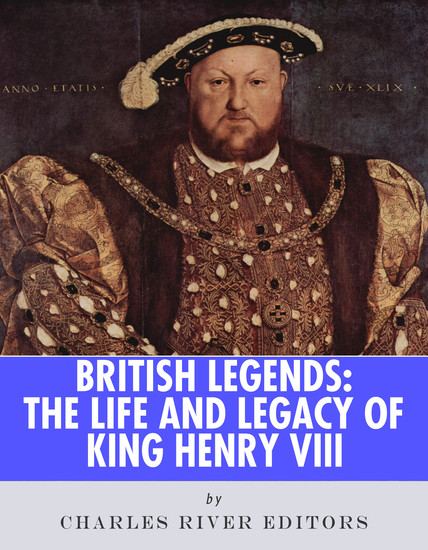
The Life and Legacy of of King Henry VIII - cover

The Life and Legacy of of King Henry VIII

Editors Charles River

Publisher: Charles River Editors

  • 0
  • 0
  • 0

Summary

"We are, by the sufferance of God, King of England; and the Kings of England in times past never had any superior but God." – King Henry VIII
 
In Charles River Editors’ History for Kids series, your children can learn about history’s most important people and events in an easy, entertaining, and educational way. Pictures help bring the story to life, and the concise but comprehensive book will keep your kid’s attention all the way to the end.
 
Over 450 years after his reign, Henry VIII is still the most famous and recognizable King of England, but it’s for all the wrong reasons. Though well regarded by contemporaries as a learned king and "one of the most charismatic rulers to sit on the English throne", he is best remembered today for his gluttony and multiple marriages, particularly the gruesome way in which he was widowed on more than one occasion. Naturally, that was the focus of the popular Show Time drama series centered around his life, The Tudors.
 
Henry VIII will probably continue to be best known for beheading some of his wives, most notably Anne Boleyn, so it is somewhat fitting that his most decisive act came as a result of a marital mishap. Sharply at odds with the Catholic Church over his attempt to dissolve his marriage with Catherine of Aragon, Henry VIII ultimately broke with the Church and established the Church of England, which forever both the religious history of England and the social hierarchy of the nation and its empire.  
 
 Though the popular perception of his reign has taken hold, King Henry VIII did not start life in any of those ways. In fact, he did not even start life as heir to the English throne. And when he did come to the throne at the age of 18, King Henry VIII’s earliest monarchical years showed his promise as a quintessential renaissance, polymath Prince. Even on the religious front, Henry VIII started out believing in the essential Catholic theology, even after the Pope and the Vatican excommunicated Henry from the Catholic Church (until then, the undisputed political as well as theological leader of Christendom, from which monarchs often needed various forms of legitimacy).
 
 For all these reasons, the manner in which his life and legacy diverge makes him an even more fascinating topic, one that clearly continues to captivate audiences around the world today. This book chronicles Henry VIII’s life and reign, but it also humanizes the man who fashioned himself both an athlete and scholar. Along with pictures of important people, places, and events in his life, your kids will learn about Henry VIII like never before.
Available since: 06/21/2025.
Print length: 30 pages.

Other books that might interest you

  • Economic History of Colombia - From Independence to Modern Times - cover

    Economic History of Colombia -...

    Anya Solace

    • 0
    • 0
    • 0
    The economic history of Colombia is a rich and complex narrative shaped by its colonial past, its struggle for independence, and its evolution into a modern, globalized economy. Colombia’s economic trajectory is marked by cycles of growth, stagnation, and reform, heavily influenced by both internal and external forces. To understand Colombia’s present-day economic standing, it is essential to first explore the historical context that laid the foundation for its economic structure. 
    The history of Colombia’s economy begins with its pre-Colombian civilizations, which thrived through agriculture and trade. The Spanish colonization in the 16th century drastically altered the region's economic systems. Colombia became a key part of the Spanish Empire’s colonial economy, centered on the extraction of gold, silver, and agricultural products. During the colonial era, the economic structure was based on a system of encomiendas, which exploited Indigenous labor, and the export of valuable resources to Spain. This period was foundational in creating the early foundations of the Colombian economy, particularly its dependence on mineral wealth. 
    The struggle for independence from Spain in the early 19th century, which culminated in 1810 with the declaration of independence and a protracted series of wars, significantly disrupted the economy. The wars of independence led to the fragmentation of the region into several separate entities, each facing economic challenges as they sought to stabilize and develop. Upon achieving independence in 1819, Colombia faced a host of problems, including political fragmentation, lack of infrastructure, and limited industrial capacity. These challenges hindered the country's economic development for much of the 19th century.
    Show book
  • We Need to Talk - How to Have Conversations That Matter - cover

    We Need to Talk - How to Have...

    Anonymous

    • 0
    • 0
    • 0
    “WE NEED TO TALK.” 
    They are, perhaps, the most dreaded four words in the English language. But in her timely, insightful, and wonderfully practical audiobook, We Need to Talk, Celeste Headlee—who earns a living by talking on the airwaves of National Public Radio—makes the case that they are urgently needed. 
    Today most of us communicate from behind electronic screens, and studies show that Americans feel less connected and more divided than ever before. The blame for some of this disconnect can be attributed to our political landscape, but the erosion of our conversational skills as a society lies with us as individuals.  
    And the only way forward, says Headlee, is to start talking to each other. In We Need to Talk, she outlines the strategies that have made her a better conversationalist—and offers simple tools that can improve anyone’s communication. For example: BE THERE OR GO ELSEWHERE. Human beings are incapable of multitasking, and this is especially true of tasks that involve language. Think you can type up a few emails while on a business call, or hold a conversation with your child while texting your spouse? Think again.CHECK YOUR BIAS. The belief that your intelligence protects you from erroneous assumptions can end up making you more vulnerable to them. We all have blind spots that affect the way we view others. Check your bias before you judge someone else.HIDE YOUR PHONE. Don’t just put down your phone, put it away. New research suggests that the mere presence of a cell phone can negatively impact the quality of a conversation.  
    Whether you’re struggling to communicate with your kid’s teacher at school, an employee at work, or the people you love the most—Headlee offers smart strategies that can help us all have conversations that matter.
    Show book
  • The Bodhisattva Concept - cover

    The Bodhisattva Concept

    A.G.S. Kariyawasam

    • 0
    • 0
    • 0
    This is a Pariyatti audiobook of Bodhi Leaves No. 157, "The Bodhisattva Concept" by A.G.S. Kariyawasam found in the Pariyatti Edition of Collected Bodhi Leaves Vol. V.
     
    Excerpt from The Bodhisattva Concept:
     
    In original Pali Buddhism, the term bodhisatta is used more or less exclusively to designate Gautama Buddha prior to his enlightenment.
     
    'The concept of bodhisattva, along with that of Buddha and of the cakravartin (world-ruler), was in vogue in India even before the appearance of Gautama Buddha. When Prince Siddhārtha, who later became Gautama Buddha, took conception in the womb of Queen Māyā, a seer predicted that Suddhodana’s future son would be either a world-ruler (cakravartin) or a Buddha. Once, answering a question by a brahmin, the Buddha himself admitted that he is neither a god nor a yakkha, but a Buddha, meaning thereby one of a succession of Buddhas (A II 38).
    Show book
  • A Room of One's Own - cover

    A Room of One's Own

    Virginia Woolf

    • 0
    • 0
    • 0
    A Le Monde 100 Books of the Century book  
    Women have burnt like beacons in all the works of all the poets from the beginning of time. … [Woman] pervades poetry from cover to cover; she is all but absent from history. She dominates the lives of kings and conquerors in fiction; in fact she was the slave of any boy whose parents forced a ring upon her finger. Some of the most inspired words and profound thoughts in literature fall from her lips; in real life she could hardly read; scarcely spell; and was the property of her husband. 
    A Room of One's Own is an extended essay, originally delivered in 1928 as two lectures at two of Cambridge University's women's colleges—Newnham College and Girton College. Through the use of several metaphors, lauded author Virginia Woolf explores the social injustices and structures that prevent women from engaging in free expression and contributing to literature.  
    A Room of One's Own was published as a book in 1929, and would go on to become a seminal work of feminist criticism. Considered one of the great modernist writers of the 20th century, Virginia Woolf has been named as an influence for writers including Margaret Atwood, Toni Morrison, and Gabriel García Márquez.
    Show book
  • Spanish Empire The: A Captivating Guide to Its Imperialism Expansion into the New World Colonial Conflicts and Its Legacy in Modern Times - cover

    Spanish Empire The: A...

    Captivating History

    • 0
    • 0
    • 0
    What was it that set the Spanish Empire on the path to such illustrious glory? Was it the Spaniards’ fiery passion, unwavering ambition, or simply the sheer fortune of timing? To find out, keep reading… 
    The Spanish Empire stands as one of the most magnificent empires in the history of the world. It unfurled its might across multiple continents, conquered all who stood in its way, and left an indelible impact on cultures around the globe. For over four centuries, its dominance remained unchallenged, casting a vast shadow across Europe and beyond. 
    But how did Spain, a modest nation nestled in the Iberian Peninsula, ascend to such meteoric heights? What fueled their insatiable hunger for expansion? And what catalyzed their eventual descent into decline? 
    You will find these answers in this introductory history audiobook. Here are some of the things you can look forward to doing with this guide:Trace the roots of the Spanish Empire, its influences, and the circumstances that sowed the seeds for its rise.Sail through the Age of Exploration, a time when Spain’s thirst for land and resources took its explorers across the seas, forging unprecedented global connections.Witness the brutal conquests, devastating wars, and complex political struggles that shaped the empire’s expansion into the New World.Revel in the empire’s Golden Age—a period of unparalleled artistic, literary, and scientific achievements.Learn about the key figures who defined the empire, from its most successful rulers to the infamous conquerors whose actions still spark controversy today.Understand the impact of colonialism on both the conquered and the conquerors and how this legacy continues to shape our world today. 
    Scroll up and click the “add to cart” button to uncover the story of the Spanish Empire!
    Show book
  • Tending the Heart of Virtue - How Classic Stories Awaken a Child's Moral Imagination 2nd edition - cover

    Tending the Heart of Virtue -...

    Vigen Guroian

    • 0
    • 0
    • 0
    In Tending the Heart of Virtue, Vigen Guroian illuminates the power of classic tales and their impact on the moral imagination. He demonstrates how these stories teach the virtues through vivid depictions of the struggle between good and evil, while he also unveils components of the good, the true, and the beautiful in plot and character. With clarity and elegance, Guroian reads deeply into the classic stories. He demonstrates how these stories challenge and enliven the moral imaginations of children. And he shows the listener how to get "inside" of classic stories and communicate their lessons to the child. 


    For more than two decades Tending the Heart of Virtue has been embraced by parents, guardians, and teachers for whom the stories it discusses are not only beloved classics but repositories of moral wisdom. This revised and expanded second edition includes three new chapters in which Guroian inteprets such stories as Hans Christian Andersen's The Ugly Duckling, the Grimms' Cinderella, and John Ruskin's The King of the Golden River.
    Show book