Join us on a literary world trip!
Add this book to bookshelf
Grey
Write a new comment Default profile 50px
Grey
Subscribe to read the full book or read the first pages for free!
All characters reduced
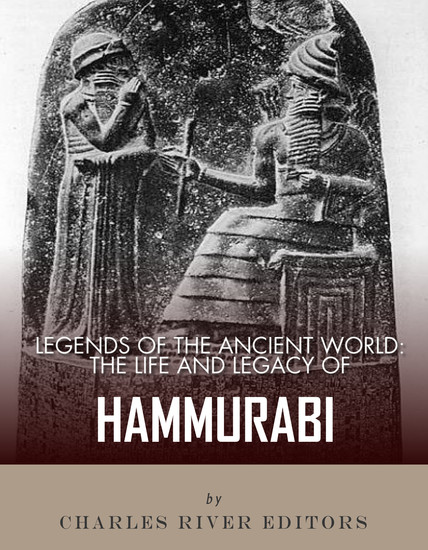
The Life and Legacy of Hammurabi - cover

The Life and Legacy of Hammurabi

Editors Charles River

Publisher: Charles River Editors

  • 0
  • 0
  • 0

Summary

“If a man has accused another of laying a kišpu (spell) upon him, but has not proved it, the accused shall go to the sacred river, he shall plunge into the sacred river, and if the sacred river shall conquer him, he that accused him shall take possession of his house. If the sacred river shall show his innocence and he is saved, his accuser shall be put to death. He that plunged into the sacred river shall appropriate the house of him that accused him.” – The Code of Hammurabi
 
A lot of ink has been spilled covering the lives of history’s most influential figures, but how much of the forest is lost for the trees? In Charles River Editors’ Legends of the Ancient World series, readers can get caught up to speed on the lives of antiquity’s most important men and women in the time it takes to finish a commute, while learning interesting facts long forgotten or never known.
 
The Babylonians were one of the earliest of history’s great ancient civilizations, and the most famous Babylonian of them all was Hammurabi, who came to the throne as the first king of the Babylonian empire around the beginning of the 18th century B.C. Hammurabi had a long and fruitful reign that saw him consolidate most of Mesopotamia under his control, but he’s best known today for Hammurabi’s Code, one of the earliest known code of laws in human history. Inscribed on stone tablets, Hammurabi’s Code was found over 3,500 years later in the early 20th century, making him one of antiquity’s most famous men.
 
Babylonian culture, including art, architecture and literature, flourished during his reign, and Hammurabi (or the scribes in his employ) wrote enough public royal inscriptions and personal official letters to store in museums across the world. There are also many letters from other contemporary rulers that make reference to him or to significant events during his reign.  The large amount of documentation available, both from and about him, has allowed modern scholars to paint a colorful picture of the famous king and the various facets of his life.
 
Although there is no information on the age of Hammurabi when he took the throne, he ruled Babylon for 43 years from 1792-1750 B.C., when he became gravely ill and handed the throne to one of his sons, Samsu-iluna.  Hammurabi spent the first 28 years of his career strengthening the kingdom he inherited and managing construction projects ranging from temples to irrigation canals. He also focused himself on winning the hearts of his people by making a reliable, transparent judicial system.  He fought a few local skirmishes on the outskirts of his kingdom that seemed to involve securing his own borders from outside threats more than increasing the size of his own kingdom.  During most of that time he ruled in the shadow of his neighbor to the north, Šamši-Adad, the king of Ekallatum (and later Assyria).
 
The last decade or so of his reign was spent empire building.  Hammurabi established powerful alliances and conquered enemies on all sides expanding his kingdom to a monumental empire.  He stopped the Elamite incursion from the east, driving them from regions they had taken adjacent to Babylon, and he finally routed Rim-Sîn, his long-time enemy to the south in Larsa.  Hammurabi subsequently brought the kingdom of Assyria under his control, and after several years being allied with the powerful northwestern kingdom of Mari, he defeated their army as well and brought Mari under the ultimate control of Babylon.  When all was said and done, Hammurabi handed over to his son a vast empire eight times the size of the kingdom left to him by his own father. It is no wonder that later generations of Babylonians considered the reign of Hammurabi to be the golden age of Babylon, a sentiment shared by many today. 
 
 
Available since: 06/29/2025.
Print length: 30 pages.

Other books that might interest you

  • Early Christianity: An Enthralling Overview of Jesus the Twelve Apostles the Conversion of Constantine and Other Events in Christian History - cover

    Early Christianity: An...

    Billy Wellman

    • 0
    • 0
    • 0
    Did you know that Christianity has gone through many changes since its origin? 
    Over two thousand years ago, a Jewish man was born into a society in turmoil. It is impossible to tell the story of Christianity without understanding the man behind it. What were the lives of Jesus and his followers like? How were their words so impactful that they changed history and affected the lives of billions of people over the course of two thousand years? 
    Throughout the centuries, Christianity underwent a series of evolutions that engulfed many cultural traditions and ideas into its fold. But with such a wide variety of beliefs throughout Christendom, where did they all stem from, and how did they change over time? 
    In this audiobook, we will look at the time of Jesus from a historical viewpoint and also find out the truth about Christianity and what revolutionary changes occurred in the first few centuries AD. 
    You may be surprised to discover the truth about the following:Why the first-century Jews were so eagerly waiting for a savior and how they knew when he would arrive;Jesus’ origins and the historical and biblical events surrounding his birth;The heartbreaking terror that Jesus’ parents faced in his early years and the drastic life decision they were guided to make;Some of the compelling words Jesus spoke and why they drew so many people to him;The ideas that laid the foundation for Christianity;How the apostles and disciples carried on with their work after Jesus’ death and organized the first Christian congregations;What life was like for the early disciples; 
    You will also find a bonus chapter on how Christianity influenced art and had an impact on many creative minds. 
    Scroll up and click “add to cart” to find out the real history of early Christianity!
    Show book
  • How To Not Die Alone - Learn How to Love the One You Love - cover

    How To Not Die Alone - Learn How...

    M.J. Sulmin

    • 0
    • 0
    • 0
    How To Not Die Alone: Learn How to Live With Love The One You Love. 
    Simple Lessons For A Successful Love Relationships. 
    "Are you tired of feeling lonely and longing for a meaningful relationship? 
    Look no further. 
    In 'Learn How Not to Die Alone: Simple Lessons for a Successful Love Relationship,' you will discover the secrets to finding and maintaining a healthy and fulfilling partnership. 
    Through real-life examples and expert advice, this book guides you on a journey to understanding yourself and what you truly want in a partner and the necessary steps for building and nurturing a loving relationship. 
    Whether you're single, looking for love, or in a relationship and seeking to strengthen your bond, this book offers practical and actionable insights for achieving happy and lasting love. 
    Start your journey today and learn how not to die alone."
    Show book
  • The Art and Business of Online Writing - The Expert Guide on Article Marketing Discover How it Can Help Promote and Drive Traffic to Your Website - cover

    The Art and Business of Online...

    Francis Wastrom

    • 0
    • 0
    • 0
    The Art and Business of Online Writing: The Expert Guide on Article Marketing. Discover How it Can Help Promote and Drive Traffic to Your Website 
    One method for promoting your business or website can be accomplished for free through what is known as article marketing. This free strategy can help with traffic, sales and add additional rewards such as building your influence and authority in your niche. You might be wondering how writing articles can help your business. When you write these articles and submit them to article directories, you can place your website link and this in turn, help boost traffic, increase sign ups and bolster your sales. 
    In this audiobook, you will discover everything about article marketing, how it works, the many benefits and how you can do it effectively. It will give you tips on how to write your articles well to establish your expertise on your specific niche.  
    Once your articles begin being seen and seen on the article directories, then you can sensibly hope to see guests touching base on your site from those same articles for a long time. To learn more, scroll up and click “add to cart” now!
    Show book
  • Making A Small Fortune - Surviving publishing parenting and porphyria - cover

    Making A Small Fortune -...

    Matthew Spaur

    • 0
    • 0
    • 0
    "This memoir's reward is insights shared by a man honest with himself and his strengths and limitations in a way that is compelling, actually quietly fascinating." -- Jay Levin, Founder of LA Weekly newspaper 
    Having it all can leave you with nothing.  
    At the height of the Dot-com Boom on Wall St., Matthew Spaur used his earnings from the tech industry to remarry, become a stepparent to three boys, and start a weekly newspaper--all at the same time. Overnight, he became a self-employed working parent with a new business in a cutthroat market. He did this despite having never owned a business, worked on a newspaper, taken a journalism class, sold advertising, or been a parent.  
    Soon, the tech stock bubble burst, the 9/11 attacks exploded, and the country slid into recession and then war. Media outlets started receiving envelopes of anthrax in their mail. The internet revolution began to obliterate the newspaper industry. At home, his new wife and two of his step-sons developed life-threatening illnesses.  
    What do you do when your fortune goes from bad to worse?
    Show book
  • Eastern Han Dynasty The: A History of China - cover

    Eastern Han Dynasty The: A...

    Hui Wang

    • 0
    • 0
    • 0
    The Eastern Han Dynasty: A History of China, PART TWO takes you on a thrilling ride through one of China's most dramatic and chaotic eras. This book pulls you right into the palace, where figures like Empress Dou plot and scheme to secure power, even using poison and false charges to remove rivals. You'll watch the rise and fall of powerful families like the Dous and the Liang clan, who used their ties to the throne to control the empire — but always at a heavy cost. 
    You'll follow brave officials like Yuan An, Yue Hui, and Cai Yong, who risked everything to speak the truth and challenge corruption. These weren't dry, stiff scholars — they were real people caught in a deadly game of politics, facing off against terrifying figures like Liang Ji and the infamous Ten Regular Attendants, the emperor's most corrupt and dangerous eunuchs. 
    This book doesn't just tell you about emperors and generals; it shines a light on the students, rebels, and farmers, too. You'll see how the National Academy students stood up to the powerful, how the Yellow Turban Rebellion shook the empire, and how even everyday folk got tangled in the madness, whether they were sucked into fake "filial" shows or forced to pay crushing taxes to fund the emperor's endless luxuries. 
    You'll walk through lavish palace gardens, secret court meetings, bloody battlefields, and fake street markets set up inside the palace for the emperor's entertainment. From wild feasts to puppet rulers, from political assassinations to daring military campaigns, the Eastern Han was packed with stories that read like the best kind of historical drama — because they were real.
    Show book
  • Carbon Democracy - Political Power in the Age of Oil - cover

    Carbon Democracy - Political...

    Timothy Mitchell

    • 0
    • 0
    • 0
    Oil is a curse, it is often said, that condemns the countries producing it to an existence defined by war, corruption, and enormous inequality. Carbon Democracy tells a more complex story, arguing that no nation escapes the political consequences of our collective dependence on oil. It shapes the body politic both in regions such as the Middle East, which rely upon revenues from oil production, and in the places that have the greatest demand for energy. 


    Coal was a source of energy so open to disruption that oligarchies in the West became vulnerable to mass demands for democracy. In the mid-twentieth century, however, the development of cheap and abundant energy from oil offered a means to reduce this vulnerability to democratic pressures. The abundance of oil made it possible to reorganize political life around the management of something now called "the economy". The politics of the West became dependent on an undemocratic Middle East. 


    In the twenty-first century, the oil-based forms of modern democratic politics have become unsustainable. Foreign intervention and military rule are faltering in the Middle East, while governments everywhere appear incapable of addressing the crises that threaten to end the age of carbon democracy—the disappearance of cheap energy and the carbon-fueled collapse of the ecological order.
    Show book