¡Acompáñanos a viajar por el mundo de los libros!
Añadir este libro a la estantería
Grey
Escribe un nuevo comentario Default profile 50px
Grey
Suscríbete para leer el libro completo o lee las primeras páginas gratis.
All characters reduced
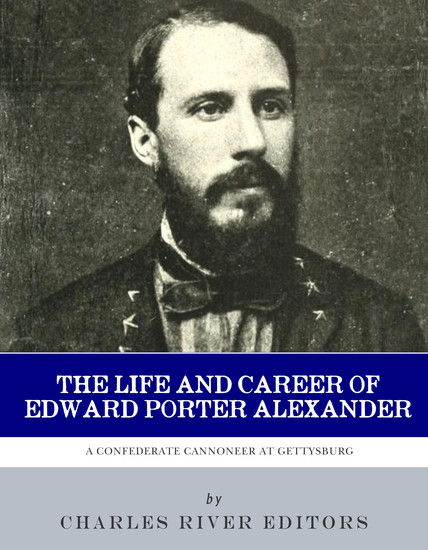
The Life and Career of Edward Porter Alexander - A Confederate Cannoneer at Gettysburg - cover

The Life and Career of Edward Porter Alexander - A Confederate Cannoneer at Gettysburg

Editors Charles River

Editorial: Charles River Editors

  • 0
  • 0
  • 0

Sinopsis

In the narrative of the Civil War, Edward Porter Alexander has loomed larger in death than in life. Just 25 years old when the war broke out, Porter Alexander had already served as an engineer and officer in the U.S. Army, but the native Georgian resigned his commission in May 1861 and joined the Confederacy after his home state seceded.
 
Porter Alexander spent 1861 as an intelligence officer, and he served as part of a signal guard, but he soon became chief of ordnance for Joseph Johnston’s army near Richmond. Half a year later, Johnston would be injured during the Peninsula Campaign at the Battle of Seven Pines, after which he was replaced by Robert E. Lee. Over the course of 1862, Porter Alexander took on more roles in the Army of Northern Virginia’s artillery branch, particularly under James Longstreet’s 1st Corps.
 
Though he participated in several battles, he played his biggest role at the Battle of Gettysburg. On the third day, Lee decided to make a thrust at the center of the Union’s line with about 15,000 men spread out over three divisions. Though it is now known as Pickett’s Charge, named after division commander George Pickett, the assignment for the charge was given to Longstreet, whose 1st Corps included Pickett’s division. Lee’s decision necessitated a heavy artillery bombardment of the Union line in an attempt to knock out the Union’s own artillery before beginning the charge that would cover nearly a mile of open space from Seminary Ridge to the Union line on Cemetery Ridge. Lee tasked Porter Alexander, in charge of the 1st Corps’ guns, to conduct the artillery bombardment. What resulted was the largest sustained bombardment of the Civil War, with over 150 Confederate cannons across the line firing incessantly at the Union line for nearly 2 hours.
 
Unfortunately for Porter Alexander and the Confederates, the sheer number of cannons belched so much smoke that they had trouble gauging how effective the shells were. As it turned out, most of the artillery was overshooting the target, landing in the rear of the Union line. Reluctant to order the charge, Longstreet commanded Porter Alexander to order the timing for the charge. As Longstreet and Alexander anticipated, the charge was an utter disaster, incurring a nearly 50% casualty rate and failing to break the Union line.
 
Porter Alexander would continue to serve under Longstreet’s corps for most of the rest of the war, and he famously suggested to Lee at Appomattox that the Confederate army should disband and melt away instead of surrender. Porter Alexander would later regret the suggestion, and Lee scolded him for it anyway.
 
Though he had served with distinction during the Civil War, it was Porter Alexander’s memoirs that have kept his name alive today. While many prominent officers on both sides wrote memoirs, Porter Alexander’s were among the most insightful and often considered by historians as the most evenhanded. With a sense of humor and a good narrative, Porter Alexander skillfully narrated the war, his service, and what he considered the successes and faults of others, including Lee, when he thought they had made good decisions or mistakes. As a result, historians continue to rely heavily on his memoirs as a source for Civil War history.
Disponible desde: 21/06/2025.
Longitud de impresión: 89 páginas.
Otros libros que te pueden interesar

  • Nefertiti - The Beautiful Queen of Ancient Egypt - cover

    Nefertiti - The Beautiful Queen...

    Omar Khalil

    • 0
    • 0
    • 0
    Nefertiti, one of ancient Egypt’s most captivating and influential queens, remains a figure shrouded in mystery and intrigue. Her name, meaning “the beautiful one has come,” hints at her exotic origins, though little is known for certain about her early life. Some historians believe she was a member of the Egyptian nobility, possibly the daughter of Ay, a prominent official. Others suggest foreign origins, potentially linking her to Mitanni royalty. Regardless of her birthplace, Nefertiti’s remarkable journey from obscurity to queenhood is a testament to her enduring legacy. 
    Nefertiti’s life took a dramatic turn when she married Amenhotep IV, later known as Akhenaten. Their union marked the beginning of one of ancient Egypt’s most transformative periods. As Akhenaten’s Great Royal Wife, Nefertiti played a central role in the royal family, often depicted alongside her husband in scenes of worship and domestic life. Their partnership appeared to be one of both love and power, as Nefertiti is shown participating actively in religious ceremonies and royal duties, signifying her status as more than just a consort. 
    Upon ascending to the throne, Akhenaten and Nefertiti initiated radical religious changes, abandoning traditional polytheism in favor of the monotheistic worship of Aten, the sun disk. This religious revolution, known as the Amarna Period, saw the couple establish a new capital, Akhetaten, modern-day Amarna. Nefertiti’s involvement in this spiritual shift was profound, as she was frequently depicted alongside Akhenaten, worshiping Aten with equal devotion. She became a symbol of the new religious order, embodying divine femininity and royal authority.
    Ver libro
  • Under the Boab Tree - cover

    Under the Boab Tree

    Franceska Jordan

    • 0
    • 0
    • 0
    Boaboa - pronounced ‘Bow-a-Bow-a’ - is the name given to a real tree—the Baobab—that imparts wisdom to a growing child in a South African garden. This stirring memoir traverses Africa and Australia following the Speer-Jordan family, who fled persecution and poverty in Varniai, Lithuania, to South Africa. The political machinations they witnessed in that time in South Africa changed the women forever in this unusual family. As the story unfolds, Isabella and Franceska’s tenacity and courage surface as they prove to be hardy and, at times, seemingly indestructible with their strong roots.Under The Boab Tree is a tale about the souls of these women connecting to the people they meet—like Princess Yasmin Aga Khan, Rita Hayworth’s daughter—and the richness of their hearts. The mother and daughter’s spiritual, political, and humanitarian awakenings in this chronicle give them power and purpose in finding truth and justice for others and themselves through adversity. This is a story about how Isabella and Franceska came to a place of acceptance and stillness, finding their ultimate saviour: love. A love that unravels and transcends exploitation and fear.
    Ver libro
  • Crash Landing - NOW WHAT DO I DO? - cover

    Crash Landing - NOW WHAT DO I DO?

    Shera Winter

    • 0
    • 0
    • 0
    "Crash Landings" traces the author's journey through a series of events that require her to make continuous changes, redefining herself multiple times. It is set against the backdrop of having a verbally abusive mother and an absentee father, and later a high-tech career during the emergence of Silicon Valley. In the memoir, she delves into family dynamics, overcoming adversity, and personal growth. Throughout the memoir, she explores both failed and successful relationships, changes her career from writing to computer science, and overcomes multiple difficulties while also enjoying satisfying successes.
    Ver libro
  • Guts - A memoir of food failure and taking impossible chances - cover

    Guts - A memoir of food failure...

    Melissa Leong

    • 0
    • 0
    • 0
    Gold Logie-nominated TV personality and food icon Melissa Leong bites down on her demons in this searing memoir, exploring themes of abuse in the hospitality industry, racism, mental health and, for a light palate cleanser, the thrill of mouth-wateringly memorable food. Most of all, she inspires the courage to create a life you really, really want. 
     
    From Melissa Leong (aka fooderati) - the first female judge of MasterChef Australia and Dessert Masters, fashion obsessive and self-confessed contrarian - comes an evocative, sharp, darkly funny and often brutal account of what it's like to try, fail and scrape together the confidence to try again. She invites you to consider your own limiting self-beliefs ... and give them the finger. 
     
    These stories take place inside kitchens and television studios, on farms and even in an abattoir. Leong shares how her dream of being a concert pianist crumbled due to chronic pain, her struggles with racism and identity as a first-generation Singaporean Chinese woman, how blowing up her life to reset her path was maybe (definitely!) worth it, and why going your own way absolutely is. 
     
    Garnished with Leong's favourite recipes, Guts is above all a glorious love letter to food, to choosing the unpredictable path and to believing in yourself even - and especially - when the odds are stacked against you. 
     
    No guts, no glory. Hope you're hungry.
    Ver libro
  • Rahel Varnhagen - The Life of a Jewish Woman - cover

    Rahel Varnhagen - The Life of a...

    Hannah Arendt

    • 0
    • 0
    • 0
    Rahel Varnhagen: The Life of a Jewish Woman is the biography of a remarkable, complicated, troubled, passionate woman, an important figure in German romanticism, the person who in a sense founded the Goethe cult that would become central to German cultural life in the nineteenth century, as well as someone who confronted with unusual determination and bore the burden of being both a woman in a man's world and an assimilated Jew in Germany. 


    Rahel Levin Varnhagen was, Arendt writes, "neither beautiful nor attractive . . . and possessed no talents with which to employ her extraordinary intelligence and passionate originality." Arendt sets out to tell the story of Rahel's life as Rahel might have told it and, in doing so, to reveal the way in which intellectual and social assimilation works out in one person's destiny. 


    On her deathbed Rahel is reported to have said, "The thing which all my life seemed to me the greatest shame, which was the misery and misfortune of my life—having been born a Jewess—this I should on no account now wish to have missed." Only because she had remained both a Jew and a pariah, Arendt observes, "did she find a place in the history of European humanity."
    Ver libro
  • Kidnapped at Sea - The Civil War Voyage of David Henry White - cover

    Kidnapped at Sea - The Civil War...

    Andrew Sillen

    • 0
    • 0
    • 0
    THE TRUE STORY OF DAVID HENRY WHITE, A FREE BLACK TEENAGE SAILOR ENSLAVED ON THE HIGH SEAS DURING THE CIVIL WAR, WHOSE LIFE STORY WAS FALSELY AND INTENTIONALLY APPROPRIATED TO ADVANCE THE LOST CAUSE TROPE OF A CONTENTED SLAVE, HAPPY AND SAFE IN SERVILITY. 
     
    David Henry White, a free Black teenage sailor from Lewes, Delaware, was kidnapped by Captain Raphael Semmes of the Confederate raider Alabama on October 9, 1862, from the Philadelphia-based packet ship Tonawanda. White remained captive on the Alabama for over 600 days, until he drowned during the Battle of Cherbourg on June 19, 1864. 
     
    In a best-selling postwar memoir, Semmes falsely described White as a contented slave who remained loyal to the Confederacy. In Kidnapped at Sea, archaeologist Andrew Sillen uses a forensic approach to describe White’s enslavement and demise and illustrates how White’s actual life belies the Lost Cause narrative his captors sought to construct. 
     
    Kidnapped at Sea is the first book to focus on White’s actual life, rather than relying on Semmes and other secondary sources. Until now, Semmes’s appropriation of White’s life has escaped scrutiny, thereby demonstrating the challenges faced by disempowered, illiterate people—and how well-crafted, racist fabrications have become part of Civil War memory. 
     
    “In this fast-paced narrative, Andrew Sillen uncovers the astounding story of David Henry White, a free Black teenager kidnapped from a US ship and forced to accompany the Confederate raider Alabama. Through a haunting account, Sillen restores White’s humanity and, in doing so, provides a timely examination of the necessity for addressing historical crimes.”—Caroline E. Janney, author of Ends of War: The Unfinished Fight of Lee’s Army after Appomattox
    Ver libro