Junte-se a nós em uma viagem ao mundo dos livros!
Adicionar este livro à prateleira
Grey
Deixe um novo comentário Default profile 50px
Grey
Assine para ler o livro completo ou leia as primeiras páginas de graça!
All characters reduced
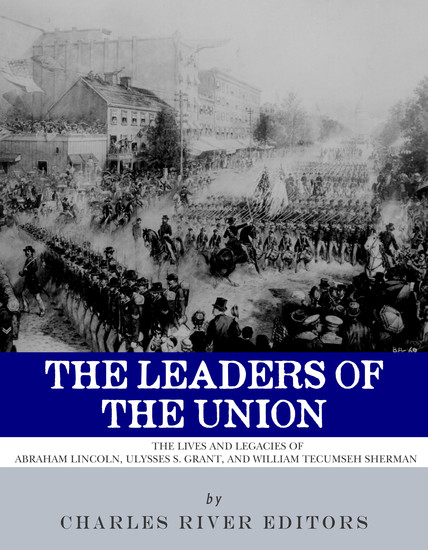
The Leaders of the Union - The Lives and Legacies of Abraham Lincoln Ulysses S Grant and William Tecumseh Sherman - cover
LER

The Leaders of the Union - The Lives and Legacies of Abraham Lincoln Ulysses S Grant and William Tecumseh Sherman

Editors Charles River

Editora: Charles River Editors

  • 0
  • 0
  • 0

Sinopse

Abraham Lincoln (1809–1865) is one of the most famous Americans in history and one of the country’s most revered presidents. Schoolchildren can recite the life story of Lincoln, the “Westerner” who educated himself and became a self made man, rising from lawyer to leader of the new Republican Party before becoming the 16th President of the United States. Lincoln successfully navigated the Union through the Civil War but didn’t live to witness his crowning achievement, becoming the first president assassinated when he was shot at Ford’s Theater by John Wilkes Booth on April 14, 1865.
 
In the generation after the Civil War, Lincoln became an American deity and one of the most written about men in history. With such a sterling reputation, even historians hesitate to write a critical word; in Team of Rivals Doris Kearns Goodwin casts Lincoln as an almost superhuman puppet master in control of his Cabinet’s political machinations and the war’s direction, juggling the balancing act flawlessly. As a result, Lincoln the man is far less known than Lincoln the myth.
 
In the 19th century, one of the surest ways to rise to prominence in American society was to be a war hero, like Andrew Jackson and William Henry Harrison. But few would have predicted such a destiny for Hiram Ulysses Grant, who had been a career soldier with little experience in combat and a failed businessman when the Civil War broke out in 1861.
 
However, while all eyes were fixed on the Eastern theater at places like Manassas, Richmond, the Shenandoah Valley and Antietam, Grant went about a steady rise up the ranks through a series of successes in the West. His victory at Fort Donelson, in which his terms to the doomed Confederate garrison earned him the nickname “Unconditional Surrender” Grant, could be considered the first major Union victory of the war, and Grant’s fame and rank only grew after that at battlefields like Shiloh and Vicksburg.
 
William Tecumseh Sherman (February 8, 1820 – February 14, 1891) holds a unique position in American history. Synonymous with barbarity in the South, Sherman is lauded as a war hero in the North, and modern historians consider him the harbinger of total war. As a General in the Union Army during the American Civil War (1861–65), Sherman was recognized for his outstanding command of military strategy but criticized for the harshness of the "scorched earth" policies that he implemented in conducting total war against the Confederate States, especially in 1864 and 1865. Military historian B. H. Liddell Hart famously declared that Sherman was "the first modern general."
 
Sherman spent a majority of the war out west, although it is often forgotten that he was a brigade commander at the First Battle of Bull Run, and that the Civil War actually finished with General Joseph E. Johnston surrendering to Sherman weeks after Appomattox. By 1865, Sherman was the second most popular general in the North behind Grant, and history has accorded him a strong Civil War legacy.
 
Nevertheless, Sherman remains controversial across much of the United States today. He was unquestionably instrumental at battles like Shiloh, his victory in the Atlanta Campaign reassured Lincoln’s reelection, and his March to the Sea revolutionized total warfare. At the same time, the South considered him akin to a terrorist, violating the norms of warfare by targeting civilians, and accuse him of needlessly burning Atlanta and Columbia. In many ways, Sherman is still the scourge of the South, nearly 160 years after he vowed to make Georgia howl. 
Disponível desde: 04/05/2025.
Comprimento de impressão: 124 páginas.
Outros livros que poderiam interessá-lo

  • Walking the Appalachian Trail - cover

    Walking the Appalachian Trail

    Larry Luxenberg

    • 0
    • 0
    • 0
    A fascinating portrait of the community of people—and one cat—who’ve traveled the trail end to end, by the founder of the Appalachian Trail Museum.   Countless hikers have walked stretches of the two-thousand-plus-mile Appalachian Trail, but only a small, deeply dedicated group has completed the trek all the way through from Georgia to Maine. This book explores the history of the trail through colorful profiles of those who are a part of this unique community and reveals the customs and culture that have evolved around them over the years.   From the sore muscles to the moments of solitude in nature, from the retired postmaster who parachuted onto the top of Springer Mountain to begin his journey to the woman who set out in tennis shoes because she couldn’t find women’s hiking boots in her size, Walking the Appalachian Trail explores questions of who these end-to-enders are, what drives them, what risks they face, and what rewards to body and soul they gain from this extraordinary walk.   Includes color photographs
    Ver livro
  • Occupation and Liberation of France during World War II The: The History of the Decisive Campaigns in 1940 and 1944 - cover

    Occupation and Liberation of...

    Editors Charles River

    • 0
    • 0
    • 0
    One of the most famous people in the world came to tour the city of Paris for the first time on June 28, 1940. Over the next three hours, he rode through the city’s streets, stopping to tour L’Opéra Paris. He rode down the Champs-Élysées toward the Trocadero and the Eiffel Tower, where he had his picture taken. After passing through the Arc de Triomphe, he toured the Pantheon and old medieval churches, though he did not manage to see the Louvre or the Palace of Justice. Heading back to the airport, he told his staff, “It was the dream of my life to be permitted to see Paris. I cannot say how happy I am to have that dream fulfilled today.” 
    Four years after his tour, Adolf Hitler would order the city’s garrison commander, General Dietrich von Choltitz, to destroy Paris, warning his subordinate that the city "must not fall into the enemy's hand except lying in complete debris." Of course, Paris was not destroyed before the Allies liberated it, but it would take more than 4 years for them to wrest control of France from Nazi Germany after they took the country by storm in about a month in 1940. That said, it’s widely overlooked today given how history played out that as the power of Nazi Germany grew alarmingly during the 1930s, the French sought means to defend their territory against the rising menace of the Thousand-Year Reich. As architects of the most punitive measures in the Treaty of Versailles following World War I, France was a natural target for Teutonic retribution, so the Maginot Line, a series of interconnected strongpoints and fortifications running along much of France's eastern border, helped allay French fears of invasion. 
    The French had not expected the Germans would be able to move armored units through the Ardennes Forests, a heavily wooded region spanning parts of Belgium, France and the Netherlands. To the Allies’ great surprise, the Germans had no trouble rolling across these lands in the span of weeks.
    Ver livro
  • History of Florence and of the affairs of Italy - cover

    History of Florence and of the...

    Niccolo Machiavelli

    • 0
    • 0
    • 0
    "History of Florence and of the Affairs of Italy" by Niccolò Machiavelli is a seminal work in the realm of historical writing and political theory. It was written by Machiavelli during the early 16th century and offers a detailed account of the history of Florence and Italy during his lifetime. Machiavelli's work delves into the intricate political dynamics of Florence and Italy, chronicling the rise and fall of various rulers, factions, and states. It provides valuable insights into the political strategies, power struggles, and machinations that characterized Renaissance Italy. Machiavelli's analysis is marked by his pragmatism and keen understanding of human nature, making this book a cornerstone of political philosophy and historical scholarship.
    Ver livro
  • Cholula: The History and Legacy of the Sacred City that Dates Back to the Toltec Empire - cover

    Cholula: The History and Legacy...

    Editors Charles River

    • 0
    • 0
    • 0
    Spanish accounts and Mesoamerican ruins have ensured that 500 years later, people remain fascinated by civilizations like the Maya and Aztec, as well as sites such as Chichen Itza and Tikal. What is often overlooked is that the Maya and Aztec established kingdoms on lands that had been inhabited for millennia before them, and ancient cultures had not only left ruins but also influenced the civilizations that came after them. Thus, while sites like Chichen Itza are more famous, they drew upon past sites like Teotihuacan.  
    	Cholula is one of the most interesting, enigmatic, and forgotten cities in ancient Mesoamerica, and few people are aware that it is the oldest continuously-occupied settlement in the entire Western hemisphere. The current city is known for the Great Pyramid, which has the largest base of all pyramids in the world, as well as its many colonial churches and constant religious celebrations. All of these things ensure that Cholula is heavily visited, but the tremendous importance of Prehispanic Cholula has mostly been lost in the historical accounts of Puebla and even Mexico as a whole. 
    	Located in the Puebla-Tlaxcala Valley within a very fertile area, the Prehispanic city of Cholula was founded around 500 BCE. It soon developed into an important city and the construction of its Great Pyramid began around 200 BCE. During the height of Teotihuacan’s influence in the Classic period and the expansion of the Aztecs in the Postclassic, Cholula managed to maintain its independence and grew to become the greatest religious center in central Mesoamerica. As the main site for the cult of the god Quetzalcoatl, Cholula received pilgrims from many Prehispanic cities, and the two high priests of the Temple of Quetzalcoatl were charged with confirming the legitimacy of these foreign rulers, making their role one of the most important in the region.
    Ver livro
  • Trump's Indictment - The Unprecedented Indictment of Donald J Trump - cover

    Trump's Indictment - The...

    Mark Jackson

    • 0
    • 0
    • 0
    In our shared pursuit for a better America, recent events have sparked diverse perspectives. While some celebrated Trump's indictment, others questioned its alignment with democratic principles. 
    The timing of the indictment raised eyebrows, prompting reflections on fairness and equality before the law. "The Unprecedented Indictment of Donald J. Trump" offers a thought-provoking exploration of this pivotal moment in American politics. This book focuses on the first indictment of Donald Trump by Manhattan District Attorney, Alvin Bragg Jr. 
    From an impartial standpoint, the book scrutinizes Trump's presidency, encompassing achievements, controversies, and the implications of his indictment. It offers insights into the legal and political ramifications, inviting readers to engage in informed discourse. 
    Regardless of one's stance on Trump, this book promises a balanced appraisal of the indictment and its implications for the future. Delve into nuanced analyses and gain a deeper understanding of America's legal and political landscape. 
    Join the quest for truth and comprehension as we dissect the facts surrounding Trump's indictment and its broader significance. History was indeed made, yet amidst the fervor, questions of fairness linger—reminding us of the importance of justice for all. Whether seeking clarity or insight, this book offers a valuable resource for those navigating the complexities of American governance. 
    Table of Contents  
    Introduction 
    Chapter 1: What Trump Did and Didn't on January 6 
    Chapter 2: Trump's Major Accomplishments as President 
    Chapter 3: Trump's Indictment 
    Chapter 4: Can Trump Still Win the Presidency in 2024? 
    Chapter 5: Good Will
    Ver livro
  • Let Me Tell You a Story - cover

    Let Me Tell You a Story

    Larada Horner-Miller, Harold Horner

    • 0
    • 0
    • 0
    How did a young mail carrier from Oklahoma put together a ranch in southeastern Colorado during the depression when others were losing theirs? 
    This delightful booklet tells the story of how my grandfather, Laurence Horner, put our family ranch together in southeastern Colorado during the depressions. Harold Horner, my dad begins the tale in Oklahoma and how the young Horner's ended up in a small ranching community in southeastern Colorado.  
    Harold details the process of how my grandfather bought homestead near each other to build our family ranch. He shares about his family and beginning experience as a rancher. 
    Take a step back in time and witness this family story unfold.
    Ver livro