Junte-se a nós em uma viagem ao mundo dos livros!
Adicionar este livro à prateleira
Grey
Deixe um novo comentário Default profile 50px
Grey
Assine para ler o livro completo ou leia as primeiras páginas de graça!
All characters reduced
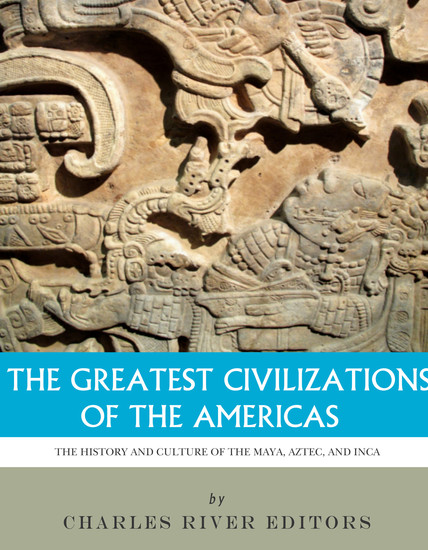
The Greatest Civilizations of the Americas - The History and Culture of the Maya Aztec and Inca - cover
LER

The Greatest Civilizations of the Americas - The History and Culture of the Maya Aztec and Inca

Editors Charles River

Editora: Charles River Editors

  • 0
  • 0
  • 0

Sinopse

Many ancient civilizations have influenced and inspired people in the 21st century. The Greeks and Romans continue to fascinate the West today. But of all the world’s civilizations, none have intrigued people more than the Mayans, whose culture, astronomy, language, and mysterious disappearance all continue to captivate people.
 
In 2012 especially, there has been a renewed focus on the Mayans, whose advanced calendar has led many to speculate the world will end on the same date the Mayan calendar ends. The focus on the “doomsday” scenario, however, has overshadowed the Mayans’ true contribution to astronomy, language, sports, and art.
 
From the moment Spanish conquistador Hernan Cortes first found and confronted them, the Aztecs have fascinated the world, and they continue to hold a unique place both culturally and in pop culture. Nearly 500 years after the Spanish conquered their mighty empire, the Aztecs are often remembered today for their major capital, Tenochtitlan, as well as being fierce conquerors of the Valley of Mexico who often engaged in human sacrifice rituals.
 
Ironically, and unlike the Mayans, the Aztecs are not widely viewed or remembered with nuance, in part because their own leader burned extant Aztec writings and rewrote a mythologized history explaining his empire’s dominance less than a century before the Spanish arrived. Naturally, Cortes and other Spaniards depicted the Aztecs as savages greatly in need of conversion to Catholicism. While the Mayans are remembered for their astronomy, numeral system, and calendar, the Aztecs have primarily been remembered in a far narrower way, despite continuing to be a source of pride to Mexicans through the centuries.
 
As a result, even though the Aztecs continue to interest people across the world centuries after their demise, it has fallen on archaeologists and historians to try to determine the actual history, culture, and lives of the Aztecs from the beginning to the end, relying on excavations, primary accounts, and more.
 
During the Age of Exploration, Native American tribes fell victim to European conquerors seeking legendary cities made of gold and other riches, attempts that were often being made in vain. And yet, of all the empires that were conquered across the continent, the one that continues to be most intimately associated with legends of gold and hidden riches is the Inca Empire. The Inca Empire, which flourished in modern day Peru and along the west coast of South America, was the largest Native American empire in pre-Columbian America until Pizarro and the Spanish conquistadors conquered them in the 16th century. What ultimately sealed their doom was the rumor that huge amounts of gold were available in regions south of the Andes Mountains.
 
Though the Spanish physically conquered them in quick fashion, the culture and legacy of the Inca Empire has continued to endure throughout the centuries in both Europe and South America, due in no small part to the fact they were one of the most advanced and sophisticated cultures on the continent. Like the Aztecs, the Spanish burned much of the Inca’s extant writings, but it is estimated that as many as 35 million once fell under their banner, and the empire’s administrative skills were so sharp that they kept accurate census records. Their religion, organization, and laws were also effectively centralized and tied to the rulers of the empire, and their military mobilization would have made the ancient Spartans proud. After the Spanish conquest, several rebellions in the area attempted to reestablish the proud Inca Empire over the next two centuries, all while famous Europeans like Voltaire glorified the Inca Empire in optimistic artistic portrayals.
 
The mystique and aura of the Inca continue to fascinate the world today, and nowhere is this more prominent than at Macchu Picchu.
Disponível desde: 05/05/2025.
Comprimento de impressão: 90 páginas.


Outros livros que poderiam interessá-lo

  • Racial Emotion at Work - Dismantling Discrimination and Building Racial Justice in the Workplace - cover

    Racial Emotion at Work -...

    Tristin K. Green

    • 0
    • 0
    • 0
    This timely book unravels race and emotion in the workplace—exploring why racial emotion is often left out of equity conversations and why we must confront it. 


    Racial Emotion at Work is an invitation to understand our own emotions and associated behaviors around race—and much more. With this surprising and timely book, Tristin K. Green takes us beyond diversity trainings and other individualized solutions to discrimination and inequality in employment, calling for sweeping changes in how the law and work organizations treat and shape racial emotions. 


    Green provides listeners with the latest research on racial emotions in interracial interactions and ties this research to thinking about discrimination and disadvantage at work. We see how our racial emotions can result in discrimination, and how our institutions—the law and work organizations—value and skew our racial emotions in ways that place the brunt of negative consequences on people of color. It turns out we need to reset our institutional and not just our personal radars on racial emotion to advance racial justice. Racial Emotion at Work shows how we can rise to the task.
    Ver livro
  • Women with ADHD - The Ultimate Guide to Live Boldly Overcome Distractions and Stay Organized Learn Practical Tips to Manage your Emotions Improve Relationships Finances & Transform Your Life - cover

    Women with ADHD - The Ultimate...

    Lisa Kennedy

    • 0
    • 0
    • 0
    Do you find yourself constantly struggling with a racing mind, unable to focus on one task at a time? Are you plagued by anxiety and find yourself obsessing over certain activities, even if they lead to exhaustion? 
    If so, you may be one of the many women living with ADHD. 
    Attention Deficit Hyperactivity Disorder, or ADHD, is a condition that affects millions of people around the world, and yet, it is often misunderstood and underdiagnosed in women. Despite being diagnosed and treated more often in men, ADHD affects women just as much, if not more. Unfortunately, there is a lack of information and research on ADHD in women, leading to a lack of understanding and support. 
    One of the biggest challenges for women with ADHD is getting diagnosed. Unlike boys, girls are more inconspicuous and less likely to have poor school performance, which is often the first red flag for ADHD. Additionally, girls are more likely than boys to have the predominantly inattentive type without hyperactivity and fewer behavior problems in clinical practice. As a result, many women come to know their ADHD when their children are diagnosed. 
    This book is an essential guide for women who suspect they have ADHD, as well as for their loved ones. We provide information on how to recognize the symptoms, how to seek professional help and how to take control of your life. We also discuss the importance of self-care, how to manage the disorder, and how to advocate for yourself in the medical and educational systems. 
    Don't let ADHD control your life any longer. Learn how to take control and find the support you deserve with this informative and empowering audiobook. With the right knowledge, tools, and support, you can learn to live a fulfilling and successful life despite the challenges of ADHD 
    Don't wait any longer, order your copy now and take the first step towards understanding and managing your ADHD
    Ver livro
  • What WE Lost - Inside the Attack on Canada’s Largest Children’s Charity - cover

    What WE Lost - Inside the Attack...

    Tawfiq S. Rangwala

    • 0
    • 0
    • 0
    TORONTO STAR #1 BESTSELLER 
    GLOBE AND MAIL AND AMAZON BESTSELLER
    		 
    WE Charity had changed the game. In its 25 years, the international development charity and youth empowerment movement impacted lives the world over. Innovation was at its core: while most charities focus on making the world a better place for our children, WE Charity focused on making better children for our world. Founded by the ubiquitous Kielburger brothers, WE Charity operated more like a Silicon Valley start-up than a traditional NGO. From creating stadium-filling events with A-list celebrity ambassadors to building schools, infrastructure, a hospital and even a university at lightning speed, the organization was always full-throttle.
    		 
    Its for-profit partner, ME to WE, filled shelves with socially-conscious products that allowed consumers to track the impact of their spending, invited young people and families to visit and work in communities WE Charity supported, and channelled proceeds back into the charity to make it self-sustaining.
    		 
    Unique and disruptive, WE generated energy, engagement, and accolades. But it also bred misunderstanding and, in some quarters, resentment. With a long history of propelling youth to act in support of myriad causes—making ”doing good doable,” the slogan went—WE Charity was the ideal candidate to administer the Canada Student Services Grant (CSSG) program. The program, if it had happened, involved matching students within non-profits in a summer in which Covid had stolen most job opportunities. And then, WE Charity in Canada was gone. It didn’t crumble. It crashed. Unwittingly caught in the crosshairs of a partisan fight that reflects the increasing ”Americanization” of Canadian politics, WE Charity was forced to shutter its doors in Canada.
    		 
    Once a media darling with politicians of all stripes clamouring to appear at its events, the charity was suddenly a pariah accused (falsely) of a litany of wrongdoings: political cronyism; governance failures; heavy-handed decision-making by executives; lining the pockets of the founders; manipulating children; mistreating donors; racism and international corruption. Many were shocked. Detractors were delighted. Led by fringe commentators, the media quickly piled on. Allies who spoke out were castigated and forced to take cover. But while most Canadians have heard of the so-called ”WE Charity Scandal”—at times forming strong views—few are able to recount the true facts.
    		 
    Misperceptions and confusion have ruled the day. And many of the most important voices—including those of educators and young people—have gone unreported and unheard. In this book, former WE board member and lawyer Tawfiq Rangwala unpacks the evidence and provides the critical context around the headline-grabbing controversies that have shaped the narrative. Drawing on the factual record, his personal experiences inside the organization, and extensive interviews with supporters and critics, Rangwala cuts through the fog and explains what really happened, why it happened, and who should be held to account. The author goes even deeper with insightful, compassionate and heartbreaking interviews with WE supporters, benefactors and the politicians that used the awarding of the contract during the global pandemic crisis to paint a picture of conflicts of interest and special favours by the Prime Minister. Along the way, we learn what has been lost and the personal cost to Canadians and people around the world.
    		 
    More than just a story of the rise and fall of an iconic global charity, this is a cautionary tale of the collateral damage that can be levelled by unchecked partisan politics, social media pundits, and sensationalist headlines. In the end, Canadians are left to ponder whether the real ”scandal” is the demise of WE Charity and the values of fair play and due process that most of us hold dear.
    Ver livro
  • Digital Liberty - Power Wealth and the Influence Machine - cover

    Digital Liberty - Power Wealth...

    Matt Stroud

    • 1
    • 1
    • 0
    Digital Liberty explores the imminent convergence of three pivotal themes: data, artificial intelligence and society's intricate social graph, and wars of a looming crisis that threatens to challenge the very foundations of liberal democracies.
    Ver livro
  • The Fish That Ate the Whale - The Life and Times of America's Banana King - cover

    The Fish That Ate the Whale -...

    Rich Cohen

    • 0
    • 0
    • 0
    Named a Best Book of the Year by the San Francisco Chronicle and The Times-Picayune The fascinating untold tale of Samuel Zemurray, the self-made banana mogul who went from penniless roadside banana peddler to kingmaker and capitalist revolutionary  When Samuel Zemurray arrived in America in 1891, he was tall, gangly, and penniless. When he died in the grandest house in New Orleans sixty-nine years later, he was among the richest, most powerful men in the world. Working his way up from a roadside fruit peddler to conquering the United Fruit Company, Zemurray became a symbol of the best and worst of the United States: proof that America is the land of opportunity, but also a classic example of the corporate pirate who treats foreign nations as the backdrop for his adventures. Zemurray lived one of the great untold stories of the last hundred years. Starting with nothing but a cart of freckled bananas, he built a sprawling empire of banana cowboys, mercenary soldiers, Honduran  peasants, CIA agents, and American statesmen. From hustling on the docks of New Orleans to overthrowing Central American governments and precipitating the bloody thirty-six-year Guatemalan civil war, the Banana Man lived a monumental and sometimes dastardly life. Rich Cohen's brilliant historical profile The Fish That Ate the Whale unveils Zemurray as a hidden power broker, driven by an indomitable will to succeed.
    Ver livro
  • Newport Gardner's Anthem - A Story of Slavery Struggle and Survival in Early America - cover

    Newport Gardner's Anthem - A...

    Edward E. Andrews

    • 0
    • 0
    • 0
    Newport Gardner's Anthem explores the remarkable life of Occramer Marycoo, an enslaved African who went on to become one of early America's most important Black leaders. In the mid-eighteenth century, Marycoo was taken from West Africa to Newport, Rhode Island, where he was forced into racial bondage and given a name that symbolized the power that his new city and new enslaver held over him: Newport Gardner. In this powerful book, Edward E. Andrews pieces together newspaper articles, church records, letters, and Gardner's own writings to tell the story of his life. 
    After acquiring his freedom via a winning lottery ticket in 1791, Gardner became a kind of Founding Father for Newport's free Black community. He became a popular educator to young Black Newporters, and emerged as a key religious figure, serving as a long-standing pillar of Newport's First Congregational Church and later founding an independent Black church in the 1820s. His final act was leading a group of about three dozen Black New Englanders to Liberia, in hopes that a new start in Africa would be better than the discrimination they faced in America. 
    A richly textured account, Newport Gardner's Anthem tells the story of a forgotten Black leader while exploring the new, but tragically limited, opportunities for formerly enslaved people in the post-Revolutionary world.
    Ver livro