Junte-se a nós em uma viagem ao mundo dos livros!
Adicionar este livro à prateleira
Grey
Deixe um novo comentário Default profile 50px
Grey
Assine para ler o livro completo ou leia as primeiras páginas de graça!
All characters reduced
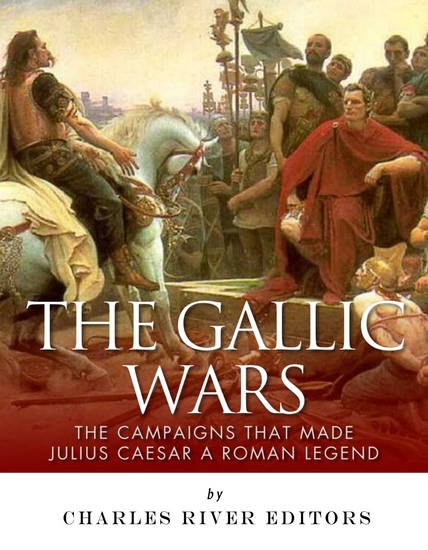
The Gallic Wars - The Campaigns That Made Julius Caesar a Roman Legend - cover
LER

The Gallic Wars - The Campaigns That Made Julius Caesar a Roman Legend

Editors Charles River

Editora: Charles River Editors

  • 0
  • 0
  • 0

Sinopse

The Gallic Wars, the series of campaigns waged by Julius Caesar on behalf of the Roman Senate between 58-50 BC, were among the defining conflicts of the Roman era. Not only was the expansion of the Republic’s domains unprecedented (especially when considering it was undertaken under the auspices of a single general), it had a profound cultural impact on Rome itself as well. The Roman Republic, so dynamic in the wake of the destruction of their ancient enemy, Carthage, had recently suffered a series of dramatic upheavals; from the great slave rebellion of Spartacus to the brutal and bloody struggle for power of Marius and Sulla. Rome had been shaken to its very core, and a victory was essential both to replenish the dwindling national coffers and to instill in the people a sense of civic pride and a certainty in the supremacy of the Republic.
 
Quite simply, in terms of scale, the Gallic Wars were unmatched by anything the Roman Republic had witnessed since the Punic Wars. By the end of the campaigns, ancient historians estimated that more than a million people had died, and still more displaced or enslaved. Even by the more conservative estimates of modern historians, a casualty count in the hundreds of thousands appears possible. Either way, the war was a cataclysm, involving tens of thousands of combatants, and it also marked the greatest displays of skill by one of the greatest battlefield generals history has ever known.
 
Caesar’s successful campaigns in Gaul have become the stuff of military legend, in part because he had the foresight to document them himself. Caesar himself wrote a famous firsthand account of the Gallic Wars, apparently from notes he had kept during the campaigns, and he wrote Commentarii de Bello Gallico (Commentaries on the Gallic War) in the third person. Caesar’s account described the campaigning and the battles, all as part of a propaganda campaign to win the popularity of the Roman people. As a result, he left out inconvenient facts, including how much of a fortune he made plundering, but the work still remains popular today, and it is still used to teach Latin.
 
The Gallic Wars: The Campaigns That Made Julius Caesar a Roman Legend comprehensively looks at the campaigns that subdued Gaul and led to Caesar’s conquest not just of the European continent but of Rome itself. Along with pictures, you will learn about the Gallic Wars like never before, in no time at all.
Disponível desde: 02/05/2025.
Comprimento de impressão: 40 páginas.

Outros livros que poderiam interessá-lo

  • British Empire - Details of the Largest Empire in Human History - cover

    British Empire - Details of the...

    Kelly Mass

    • 0
    • 0
    • 0
    The British Empire was an extensive network of dominions, colonies, protectorates, mandates, and territories ruled or administered by the United Kingdom and its predecessor governments. This sprawling empire evolved from England's early ventures into overseas territories and trading ports, beginning in the late 16th century and continuing through the early 18th century. The empire grew to become the largest in recorded history, dominating global affairs for more than a century. 
    The roots of the British Empire can be traced back to England’s desire to expand its economic and political influence, driven by competition with other European powers like Spain and Portugal, who were leading the Age of Exploration. These countries had established lucrative colonial empires in the Americas, Africa, and Asia, amassing great wealth and resources. Inspired by their success, England, along with France and the Netherlands, began establishing its own colonies and trading posts, particularly in North America, the Caribbean, and Asia. 
    During the 17th and 18th centuries, the British Empire grew in strength through a combination of military conquests, naval power, and strategic alliances. Following its unification with Scotland through the 1707 Act of Union, Britain emerged as a major colonial power, extending its control across vast regions. The empire's reach expanded dramatically after the series of conflicts with its rivals, including the Anglo-Dutch Wars and the long-standing hostilities with France, culminating in Britain's dominance over North America and its influence over global trade routes.
    Ver livro
  • Big Words Small Ideas - From Plato to Postmodernism - 3000 years of Not Saying What You Mean - cover

    Big Words Small Ideas - From...

    Anônimo

    • 0
    • 0
    • 0
    If you’ve ever read a philosophy paper and wondered, “Did they really need that many syllables to say absolutely nothing?”—this book is for you. 
    Sophia Anne Blackwell, the wildly irreverent creator of the Cogito Ergo Nope! series, returns with her most hilariously scathing book yet: a no-holds-barred takedown of philosophy’s greatest (and most obscurantist) offenders. From the ancient Greeks who invented making things harder than they need to be, to French theorists who turned not making sense into a career, Big Words, Small Ideas traces the glorious tradition of intellectual smoke and mirrors with biting wit and actual clarity. 
    In this book, you’ll meet: 
    Plato, who decided the real world was just a sad knockoff of Ideas That Don’t Exist 
    Aristotle, who invented philosophical filing cabinets with seventeen drawers too many 
    Plotinus, who tried to write about the indescribable in several hundred pages 
    Kant, who made thinking about thinking so hard you’d wish you never started 
    Hegel, the man who weaponized run-on sentences 
    Heidegger, who wrote an entire book about Being without explaining what Being means 
    And a whole cast of modern academics who think obscurity = genius 
    With ruthless humor, surprising accuracy, and zero patience for jargon masquerading as depth, Blackwell takes you on a tour through the theater of philosophical absurdity—and dares to ask the forbidden question: What the hell are they actually talking about? 
    Whether you’re a recovering philosophy major, a curious outsider, or just someone who’s tired of pretending to understand Lacan, this book is your guide to 3,000 years of intellectual gaslighting—with jokes.
    Ver livro
  • A Rare Recording of Oswald Mosley - cover

    A Rare Recording of Oswald Mosley

    Oswald Mosley

    • 0
    • 0
    • 0
    Sir Oswald Ernald Mosley (1896 - 1980) was a British politician best remembered as leader of the British Union of Fascists (Blackshirts) in the 1930s. 
    Mosley was a Member of Parliament during various periods between 1918 to 1931. He is known for holding huge political rallies in Britain, while trying to unite the various fascist movements around Europe. 
    This is a recording of a speech that he gave in London in 1954. 
    A Listen & Live audio production.
    Ver livro
  • On Disinformation - How to Fight for Truth and Protect Democracy - cover

    On Disinformation - How to Fight...

    Lee McIntyre

    • 0
    • 0
    • 0
    The effort to destroy facts and make America ungovernable didn't come out of nowhere. It is the culmination of seventy years of strategic denialism. In On Disinformation, Lee McIntyre shows how the war on facts began, and how ordinary citizens can fight back against the scourge of disinformation that is now threatening the very fabric of our society. Drawing on his twenty years of experience as a scholar of science denial, McIntyre explains how autocrats wield disinformation to manipulate a populace and deny obvious realities, why the best way to combat disinformation is to disrupt its spread, and most importantly, how we can win the war on truth. 


    McIntyre goes through the history of strategic denialism to show how we arrived at this precarious political moment and identifies the creators, amplifiers, and believers of disinformation. On Disinformation lays out ten everyday practical steps that we can take as ordinary citizens—from resisting polarization to pressuring our Congresspeople to regulate social media—as well as the important steps our government (if we elect the right leaders) must take. 


    On Disinformation empowers us to save our republic from autocracy before it is too late.
    Ver livro
  • Mr Vic’s X-Rated Television: “Miss Fisher Mysteries!” “Lesbian Loving For Miss Fisher and Dot!” Book two - cover

    Mr Vic’s X-Rated Television:...

    VIC VITALE

    • 0
    • 0
    • 0
    “A Lesbian Cums-A-Calling!” 
    “Under a Doctor’s Care and Body!”“ 
    “Alone Time For Phryne and Dot!” 
    "Hi! I'm Kitty Forman! I know I shouldn't be here, but I just have to see you." 
    Mac pauses before letting the woman who raped her inside her home. She is having mixed feelings, but truth be told, she's very glad to see this Kitty Forman. "I don't know? You forced yourself on me. Why should I want to see you?" 
     
    Ver livro
  • Burnt - Fighting for Climate Justice - cover

    Burnt - Fighting for Climate...

    Chris Saltmarsh

    • 0
    • 0
    • 0
    Time is up. The climate crisis is no longer a future to be feared, but a devastating reality. We see it in the wildfires in California and floods across Britain—the "once in a generation" extreme weather events that now happen every year. 


    In a world where those in charge are constantly letting us down, real change in our lifetime means taking power into our own hands. The task ahead of us is daunting, but the emergence of a new wave of movements focused on climate justice, equality, and solidarity also brings hope. 


    Asking how we have arrived at this moment, Chris Saltmarsh argues that the profoundly political nature of the environmental crisis has been relentlessly downplayed. After all, how can solar panels save us while capitalism places profit over the future of the planet? Analyzing the failures of NGOs, the limitations of Extinction Rebellion and Youth Strikes, the role of trade unions, and the possibilities of a Green New Deal, Burnt issues a powerful call for a radical collective movement: saving the world is not enough; we must build a better one in the process.
    Ver livro