Junte-se a nós em uma viagem ao mundo dos livros!
Adicionar este livro à prateleira
Grey
Deixe um novo comentário Default profile 50px
Grey
Assine para ler o livro completo ou leia as primeiras páginas de graça!
All characters reduced
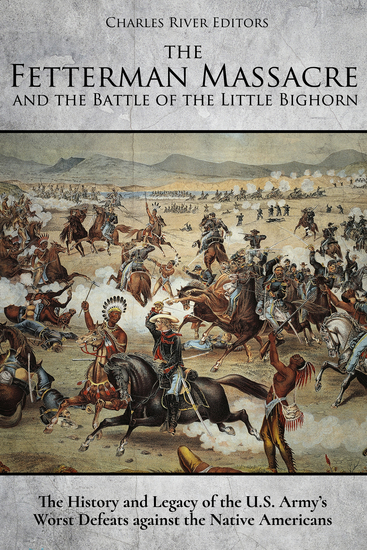
The Fetterman Massacre and the Battle of the Little Bighorn - The History and Legacy of the US Army’s Worst Defeats against the Native Americans - cover
LER

The Fetterman Massacre and the Battle of the Little Bighorn - The History and Legacy of the US Army’s Worst Defeats against the Native Americans

Editors Charles River

Editora: Charles River Editors

  • 0
  • 0
  • 0

Sinopse

Since the Battle of the Little Bighorn, George Armstrong Custer has possessed one of the most unique places in American history. Although he was a capable cavalry officer who served honorably during the Civil War, he remains one of the most instantly identifiable and famous military men in American history due to the fact he was killed during one of the country’s most well known and ignominious defeats, the Battle of Little Bighorn. At the same time, this one relatively insignificant battle during America’s Indian Wars has become one of the country’s most mythologized events and continues to fascinate Americans nearly 140 years later.
 
On the morning of June 25, Custer’s scouts discovered a Native American village about 15 miles away in the valley of the Little Bighorn River.  Choosing to disregard his superiors’ orders to wait for a concerted effort, the grandstanding Custer intended to deliver his own decisive victory by dividing his command into three units, an extremely bold tactic when done in the face of a much larger force. Due to their belief in the inferiority of the Plains Indians, and mindful of previous Indian tactics that sought to avoid pitched battle, Custer and his men were most concerned with forcing the action and failed to understand the true nature of the situation they had entered. The Native American gathering, centered around the famous Sioux chief Sitting Bull, numbered roughly 8,000 individuals, and about 2,000 of them were warriors. Custer’s forces amounted to a mere 31 officers, 566 troopers, and 50 scouts and civilians, and they had been split into three columns in order to stop a possible retreat.
 
Before the battle, it is believed Custer thought he was facing a group of about 800, which was Sitting Bull’s strength in the weeks before the battle. However, the Army’s Native American scouts and civilian scouts had not adequately informed the Army of the reinforcements that arrived, and at Little Bighorn, Custer’s three-pronged attack was completely overwhelmed. How Custer met his fate, and whether there even was a Last Stand, remain subjects of debate, but what is known is that the Battle of the Little Bighorn was one of the U.S. military’s biggest debacles. All told, the 7th Cavalry suffered over 50% casualties, with over 250 men killed and over 50 wounded. The dead included Custer's brothers Boston and Thomas, his brother-in-law James Calhoun, and his nephew Henry Reed. Custer and his men were buried where they fell.  A year later, Custer’s remains (or more accurately, the remains found in the spot labeled with his name) were relocated to West Point for final interment.
Disponível desde: 01/05/2025.
Comprimento de impressão: 76 páginas.

Outros livros que poderiam interessá-lo

  • As the Stage Turned - A Front Row Theatre Memoir - cover

    As the Stage Turned - A Front...

    Jeannie Emser Schultz

    • 0
    • 0
    • 0
    Sammy Davis, Jr. opened it. Luther Vandross closed it. During the 19 years in between, a who’s who of the world’s top entertainers and speakers performed on the novel revolving stage of the Front Row Theatre, from Liberace to Alice Cooper, Jay Leno to Jerry Seinfeld, Marlene Dietrich to Dolly Parton, Presidents Ford and Carter and culinary grand dame Julia Child. Many were unknown opening acts, like Whitney Houston. Another, the legendary Roy Orbison, would unknowingly perform the final concert of his life there. 
    Cleveland Landmarks Press’ newest release, As the Stage Turned: A Front Row Theatre Memoir, captures the dynamic energy that sprung from one of the most unique entertainment venues in the country – a theater-in-the-round located in the sleepy suburb of Highland Heights, just outside of Cleveland. 
    Jeannie Emser Schultz, the venue’s longtime former director of marketing and publicity, has written a memoir capturing the star power and draw of the Front Row. It’s an homage to seemingly everything related to show business and the cultural significance of that famed theater that drew the biggest and brightest stars of its day. 
    For instance, where else would you learn that several days into Sammy Davis’s opening run at the Front Row in 1974, he received a phone call threatening his life? Or that the only way Frank Sinatra would agree to perform there was if he and his entire entourage could rent out the Shaker Heights home of Larry Dolin, the founder and president of the Front Row? Or that comedian Bob Newhart always kept a nude picture on his dressing room table of Anthony Newley looking backwards through his legs (Newhart told Emser Schultz it was one of the funniest pictures he ever saw)? 
    Emser Schultz’s narrative takes readers on a detailed and behind-the-scenes firsthand journey of the almost 20-year history of what was considered one of America’s most significant entertainment venues. Revisit your own fond memories of a lost Cleveland classic.
    Ver livro
  • War on Warriors The: Book Summary and Analysis - cover

    War on Warriors The: Book...

    Briefly Summaries

    • 0
    • 0
    • 0
    This is a concise summary and analysis of The War on Warriors, by Pete Hegseth.
     
    It is not the original book and is not affiliated with or endorsed by Pete Hegseth.
     
    Ideal those seeking a quick and insightful overview.


    In The War on Warriors, the author uncovers the profound challenges facing modern-day warriors, both on the battlefield and in society. This powerful audiobook delves into the forces shaping today’s military and explores how cultural shifts, bureaucratic barriers, and media portrayals are impacting the morale, mission, and future of the armed forces.
     
    With a motivational and engaging tone, the author not only reveals the “war” waged on the warrior spirit but also emphasizes the timeless values of discipline, resilience, and dedication that define true strength. Each chapter offers insights that resonate beyond the military, encouraging listeners to adopt the warrior ethos in their own lives.
     
    Whether you’re in search of inspiration, looking to build mental toughness, or aiming to boost your productivity, The War on Warriors is a call to embrace values that empower you to overcome life’s obstacles. This audiobook is a tribute to resilience, an invitation to grow, and a guide to cultivating a mindset that achieves success in any field.
    Ver livro
  • The Dore Lectures on Mental Science - The Original 1909 Classic - cover

    The Dore Lectures on Mental...

    Thomas Troward

    • 0
    • 0
    • 0
    Step back in time to the early 20th century and immerse yourself in the profound wisdom of 'The Dore Lectures on Mental Science' by Thomas Troward, a book that has stood the test of time. Originally delivered as a series of lectures in the early 1900s, this literary masterpiece has continued to captivate and inspire generations of readers.
    
    'The Dore Lectures on Mental Science' offers a unique glimpse into the philosophical and metaphysical discussions of its time while providing timeless insights into the human experience.
    
    -Explore the depths of universal truths and timeless teachings.
    -Gain a deep understanding of the mysteries that have captivated great minds throughout history.
    -Unlock the latent power that resides within you, waiting to transform your life.
    
    Join the ranks of those who have been enriched by the wisdom of Thomas Troward.
    Open the book and embark on a journey through history and enlightenment that will forever transform your perspective on life
    Ver livro
  • Dancing Under the Red Star - The Extraordinary Story of Margaret Werner the Only American Woman to Survive Stalin's Gulag - cover

    Dancing Under the Red Star - The...

    Karl Tobien

    • 0
    • 0
    • 0
    Between 1930 and 1932, Henry Ford sent 450 of his Detroit employees plus their families to live in Gorky, Russia, to operate a new manufacturing facility. This is the true story of one of those families—Carl and Elisabeth Werner and their young daughter Margaret—and their terrifying life in Russia under brutal dictator Joseph Stalin. 


    Margaret was seventeen when her father was arrested on trumped-up charges of treason. She and her mother were left to withstand the hardships of life under the oppressive Soviet state, an existence marked by poverty, starvation, and fear. Refusing to comply with the Socialist agenda, Margaret was ultimately sentenced to ten years of hard labor in Stalin's Gulag. Filth, malnutrition, and despair accompanied merciless physical labor. Yet in the midst of inhumane conditions came glimpses of hope and love as Margaret came to realize her dependence upon "the grace, favor, and protection of an unseen God." In all, it would be thirty long years before Margaret returned to kiss the ground of home. Of all the Americans who made this virtually unknown journey—ultimately spending years in Siberian death camps—Margaret Werner was the only woman who lived to tell about it. Written by her son, Karl Tobien, Dancing Under the Red Star is Margaret's unforgettable true story: an inspiring chronicle of faith, defiance, and personal triumph.
    Ver livro
  • Not Paved for Us - Black Educators and Public School Reform in Philadelphia - cover

    Not Paved for Us - Black...

    Camika Royal, Gloria...

    • 0
    • 0
    • 0
    This illuminating book offers an extensive, expert analysis of a school system that bears the legacy, hallmarks, and consequences that lie at the intersection of race and education. Urban education scholar Camika Royal deftly analyzes decades of efforts aimed at improving school performance within the School District of Philadelphia (SDP), in a brisk survey spanning every SDP superintendency from the 1960s through 2017. 


    Royal interrogates the history of education and educational reforms, recounting city, state, and federal interventions. Her survey provides sociopolitical context and rich groundwork for a nuanced examination of why many large urban districts struggle to implement reforms with fidelity and in ways that advance Black students academically and holistically. 


    In a bracing critique, Royal bears witness to the ways in which positive public school reform has been obstructed: through racism and racial capitalism, but also via liberal ideals, neoliberal practices, and austerity tactics. 


    Not Paved for Us highlights the experiences of Black educators as they navigate the racial and cultural politics of urban school reform.
    Ver livro
  • World War I on the Ground: The History and Legacy of Life in the Trenches - cover

    World War I on the Ground: The...

    Editors Charles River

    • 0
    • 0
    • 0
    World War I, also known in its time as the “Great War” or the “War to End all Wars”, was an unprecedented holocaust in terms of its sheer scale. Fought by men who hailed from all corners of the globe, it saw millions of soldiers do battle in brutal assaults of attrition which dragged on for months with little to no respite. Tens of millions of artillery shells and untold hundreds of millions of rifle and machine gun bullets were fired in a conflict that demonstrated man’s capacity to kill each other on a heretofore unprecedented scale, and as always, such a war brought about technological innovation at a rate that made the boom of the Industrial Revolution seem stagnant. 
    The enduring image of World War I is of men stuck in muddy trenches, and of vast armies deadlocked in a fight neither could win. It was a war of barbed wire, poison gas, and horrific losses as officers led their troops on mass charges across No Man’s Land and into a hail of bullets. While these impressions are all too true, they hide the fact that trench warfare was dynamic and constantly evolving throughout the war as all armies struggled to find a way to break through the opposing lines. 
    There was another war going on beneath the trenches, a war of tunnels and mines fought by men who didn’t see sunlight for days at a time and who lived in constant fear of cave-ins and enemy detection. These men, who had mostly been miners in civilian life, lived a twilight existence, working long hours in silence and near darkness while great battles raged overhead. They suffered from fatigue, stress, and the knowledge that they could be killed at any time by an unseen enemy. Despite this, they persevered, and the mines they laid under enemy trench systems turned the tide of at least one major battle.
    Ver livro