¡Acompáñanos a viajar por el mundo de los libros!
Añadir este libro a la estantería
Grey
Escribe un nuevo comentario Default profile 50px
Grey
Suscríbete para leer el libro completo o lee las primeras páginas gratis.
All characters reduced
The Commanders of Gettysburg - The Lives and Careers of Robert E Lee and George G Meade - cover

The Commanders of Gettysburg - The Lives and Careers of Robert E Lee and George G Meade

Editors Charles River

Editorial: Charles River Editors

  • 0
  • 0
  • 0

Sinopsis

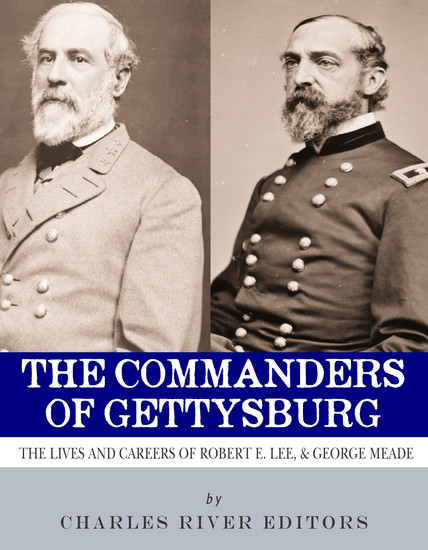
With the exception of George Washington, perhaps the most famous general in American history is Robert E. Lee, despite the fact he led the Confederate Army of Northern Virginia against the Union in the Civil War. As the son of U.S. Revolutionary War hero Henry "Light Horse Harry" Lee III, and a relative of Martha Custis Washington, Lee was imbued with a strong sense of honor and duty from the beginning. And as a top graduate of West Point, Lee had distinguished himself so well before the Civil War that President Lincoln asked him to command the entire Union Army. Lee famously declined, serving his home state of Virginia instead after it seceded.
 
Lee is remembered today for constantly defeating the Union’s Army of the Potomac in the Eastern theater from 1862-1865, considerably frustrating Lincoln and his generals. His leadership of his army led to him being deified after the war by some of his former subordinates, especially Virginians, and he came to personify the Lost Cause’s ideal Southern soldier. His reputation was secured in the decades after the war as a general who brilliantly led his men to amazing victories against all odds.
 
Despite his successes and his legacy, Lee wasn’t perfect. And of all the battles Lee fought in, he was most criticized for Gettysburg, particularly his order of Pickett’s Charge on the third and final day of the war. Despite the fact his principle subordinate and corps leader, General James Longstreet, advised against the charge, Lee went ahead with it, ending the army’s defeat at Gettysburg with a violent climax that left half of the men who charged killed or wounded.
 
Meade exemplified modesty and competence, serving as a career United States Army officer and civil engineer who fought with distinction in the eastern theater of the Civil War. During the first half of the war, Meade rose from command of a brigade to command of a division and finally command of the entire Army of the Potomac just days before the Battle of Gettysburg. Naturally, he is best known for defeating Robert E. Lee’s Army of Northern Virginia at Gettysburg in July 1863, although he’s not nearly as well remembered as his Confederate counterpart, and he has even been eclipsed in popularity by some of the men he commanded at Gettysburg, like Joshua Chamberlain. Meade continued to lead the Army of the Potomac, but when Grant attached himself to the army in 1864, it was Grant who essentially commanded the army, creating an awkward situation that Meade persevered through until the end of the war, to his credit.


If Meade distinguished himself at places like Antietam and Gettyburg, why is he frequently left out of the historical narrative of the war? Meade had a notoriously short temper that hurt his popularity with the press, his men and contemporaries during the war, despite how well he commanded. Perhaps more importantly, Meade’s relatively early death in the decade after the war prevented him from defending his record and his decisions during and after Gettysburg. Lincoln mistakenly thought Meade blundered by not being more aggressive in pursuit of Lee after Gettysburg, when in fact Lee’s men constructed strong defenses and invited attack on a number of occasions during their retreat. Just as significantly, Meade came under attack by generals like Daniel Sickles, who sought to shield themselves from scrutiny by blaming Meade for poor decisions. 
Disponible desde: 28/05/2025.
Longitud de impresión: 123 páginas.

Otros libros que te pueden interesar

  • The Leather Couch - Clinical Practice with Kinky Clients - cover

    The Leather Couch - Clinical...

    Stefani Goerlich

    • 0
    • 0
    • 0
    Winner of the 2021 AASECT Book Award! 


    The Leather Couch provides a comprehensive overview of the BDSM and kink community and guides clinicians on how to meet the unique relational and mental health needs of its members. 


    The text offers a 101-style introduction to BDSM before delving into topics ranging from intersectionality within the kink community, to conducting a kink-affirming risk assessment, and how to discern between domestic violence and consensual power-exchange. The author explores differential diagnoses and clinical concerns that are relevant to health care providers, including social workers and therapists as well as primary care physicians and sex educators. 


    Interwoven throughout with real-world case studies, each chapter presents practical suggestions, tools, and handouts the listener can use to inform their practice and serve clients in ways that meet the needs of each individual, couple, or partnership. 


    Written in a conversational, accessible style for clinicians and members of the BDSM community alike, The Leather Couch is the go-to resource for any mental health professional or educator looking to transform their practice from kink aware to kink affirming.
    Ver libro
  • How to Create and Sustain Momentum - Elevate Your Mind Elevate Your World - cover

    How to Create and Sustain...

    Vanessa James

    • 0
    • 0
    • 0
    Do you feel stuck, longing to break free from cycles of inaction and finally achieve your biggest dreams? "How to Create and Sustain Momentum: Elevate Your Mind, Elevate Your World" is your definitive guide to unlocking consistent progress and profound personal transformation. 
    Bestselling author Victoria David reveals the powerful principles and practical strategies to build unstoppable momentum in every area of your life. Discover how to shift your mindset, cultivate unwavering focus, and take decisive action that propels you forward, even when challenges arise. This isn't just about fleeting motivation; it's about engineering a continuous upward spiral of growth, achievement, and fulfillment. 
    Learn to:Ignite Your Inner Drive: Master techniques to overcome procrastination and activate your peak performance state.Build Unstoppable Habits: Develop routines that create effortless forward motion and sustainable success.Conquer Self-Doubt: Transform limiting beliefs into powerful self-belief, elevating your confidence and capacity.Amplify Your Impact: See how elevating your own mind and actions creates a ripple effect, positively transforming your world.Navigate Challenges with Grace: Develop resilience and adaptability to maintain momentum even in the face of setbacks. 
    If you're ready to stop wishing and start doing, to not just achieve your goals but to consistently surpass them, this book is your essential roadmap. Get ready to elevate your mind, elevate your actions, and truly elevate your world!
    Ver libro
  • Thoughts Out of Season - cover

    Thoughts Out of Season

    Friedrich Nietzsche

    • 0
    • 0
    • 0
    "Thoughts Out of Season" is a collection of four essays written by Friedrich Nietzsche between 1873 and 1876. Originally published in German as "Unzeitgemässe Betrachtungen," this work represents Nietzsche's critique of contemporary German culture, education, and society. In these essays, Nietzsche challenges prevailing attitudes and values, advocating for a reevaluation of societal norms and a return to individualism and authenticity.
    Ver libro
  • A Country Called Prison - Mass Incarceration and the Making of a New Nation Second Edition - cover

    A Country Called Prison - Mass...

    John D. Carl, Mary D. Looman

    • 0
    • 0
    • 0
    In the first edition of A Country Called Prison, Mary Looman and John Carl presented persuasive data calling for downsizing of America's prisons. Their novel approach continues in their second edition, shifting the beliefs many people have about prisons and their role in the American society. Since the original edition was published, the landscape of incarceration has been changing. 


    In their second edition, Carl and Looman discuss the significant world events, such as the COVID epidemic, that impacted the American society in the past decade, which lead to an overall twenty percent reduction in prison populations across the board. The second edition includes a new chapter covering the history of prisons that clearly establishes the fact that prisons have always been about making money and less about rehabilitating offenders. They also introduce the new era of decarceration and desistance, encouraging courts to defer sentences and keep minor offenders at home with their families and in their communities while they work, attend education classes, and receive mental health treatment. Once again Carl and Looman end their book with a rational and daring proposal—Marshall Plan 2024—that envisions a way to bring the criminal justice system into the twenty-first century focusing on social equity and humane compassion for those who want to emigrate out.
    Ver libro
  • Secrets of Mesoamerica - What Did the Aztec Maya and Olmec Really Know? - cover

    Secrets of Mesoamerica - What...

    Alda Dagny

    • 0
    • 0
    • 0
    How much do you know about the ancient civilizations that molded our world today? 
    Modern society has come a long way. The digital era is well and truly upon us, and technology continues to advance and dominate our everyday lives. 
    While there are many benefits to this, it has also led to many people wanting to learn more about those who came before us, with one big question they want to answer. 
    How did ancient civilizations survive with so many fewer resources than we have available today? 
    You’ve come to the right place to find the answer! 
    Introducing Secrets of Mesoamerica, a must-read for anyone who wants to know everything there is to learn about the rich history of this significant era of our history. 
    With all of the commodities and knowledge available today, it is almost impossible to fathom how civilizations survived before us. 
    But not only did the Mesoamericans survive, they also thrived. 
    This book will show you how and teach you everything you could want to know about this fascinating time. 
    Inside Secrets of Mesoamerica, discoverthe Olmec, Mayan, and Aztec civilizations.the inventions and progress made during these civilizations.how Mesoamerican society and politics operated.the medical advancements made in this era.the most famous mysteries from this era. 
    Immerse yourself in this incredible cultural period, which helped shape our modern society. 
    Grab a copy of Secrets of Mesoamerica today!
    Ver libro
  • Trade in the Ancient World: The History and Legacy of Trade in Europe the Near East and Africa during Antiquity - cover

    Trade in the Ancient World: The...

    Editors Charles River

    • 0
    • 0
    • 0
    The concept of international trade was born in the ancient Mediterranean, which provided the perfect set of circumstances needed to produce an intricate trading system whose influence can still be seen in present-day economic practices. The ancient Mediterranean was home to a diverse range of cultures and landscapes, encompassing deserts, forests, islands and fertile plains. Different natural resources were available in different geographical areas, and with the advent of sailing ships around 3000 BCE, people were suddenly able to travel much further afield than ever before. This created an opportunity to trade local resources in international markets in exchange for exotic goods not available at home. At the same time, this shift in Mediterranean trade from a local to international scale was a catalyst for immense social, political and economic changes that helped to shape the course of Western Civilization as a whole. Ancient trade in the Mediterranean brought cultures into increasingly close contact with one another, and just as in the globalized world today, these cross-cultural influences came to shape the development of belief systems, languages, economics, politics, and art throughout wide expanses of land.  
    Over the centuries, the profits generated from trade helped establish wealthy nations and fuel economic development across the sea. By taxing imports and exports, governments could afford large infrastructure projects, like the construction of roads and harbors, which in turn helped to further increase trade and wealth. As a result, wars were fought for control of important trade routes and to maintain access to crucial commodities such as grain and precious metals. Economics became a primary consideration when establishing government policies and dealing with international relations. Some cities, most notably Rome and Athens, even built empires on the back of their mercantile success.
    Ver libro